How to Block No Caller ID Calls on iPhone

The blog post by Raymond Oglesby offers tips for iPhone users on how to handle blocked or unknown calls. Among the suggestions are enabling the block unknown callers feature on iOS, which could also inadvertently block legitimate calls. Outgoing calls can be anonymized by dialing *67 before the number. A distinction is made between No Caller ID (intentionally blocked by the caller) and Unknown Caller (Caller ID was provided but not recognized). The post also answers FAQs about related subjects.

RAYMOND OGLESBY @RaymondOglesby2
October 17, 2023

This is for the iPhone with iOS 13 +. Screenshots are from iPhone 14 Pro running iOS 16+

When your phone rings and the Caller ID is blocked, or it’s an unknown caller, it’s pretty frustrating. Especially with repeat unknown calls. If you are ready to stop those annoying spam calls and unmask the Caller ID behind them, these are some of the best methods to reveal unknown numbers.

  • There are two important distinctions you should know. No Caller ID and Unknown Caller are two different things.
  • No Caller ID means that the caller intentionally blocked their ID from you. On the contrary, an Unknown Caller means the Caller ID was not recognized even though it was provided.
  • The best way to handle this is to turn on the option to block unknown callers on iOS. It sometimes blocks real callers, but it’s a good balance between being inundated with spam calls all day.

If you are looking to hide your phone number when making outbound calls, you do not need to even fiddle with your phone’s settings.

Simply dial *67 followed by the phone number you are trying to call. When you do this, it tells your carrier not to show any Caller ID for that call.

An example of the phone number string to dial would be *67-555-555-5555.

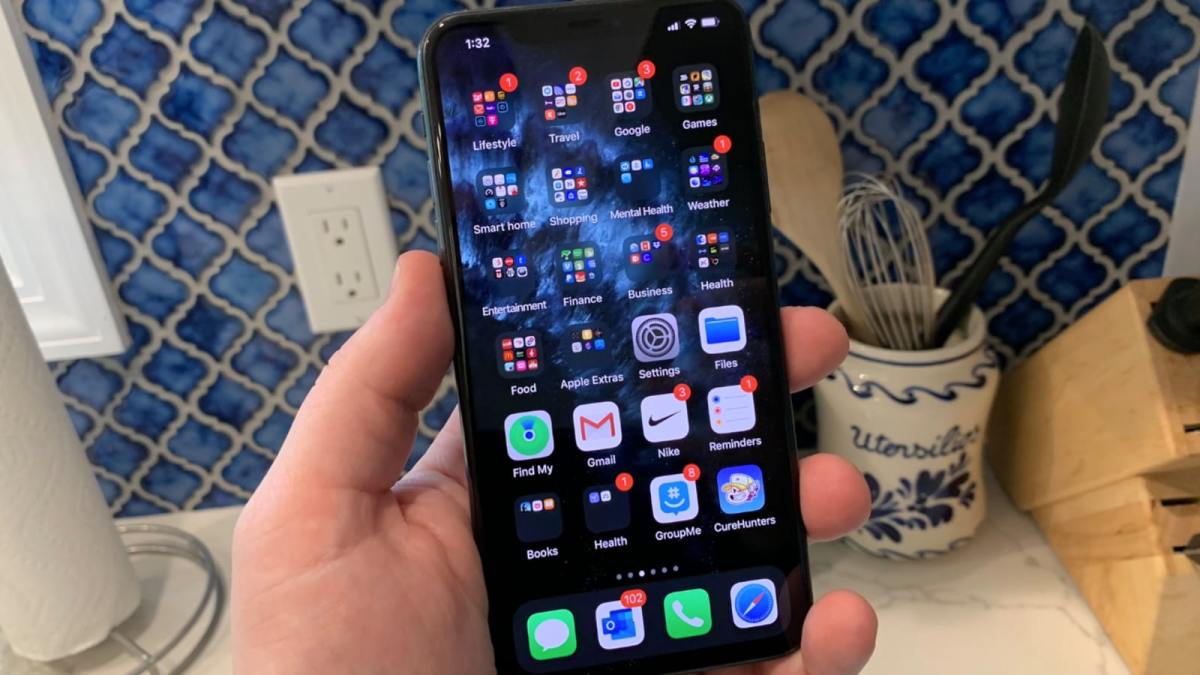
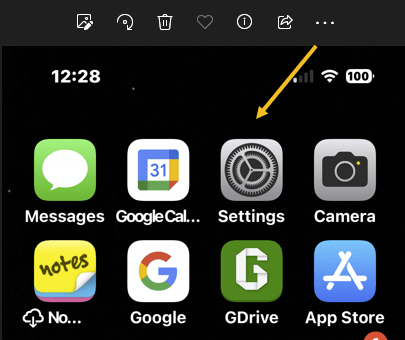
First, open the Settings app on your iPhone. Refer to the below image:
Block Call 1
Accessing Settings

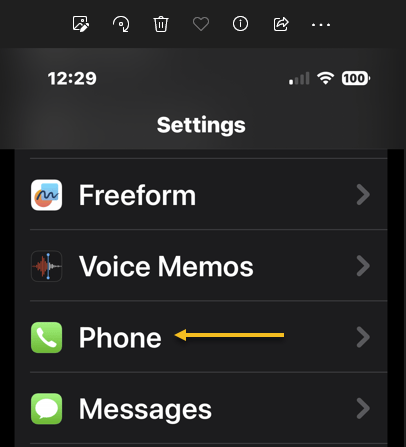
Next, scroll down to the Phone option and tap on it. See the below image:
Block Call 2
Accessing Phone option

Now, scroll down to the Silence Unknown Callers option. See the following image:

Block Call 3
Accessing the Silence Unknown Callers option

Next, toggle its switch to the ON position. Refer to the below image:
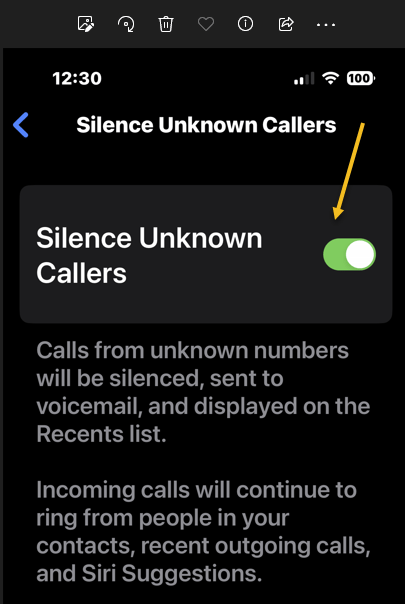
Block Call 4
Turn the option ON

All calls without a Caller ID will be automatically blocked from your phone. Remember, real numbers and callers can also be affected by this, and customer service-based calls frequently are a target. We recommend you check your voicemails and missed calls list.

Can you find out a no Caller ID number?

If you receive a call without any Caller ID, the caller has deliberately blocked their phone number from showing up. There’s no way to find out the number if the call was purposely blocked.

What does *57 do on a phone?

The service code *57 activates malicious caller identification. This is an upcharged fee service offered by some phone company providers. *57 should be dialed immediately after receiving a call from a number with no Caller ID. When you do so, it records the metadata of the malicious call to aid law enforcement investigations.

How do you call a number with a blocked ID back?

You can not call back a number that calls you with a hidden ID. If you miss a call from these numbers, you must wait till they call you back. Their hidden Caller ID prevents you from calling back if you do not have their number.

Will my telephone provider reveal an Unknown Caller’s ID to me?

It is against the law for your mobile carrier to reveal information about another user to you. They can only do that if you can prove that you are in danger or feel threatened. If you are going to request details like that from your mobile carrier, you must have enough evidence to back up your claim and most likely a police report.

Disclaimer

Technology is always changing and rarely is there static tech for smartphones and desktops. Thus, the contents of this post are only valid at the time of writing. Blog posts older than six months may have directions incompatible with your device or OS. Hopefully, older post content will continue to work as advertised. Thank you for reading TechSavvy.Life for Technology at Work For You.

When I’m old and dying, I plan to look back on my life and say, ‘Wow, that was an adventure,’ not, “Wow, I sure felt safe”.

Tom Preston-Werner

That’s it. Please feel free to share this post! One way to share is via Twitter.

Just click the Tweet icon below. This will launch Twitter where you click its icon to post the Tweet.

Checkout TechSavvy.Life for blog posts on smartphones, PCs, and Macs! You may email us at contact@techsavvy.life for comments or questions.

Please feel free to leave a comment. I would love to hear from you. Do you have a computer or smart device tech question? I will do my best to answer your inquiry. Just send an email to contact@techsavvy.life. Please mention the device, app, and version you are using. To help us out, you can send screenshots of your data related to your question.

You can access the e-book from a Kindle device, the Kindle App for the desktop or smartphone, which is a free app.
The author’s Vietnam eBook on the Battle for Tra Bong Vietnam: Events and Aftermath

How To Close Safari Tabs Automatically on iPhone or iPad

IOS 13 or higher allows you to automatically close tabs in Safari after a specified period of time, which helps to keep your iPhone running smoothly.

IOS 13 or higher allows you to automatically close tabs in Safari after a specified period of time, which helps to keep your iPhone running smoothly.

You can have up to 500 open tabs. This number of active browser tabs can quickly get out of hand. It gets to be kind of a pain to go swiping through all your open tabs every few weeks to clean out the ones you no longer use.

Fortunately, in the Safari settings on your iPhone or iPad, you can set how long your tabs stay open before they automatically close; after one day, after one week or after one month. Let’s explore how to set this feature.

This is for the iPhone and iPad

Dilbert and App
Copyright Scott Adams, Inc./Distributed by Universal Uclick for UFS

To Tweet about this post, click the Tweet icon below to launch Twitter, then click its Tweet icon to post.

Check out TechSavvy.Life for their blog posts on smartphone apps, PCs. and Macs!

Close All Tabs Solution

One solution is using the Close All Tabs option revealed by a long press on Done. But it’ is no good if you have a handful of newer tabs that are still useful to have open. Refer to below image:

Close Safari Tabs 1
Close All Tabs option

The Settings Solution

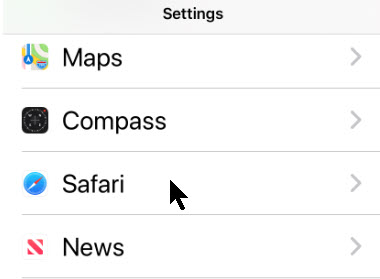
First, open Settings. Next, scroll down until you see the Safari option and tap it. See below image:

Close Safari Tabs 2
Safari option under Settings

Now, swipe down to the Tabs section, then tap Close Tabs. See following image:

Close Safari Tabs 3
Close Tabs option under Safari

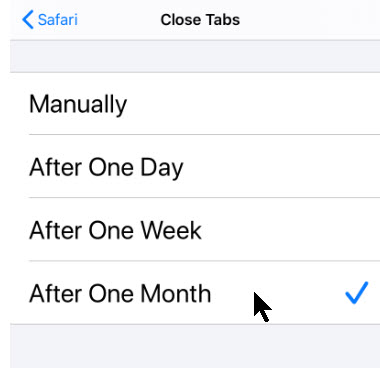
On this screen, you have the option to set the duration of open Safari browser tabs. When set, Safari will close tabs that have not been viewed within the period of time you set. The options are Manually, After One Day, After One Week or After One Month. This setting applies to Private tabs as well.

Checkmark an option that suits you. Refer to below image:

Close Safari Tabs 4
Select an option to automatically close Safari tabs

Now, you can exit Settings.

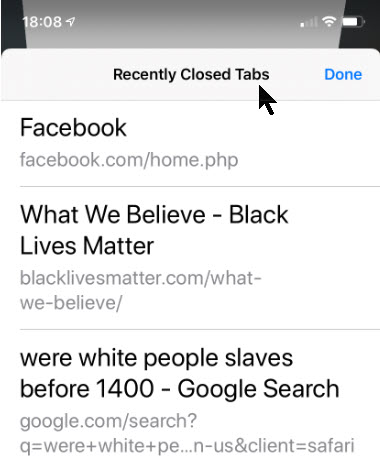
However, you can still find the automatically closed tabs as well as Private tabs in the Recently Closed Tabs menu by holding down the + (plus) button on the tab management screen in Safari. See below image:

Close Safari Tabs 5
Viewing Recently Closed Tabs

This is a potential downfall in using this feature. If you want to fully conceal recent browsing activity, it may be best to manually close the tabs.

I hope you have found this post helpful. If so, click the Tweet icon below. This will launch Twitter where you click its icon to post the Tweet.

I have found TechSavvy.Life blog posts extremely helpful. Check them out for posts on smart phone apps, Macs and PCs!

The following is a previous Twitter feed so you can view how a Tweet will be displayed.

I Would Like to Hear From You

Please feel free to leave a comment. I would love hearing from you. Do you have a computer or smart device tech question? I will do my best to answer your inquiry. Please mention the device, app and version that you are using. To help us out, you can send screenshots of your data related to your question.

The author’s Vietnam eBook on the Battle for Tra Bong: Events and Aftermath

How to Disable Autoplay on iPhone and iPad

The decision to listen to Autoplay videos should be in your control. Fortunately, with iOS 13+ you are able to control Autoplay. Whether you want to enjoy Autoplay videos as you browse or you want to shut them down until you’re ready, here is a way you can finally control the noise.

The decision to listen to Autoplay videos should be in your control. Fortunately, with iOS 13+ you are able to control Autoplay. Whether you want to enjoy Autoplay videos as you browse or you want to shut them down until you’re ready, here is a way you can finally control the noise.

By default, Apple mutes your personal photos and videos in iOS 13+. What’s particularly annoying about this feature is that your iPhone will still Autoplay videos, but it won’t enable the volume by default.

The bad news is that there doesn’t currently seem to be a way to Autoplay with volume via your phone’s settings. The good news is that there is a way to get around this feature. Let’s explore how to do this.

This is for the iPhone and iPad running iOS 13 and above

Dilbert and Lane
Copyright Scott Adams, Inc./Distributed by Universal Uclick for UFS

Check out TechSavvy.Life for similar blog posts!

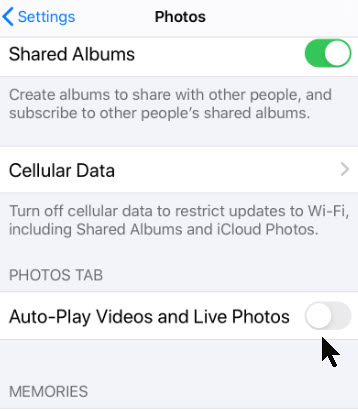
On your IPhone or iPad, open Settings. Next, scroll down to the Photos tab. Refer to below image:

Autoplay 1
Accessing the Photos option

Now, toggle off Auto-Play Videos and Live Photos.

Autoplay 2
Turning off Autoplay

It’s important to understand what this actually does. Basically, your personal collection of live photos and videos will no longer play automatically when you load them. The good news is that when you do choose to play them, the volume will be enabled. This is the best way to enjoy audio from the start without having to manually toggle it each time.

That’s it. I hope you like this post. If so, please let us know by leaving a comment.

I have found TechSavvy.Life blog posts extremely helpful. Check them out for posts on smart phone apps, Macs and PCs!

I Would Like to Hear From You

Please feel free to leave a comment. I would love hearing from you. Do you have a computer or smart device tech question? I will do my best to answer your inquiry. Please mention the device, app and version that you are using. To help us out, you can send screenshots of your data related to your question.

The author’s Vietnam eBook on the Battle for Tra Bong: Events and Aftermath

How to Use the Weather App on Your iPhone Lock Screen

There’s a hidden feature to view the weather report on your iPhone lock screen. This feature is built-in on an Android device.

There’s a hidden feature to view the weather report on your iPhone lock screen. This feature is built-in on an Android device. Let’s explore how to enable this on your iPhone.

We are going to use the Do Not Disturb Scheduled option available in iOS 12 and later. When enabled, you will see the weather report on the first tap of the lock screen after the Do Not Disturb time has passed. The Do Not Disturb feature automatically mutes all incoming notifications.

This is for the iPhone with iOS 12+

Dilbert and Page Layout
Copyright Scott Adams, Inc./Distributed by Universal Uclick for UFS

Check out TechSavvy.Life for similar blog posts!

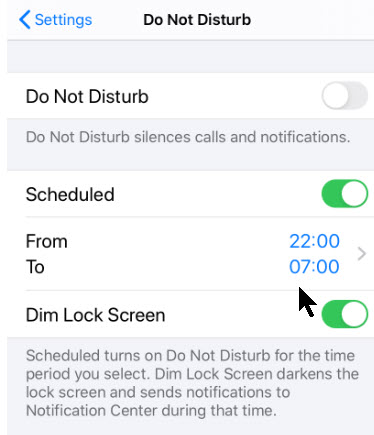
Open the Settings app, go to Do Not Disturb section. Next, toggle the Scheduled option. Set the From and To time. Important! You want to set the “To” time frame to 10-15 minutes before you wake up. Finally, toggle the Dim Lock Screen. Refer to below image:

Weather Lock Screen 1
Setting the Do Not Disturb time frame

We are dimming the lock screen and sending all new notifications to the Notifications Center until the Do Not Disturb schedule is over.

Let’s go back to Settings and tap the Privacy option. Now, tap the Location Services option. Next, scroll down to the Weather app. See below image:

Weather Lock Screen 2
The Weather app

Now, tap the While Using the App button to enable. This gives the Weather app permission to see your location, so it show you the weather report. See following image:

Weather Lock Screen 3
Setting permission for the Weather app

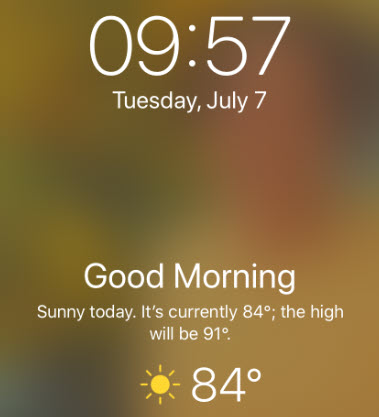
The next morning, after the Do Not Disturb time has passed, you will see the day’s weather report on your lock screen. Refer to below image:

Weather Lock Screen 4
The Weather screenshot

I have found TechSavvy.Life blog posts extremely helpful. Check them out for posts on smart phone apps, Macs and PCs!

I Would Like to Hear From You

Please feel free to leave a comment. I would love hearing from you. Do you have a computer or smart device tech question? I will do my best to answer your inquiry. Please mention the device, app and version that you are using. To help us out, you can send screenshots of your data related to your question.

The author’s Vietnam eBook on the Battle for Tra Bong: Events and Aftermath

How to Make the iPhone More Readable on the Web

Most of the content you read on your iPhone is likely on the web. There are some hidden features that can make your reading a more enjoyable experience.

Most of the content you read on your iPhone is likely on the web. There are some hidden features that can make your reading a more enjoyable experience.

I am legally blind in one eye and have a hard time seeing the big E. I wear one contact to aid my sight. This post is of special interest to me and hope it’s of help to you.

This is for the iPhone running iOS 13+

Dilbert and Russian
Copyright Scott Adams, Inc./Distributed by Universal Uclick for UFS

Check out TechSavvy.Life for similar blog posts!

Safari Reader View

We know that Safari is the default browser for the iPhone. It comes as a standard app and for a reason. The app has a Reader View, unlike third-party apps. This view reformats web pages making them easier to read. It removes all the distractions and just shows you the content.

Some browsers might offer Reader View but the popular browser Google Chrome doesn’t.

When you land on a web page or similar content, the address bar will display Reader View Available for 2-3 seconds. If you tap on the icon in upper left hand corner, you will enter Reader View immediately. Refer to below image:

Web Read 1
Reader View available for this site

If you are fast, tap and hold “AA” for a second to jump straight to Reader View. If you miss it, you can tap the “AA” in the address bar and choose Show Reader View. See below image:

Web Read 2
Shoe Reader View

While you’re in Reader View, you can tap “AA” again to see some options. Tap the smaller “A” to shrink the text, or the larger “A” to enlarge it.

For more options, tap the “AA” again. Refer to below image:

Web Read 3
Reader Virw options

Here you can change the Font from the list that appears and change screen color from white to black. See following image for the font list:

Web Read 4
Available fonts

Also, you can access the settings for the website by tapping Website Settings. Here, you can enable Use Reader Automatically. This forces Safari to enter Reader View whenever you visit any page on that domain in the future. Click Done when finished. See below image:

Web Read 5
Available Website settings

When you change these settings, they’ll change for all the websites you view in Reader View. To get back to the original webpage, tap “AA” again, and then choose Hide Reader View (refer to third image above)..

Tap and hold “AA” to return to the originally formatted website. Safari will remember your choice for future visits. If the dialog box is still visible, just tap outside the box and it will disappear.

Safari Web Page to PDF or Print

You can save pages as readable PDF documents or print them. To save as PDF:

  1. Enable Reader View
  2. Tap Share
  3. Tap Options on upper part of screen
  4. Tap PDF
  5. Tap Done
  6. Select Save to Files from the Actions list

This also works to print via Share > Print.

Make Text Easier to Read

If you’d like to make text easier to read across your whole system, rather than having to rely on Reader View, your iPhone also includes a lot of accessibility options. For these options:

  1. Go to Settings
  2. Tap Accessibility
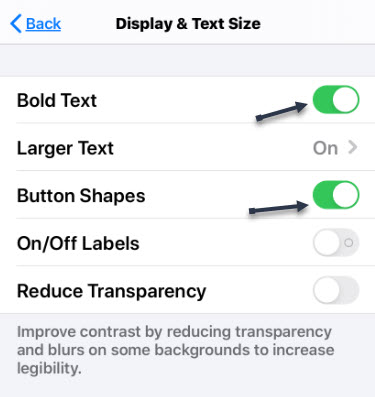
  3. Tap Display and Text Size

See following image:

Web Read 6
Setting the text

Bold Text option makes text easier to read without increasing its size. However, you can also tap Larger Text, and then slide the slider to increase text size. Any apps that use Dynamic Type (like most of the content on Facebook, Twitter and news stories) will apply this setting.

Button Shapes places the outline of a button beneath any text that is also a button. This can help with readability and navigation. Other options you might want to enable include:

  1. Increase Contrast – Makes text easier to read by increasing the contrast between the foreground and background
  2. Smart Invert – Inverts the color scheme (except on media, like photos and videos)
  3. Classic Invert – The same as Smart Invert, except it also inverts the color scheme on media

Ensure that Auto Brightness is enabled to save battery and improve performance. Refer to below image:

Weg Read 7
Other settings

Let iPhone Read to You

Do you want to listen instead of reading? Apple’s phones and tablets include an accessibility option that will read the current screen, web page or copied text aloud. While this is an accessibility feature for the visually impaired, it has broader applications for handling written content.

To enable this feature:

  1. Go to Settings
  2. Tap Accessibility
  3. Tap Spoken Content
  4. Enable Speak Selection and Speak Screen

See following image:

Web Read 8
Setting iPhone speech

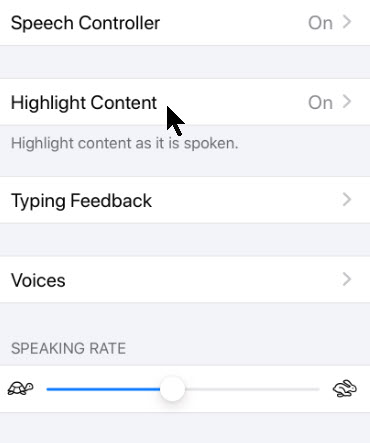
Speak Selection toggle allows you to highlight text, and then tap Speak button to read the text . Speak Screen toggle will read the entire screen aloud whenever you swipe down from the top with two fingers. If this is proving to be probmatic as it is for me, see next paragraph for another method. Additionally, you will want to adjust SPEAKING RATE by moving the slider. See below image:

Web Read 9
Setting the Speaking Rate

To have the Speak Screen playback controller visible, enable Speach Controller. Instead of swiping your fingers, just tap the playback button to read your content. You can drag and reposition this small box anywhere you want it. Tap it to see options to silence speech, skip backward or forward through an article, pause the speaking or increase/decrease the speed at which the text is being read. Refer to below image:

Web Read 10
The speech playback controls

If you wish to highlight the content as it reads, enable the Highlight Content button and adjust its options. See below image:

Web Read 11
Other options

Tap Voices to customize the voices you hear. Most voice selections require a download. The default, English, will mirror your current Siri settings. Refer to below image:

Web Read 14

The Speak Screen feature works best when paired with Reader View. In regular view, your iPhone will also read descriptive image text, menu items, adverts, and other things that can be distracting. By triggering Reader View first, you can cut straight to the content.

Speak Screen works intuitively based on whatever is currently on the screen. For example, if you’re reading an article, and you are halfway through, triggering Speak Screen will begin reading based on how far down the page you are. The same is true for social feeds, like Facebook or Twitter.

Ask Siri for News

You can just say “give me the news” to Siri at any time to see and hear a list of headlines from the News app. You can also launch the News app (or your favorite alternative), and then have your iPhone read aloud with Speak Screen or Speak Selection. See below image:

Web Read 12
Asking Siri for the news

Siri will give you an alternative news source to switch to, if available, and it will be remembered the next time you ask for an update.

Enable Different Modes

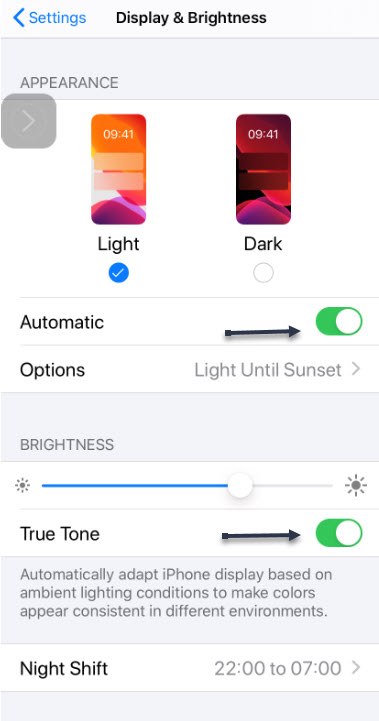
Using your iPhone at night in a dark room became a lot more pleasant with the arrival of Dark Mode on iOS 13+. To enable this feature:

  1. Go to Settings
  2. Tap Display and Brightness
  3. Choose Automatic to enable when it gets dark outside
  4. Set Options to your preference

Below the Dark Mode setting option is a toggle for True Tone. If you enable this setting, your iPhone will automatically adjust the white balance onscreen to reflect your ambient environment. This means the screen will look a lot more natural. True Tone makes reading less jarring, particularly under fluorescent or incandescent lighting.

Finally, Night Shift removes blue light from the screen to simulate the setting sun, which might help your body naturally switch off at the end of the day.

Its recommended you enable all five (Automatic, Options, Dark Mode, True Tone and Night Shift) options. Refer to below image:

Web Read 13
Enable readable options

Keep in mind that Night Shift will also change how your photos and videos are displayed until you turn it off again, so we recommend no serious editing when it’s enabled.

Related

Eight Ways for Better Battery Life in iOS 13

There are many other hidden accessibility options for you to explore besides the ones in this post. Have fun exploring.

I have found TechSavvy.Life blog posts extremely helpful. Check them out for posts on smart phone apps, Macs and PCs!

I Would Like to Hear From You

Please feel free to leave a comment. I would love hearing from you. Do you have a computer or smart device tech question? I will do my best to answer your inquiry. Please mention the device, app and version that you are using. To help us out, you can send screenshots of your data related to your question.

The author’s Vietnam eBook on the Battle for Tra Bong: Events and Aftermath

How to Use iOS 13+ Printing

We are going to explore how to print to PDF while on the go, do custom printing options like labels and manage existing print jobs through AirPrint right on your iOS 13+ devices.

We are going to explore how to print to PDF while on the go, do custom printing options like labels and manage existing print jobs through AirPrint right on your iOS 13+ devices. iOS 13+ has a very robust printing subsystem that can allow you to export PDFs and more.

In this blog post, we’ll delve into how to print custom items like labels. We’ll also see how to print to PDF instead of paper and how to manage printer jobs and viewing ink supply levels.

iOS 13+ can handily help in this situation, and it works in any app that supports printing or sharing. We will be using Safari browser in our examples.

This is for Apple devices supporting iOS 13+

Dilbert and Supremist
Copyright Scott Adams, Inc./Distributed by Universal Uclick for UFS

Check out TechSavvy.Life for similar blog posts!

Print to PDF

To print to PDF using any app that supports printing:

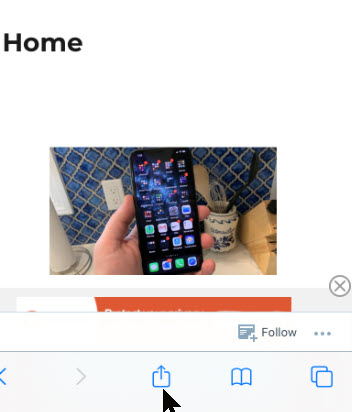
Select the Share (or Print) button in the app. When browsing in Safari, just tap the Share button in the bottom toolbar. Refer to below image:

iPhone Printing 1
The Share ibutton

Next, scroll down and tap Print. See below image:

iPhone Printing 2
The Print option

Using two fingers, pinch your fingers apart as if zooming on the Print Preview. This will generate a PDF and show a new view. Refer to below image:

iPhone Printing 3
Print Preview

In this Print Preview PDF view, tap the Share button in upper right-hand corner. See following image:

iPhone Printing 4
The Share button

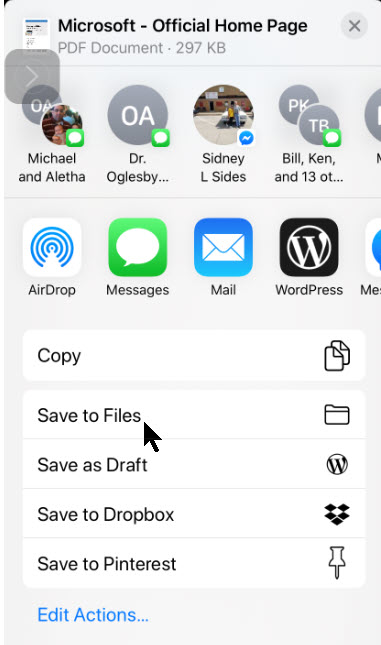
Select your choice to save the PDF to Files, send as an iMessage or an email. Refer to below image:

Phone Printing 5
The Save to Files option

Sharing a PDF from Print Preview is easy and works on all apps where printing is supported.

Printing Labels

For now, the only way to print labels for contacts is through third-party apps. This feature has been built-into Macs for years.

If you are using Avery Labels for printing contact sheets, there are two apps worth mentioning. Click on the links below to download from the Apple App Store.

Label Printer for $2.99 and the free Label Printer Lite.

Address Labels for CardLists for $1.99.

Both of these apps have numerous features. You can print multiple contacts or a single contact on a sheet, select templates from Avery and others, add a graphic to your labels, design your label, manually adjust alignment, and much more.

Managing Your Print Jobs and Ink Levels

You can check the ink or toner levels to ensure you have plenty for your print project. Once you have spooled a print job, you can monitor its status or cancel it.

Check Your Ink Levels

With iOS and iPadOS you are able to view your ink or toner levels without a computer. This is easily to do.

Select the Share (or Print) button in the app. Refer to image one above.
Next, scroll down and tap Print. Refer to image two above.

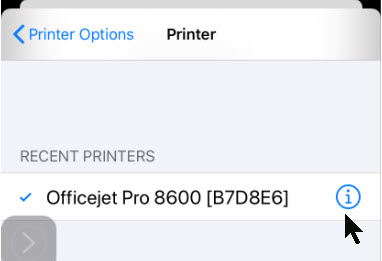
Now, tap the right hand arrow beside an available printer name. See following image:

iPhone Printing 6
Selecting your printer

Select the “i” with an enclosed circle button beside the available printer name. Refer to below image:

iPhone Printing 7
Your selected printer

If there is no printer listed, you do not have a wireless printer and/or lack support for the AirPrint feature; you may skip this section. Nearly all modern day printers support AirPrint.

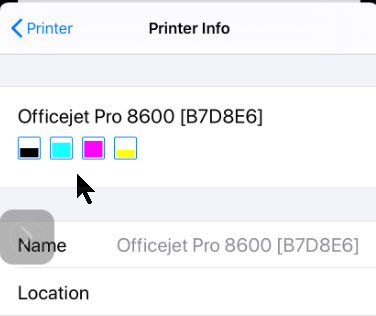
You will now be viewing the Printer Info which contains ink levels, name and location (if supplied by the printer or printer server). See following image:

iPhone Printing 8
Your printer ink levels

Viewing ink or toner levels can be done from the iOS or iPadOS Print Setup dialog in any app that supports it.

Manage Print Jobs

When you print with AirPrint, you are able to manage your print jobs. Once a print job has been started, you can look at the status of the job and/or cancel the job. This can be done by opening the App Switcher (double-tap the Home button if you have one). For Face ID devices, swipe up partially on the screen, hold, then release.

You’ll see the printer job app at the top of the screen. Just tap it to see the print details like how many pages are being printed and which page is active in the queue. Tap the Cancel Printing button to stop any active print jobs. See below image:

iPhone Printing 9
An active print job

If the print queue is empty,, you will receive a message about no print jobs. Refer to below image:

iPhone Printing 10
No active print jobs

When printing in IOS or iPadOS, a new app will appear in the App Switcher for non-Face ID and Face ID devices to manage print jobs.

I have found TechSavvy.Life blog posts extremely helpful. Check them out for posts on smart phone apps, Macs and PCs!

I Would Like to Hear From You

Please feel free to leave a comment. I would love hearing from you. Do you have a computer or smart device tech question? I will do my best to answer your inquiry. Please mention the device, app and version that you are using. To help us out, you can send screenshots of your data related to your question.

The author’s Vietnam eBook on the Battle for Tra Bong: Events and Aftermath

How to Secure Your iOS Lock Screen

Do you want to configure your iOS Lock Screen to block those picking up your device from reading messages, viewing the Today View or interacting with Siri.

Do you want to configure your iOS Lock Screen to block those picking up your device from reading messages, viewing the Today View or interacting with Siri.

It may appear that securing our devices with Touch ID and Face ID is all we need to protect our data. However, there’s other data accessible on the Lock Screen that can still be read by potential data thieves or on-lookers that can gain valuable information.

Lets explore how to secure the Lock Screen so that your messages and push notifications aren’t visible to anyone except you when you pick up your device. We’ll do this by disabling push notification, Siri and the Today View when the device is locked.

By doing the above, you will make your device more secure and prevent onlookers, or someone picking up your device, from gaining access to your private information contained on the Lock Screen.

This is for the iPhone and iPad running iOS 13+. Screenshots are for iPhone

Dilbert and Stupid
Copyright Scott Adams, Inc./Distributed by Universal Uclick for UFS

Click to tweet on how you like TechSavvy.Life!

Disable Notification and the Today View

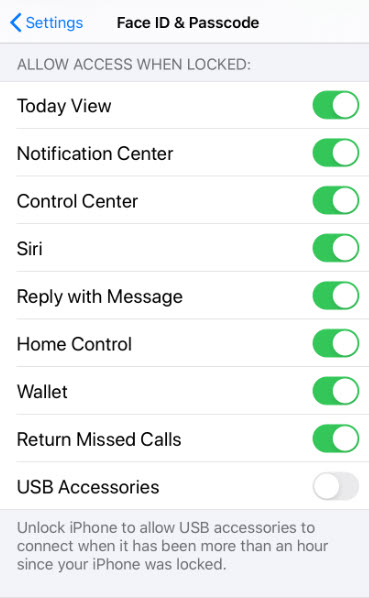
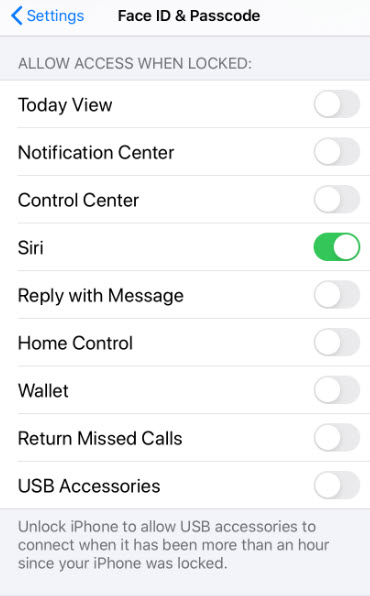
Open the Settings app. Next, select Face ID & Passcode. Enter your Passcode to proceed. Then, scroll down till you see the section ALLOW ACCESS WHEN LOCKED. Now, toggle off all options except for Siri. We will handle Siri in the Disable Siri section below. Just ignore the USB Accessories option. You will be toggling off 7 options. Refer to below for before toggling off image:

iPhone Lock Screen 1
Before disabling

Refer to below for after toggling off image:

iPhone Lock Screen 2
After disabling

Unchecking items in this section will make them unavailable from the Lock Screen when the user is not authenticated by Passcode, Touch ID or Face ID.

There is an alternative feature if you are using a Face ID device.

Open the Settings app. Next, select Face ID & Passcode. Enter your Passcode to proceed. Scroll down to the ATTENTION section. Now, toggle on Attention Aware Features. See below image:

iPhone Lock Screen 3
Setting the Attention Aware Features

The Attention Aware Features setting is available on iPhone and iPads with Face ID.

When this option is enabled, you will be unable to view notifications on the Lock Screen or Notification Center until the face of the device owner is visible to the Face ID sensor. This feature also provides not dimming the screen when looking directly at it and lowering the volume when the device is picked up.

However, the Today View, will still be visible. You can disable this behavior from the Lock Screen by following instructions in Disable Notifications and the Today View section above.
Disable Siri

If you want to ensure the highest privacy protection, you can disable Siri on the Lock Screen till your device has been authenticated with the Passcode, Touch ID or Face ID.

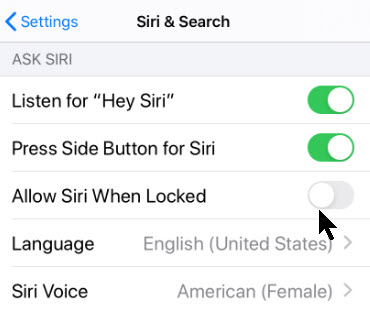
Open the Settings app. Next, select Siri & Search. Toggle off the Allow Siri When Locked option. See following image:

iPhone Lock Screen 4
Disabling Siri

Now whenever you try to access Siri and any personal requests it allows, you will first need to enter your Passcode, Touch ID or Face ID.

Click to tweet if you find TechSavvy.Life blog posts extremely helpful. Check them out for posts on smart phone apps, Macs and PCs!

I Would Like to Hear From You

Please feel free to leave a comment. I would love hearing from you. Do you have a computer or smart device tech question? I will do my best to answer your inquiry. Please mention the device, app and version that you are using. To help us out, you can send screenshots of your data related to your question.

The author’s Vietnam eBook on the Battle for Tra Bong: Events and Aftermath

How to Use Widgets on Your iPhone and iPad

When you swipe right on your iPhone Lock or Home screen, you are presented with the Today View screen. On this screen are widgets from Apple main apps. If you want to customize this screen, you can add and customize widgets from Apple and/or third-party apps. Also, you can rearrange these widgets to your liking.

By default, Apple shows you the widgets from the Calendar, Siri App Suggestions, News, Weather and more. But that’s not all. When you go into the editing mode, you’ll discover that many of the apps that you have installed (whether they’re popular apps or not) include useful widgets.

You can add extra functionality to your iPhone using third-party app widgets. Here are a couple of recommendations:

This is for iPhone and iPad devices. Text and screenshots are for the iPhone.

Dilbert and Work
Copyright Scott Adams, Inc./Distributed by Universal Uclick for UFS

Accessing Your Widgets

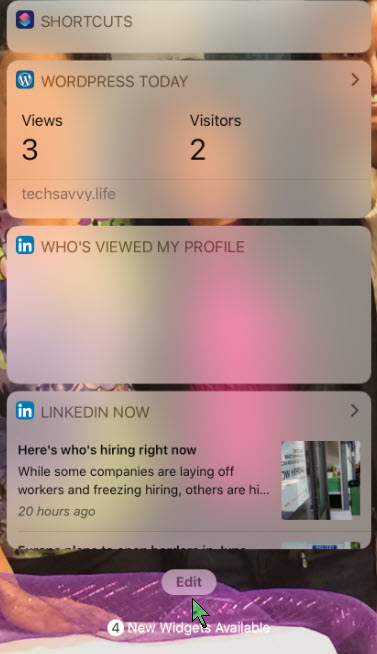
Lets get started. First, swipe right when you’re on your iPhone’s Lock or Home screen to access the Today View. Here, you can swipe up to view more widgets and tap on any of the arrow buttons (to the right of the widget name) to expand or contract a widget. Refer to below image:

Widgets 1
Your Widgets screenshot

Editing a Widget

If we want to edit a widget, swipe all the way down to the bottom of the widgets screen and tap on the Edit button. See below image:

Widgets 2
Accessing the Edit button

At the top of the list are the widgets installed on your iPhone, they have a “-“ sign next to the widget name. See following image:

Widgets 3
Displaying your Widgets

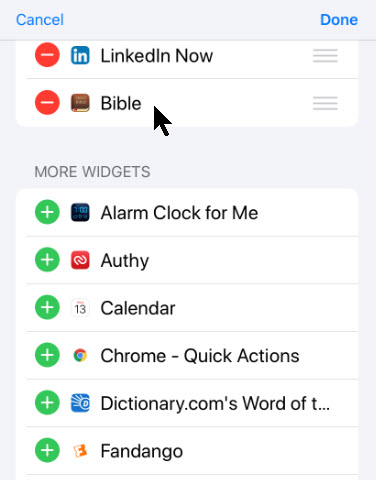
Scroll down till you see the More Widgets listing, denoted by the “+” sign. Refer to below image:

Widgets 4
Listing of Widges you can add

Adding a Widget

When you see a widget you want to add, tap on that “+” sign next to the widget label. It will be added to the bottom of the enabled widgets list. Simply do this for each widget you want to add. In my example, I added the Bible widget. See following screen:

Widgets 5
Selecting a Widget to add

Remove a Widget

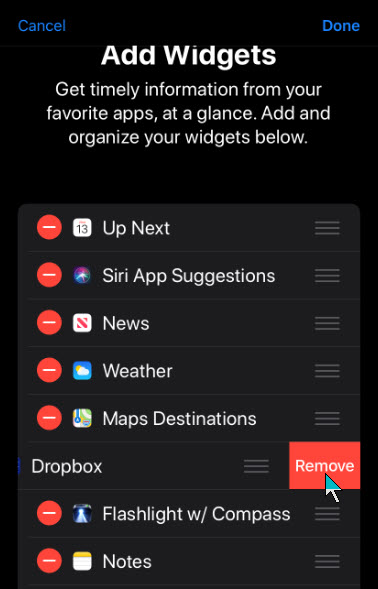
To remove a widget, navigate to the top of the list for the enabled widgets. Tap the “-“ sign left of the widget name, then tap the Remove option. Refer to below image for my removal of the Dropbox widget:

Widgets 6
Selecting a Widget to remove

This does not delete the iPhone app, only the widget associated with it.

Reorder Widgets

To reorder widgets, tap on the Hamburger icon to the right of the widget name and drag each item to a new location. See following image where I moved Siri App Suggestions to the top of the list:

Widgets 6
Rearrange a Widget

Saving Your Changes

To save all your changes, tap Done in upper right hand corner at the top of your enabled widgets list. Refer to below image:

Widgets 8
Saving all your changes

Note: Your must tap the Done option, if not, all your changes will be lost.

You will be taken back to the Today View with your saved changes.

When you add new apps, you can go back to the Edit screen and add new widgets to the Today View by following the above steps.

Checking if an App Has a Widget

To see if a widget is available for an app, press and hold the app icon. If it supports widgets, you will see the Add Widget link. Tap on it to add the widget to the bottom of Today View screen. See following image where I added back the Dropbox widget:

Widgets 9
Checking if your app has a Widget

As a confirmation, the Add Widget link will be replaced with a check mark. Refer to below image:

Widgets 10
Confirming your Widget has been added

That’s it. You have learned how to add, remove and rearrange your iPhone widgets. The process is similar for an iPad.

Feel free to tweet me. Thanks for reading this post and others.

I Would Like to Hear From You

Please feel free to leave a comment. I would love hearing from you. Do you have a computer or smart device tech question? I will do my best to answer your inquiry. Please mention the device, app and version that you are using. To help us out, you can send screenshots of your data related to your question.

The author’s Vietnam eBook on the Battle for Tra Bong: Events and Aftermath

How to Use the Files App to Share Files and Folders

With the release of iOS 13.4 and above, you can now share files and folders using your favorite share connection. This feature is built into the Files app.

Apple engineers took a long time in releasing this feature. It’s about time. Let’s see how this is done.

This is for iPhone and iPad running iOS 13.4 or higher

Dilbert and Reports
Copyright Scott Adams, Inc./Distributed by Universal Uclick for UFS

Sharing a Folder

First, launch the Files app. Navigate to the iCloud folder you would like to share. Next, press and hold the folder until a menu appears. Now, select Share. See below image:

iPhone Files 1
Selecting the Share option for a folder

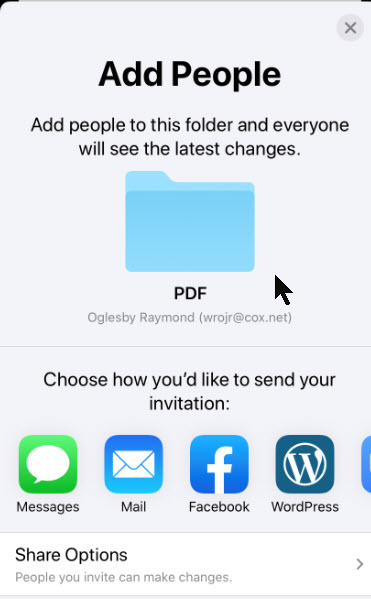
Next, select Add People. Refer to below image:

iPhone Files 2
Selecting the Add People option for the folder to be shared

Now, select a share method from the options like Mail, Messages, Messenger and so on. See following image:

iPhone Files 3
Selecting the share connection for the folder

Type in your subject and message, if necessary, then select your audience. When finished, Send your message. See below image:

iPhone Files 4
Selecting the recipient(s) for sharing the folder

Change Access Rights

First, launch the Files app. Navigate to the shared iCloud folder. Next, press and hold the folder until a menu appears. Select Share then select Show People. Refer to below image:

iPhone Files 5
Accessing the Show People option

Tap a person in the list. Refer below to my list:

iPhone Files 6
Selecting the recipient(s) to change access rights

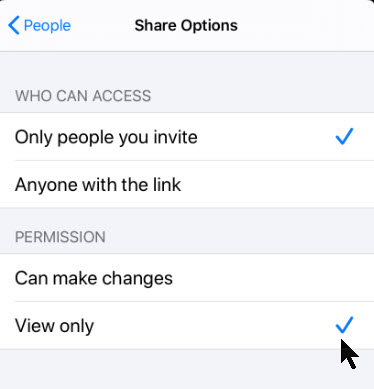
You are given two options for Permission: Can make changes and View only. You can also change Who Can Access options for the folder by selecting Only people you invite and Anyone with the link. See below image:

iPhone Files 7
Setting the access rights

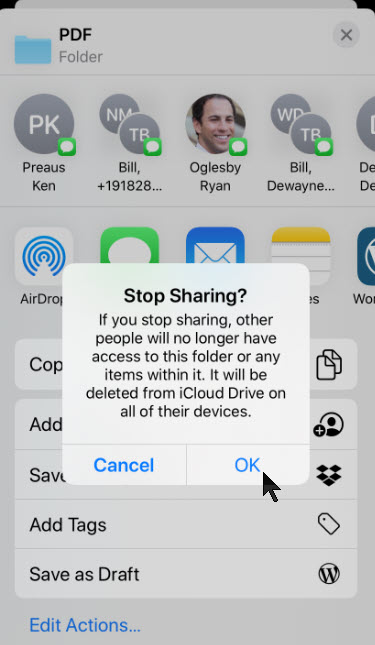
There is the option to remove the user’s access, just tap Stop Sharing and tap OK. See following image:

iPhone Files 8
Cancelling the sharing

I Would Like to Hear From You

Please feel free to leave a comment. I would love hearing from you. Do you have a computer or smart device tech question? I will do my best to answer your inquiry. Please mention the device, app and version that you are using. To help us out, you can send screenshots of your data related to your question.

The author’s Vietnam eBook on the Battle for Tra Bong: Events and Aftermath

How to Sign a PDF on Your iPhone or iPad

You’ve received or need to send a PDF through email that must be signed and sent to the other party. If you’re working with the email on your iPhone or iPad, you can sign the document directly from your mobile device. This handy capability is possible due to the Markup feature. With iOS 13, you can use a variety of tools. In this post, we will look at the Signature Markup tool.

This is for iPhone/iPad or similar devices using iOS 13 or above

Dilbert and Job Opening
Copyright Scott Adams, Inc./Distributed by Universal Uclick for UFS

How to Add a Signature

Follow these steps when you want to email someone a PDF from your iPhone or iPad but need to sign it before sending it.

1. Make sure the PDF is stored in a convenient location, such as OneDrive, iCloud Drive or other online service accessible from your iPhone or iPad
2. Attach the file to your email
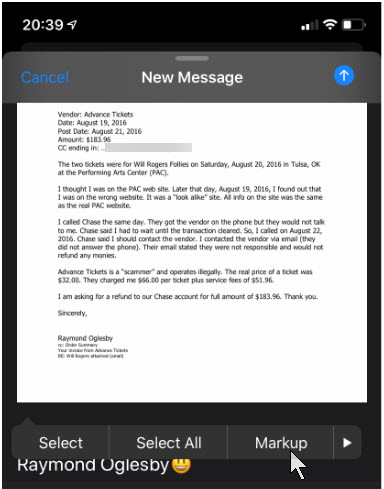
3. Tap the attachment and select Markup from the toolbar. Refer to below image:

PDF Signature 1
Selecting the Markup option

4. Swipe down to the area where you need to sign. If not, the Signature will be placed in the middle.
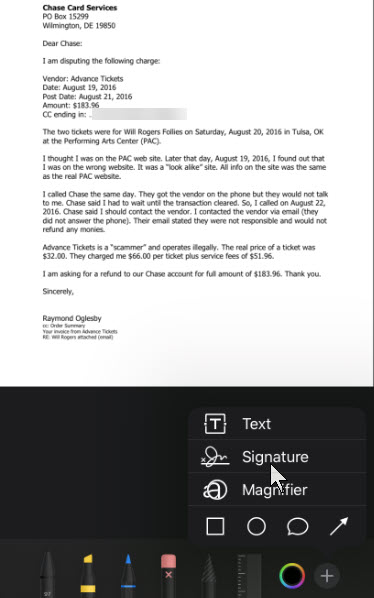
5. On the Markup toolbar at the bottom, tap the “+” icon and select Signature. See below image:

PDF Signature 2
Selecting the Signature option

Drawing Your Signature

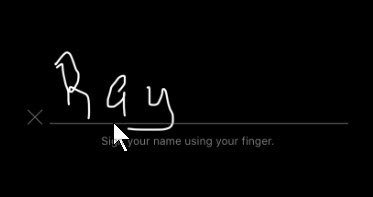
6. If you’re doing this for the first time, write your Signature via your finger tip or a stylus
7. Tap Clear if you wish to start over. See following image:

PDF Signature 3
Writing your Signature

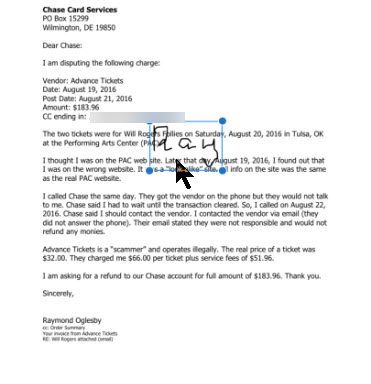
8. When you’re satisfied with your Signature, tap Done. See below image:

PDF Signature 4
Your Signature in the document

Position Your Signature

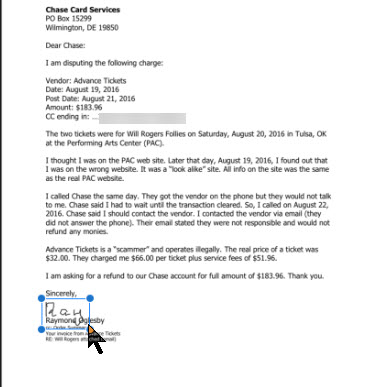
9. Move the text box for your Signature to the right spot. You can also resize the box by dragging any of the corners. Refer to below image:

PDF Signature 5
Positioning your Signature

Email Your Signed Document

10. When the Signature is sized and positioned correctly, tap Done at the upper left corner for the new Signature. Now you are ready to send your email by tapping on the Up Arrow icon. See following image:

PDF Signature 6
Email your signed document

How to Reply With Your Signature

If you receive an attachment that you need to sign and send back to the sender, the process is similar. 

1. Tap the PDF to open it and swipe down to the area that requires your Signature
2. Tap the Markup icon in the upper right (the one that resumbles a pen tip)
3. Tap the “+” icon on the Markup toolbar at bottom righ hand corner and select Signature. Your Signature will automatically appear if you already created it via Markup.
4. Tap your Signature, position and resize it accordingly
5. When finished, tap Done
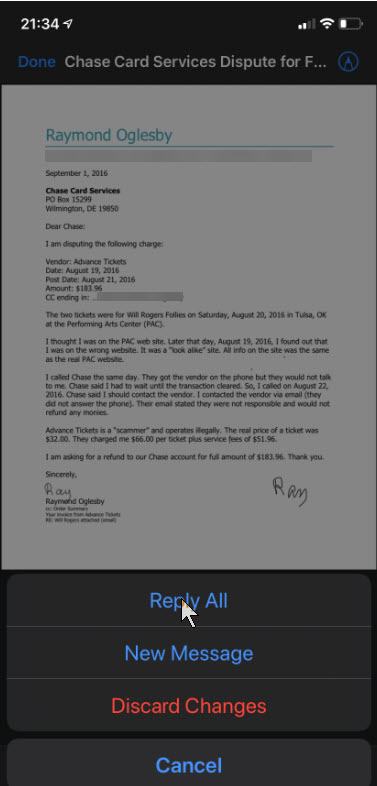
6, Tap New Message or Reply All and send the signed document back to the sender. For demonstration purposes, I just placed my Signature again, this time in lower right hand corner. Refer to below image:

PDF Signature 7
Selecting the Reply All option

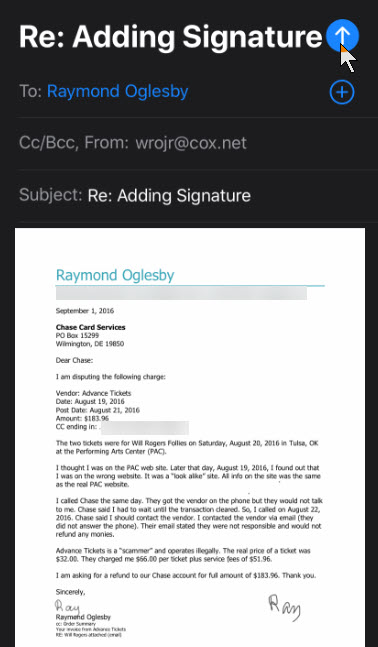
7. Tap the Up Arrow icon to send your return message. See below image:

PDF Signature 8
Returing your signed document back to the sender

You have successfully adding your Signature to a PDF file, emailed the attachment and replied to the other party with your Signature.

I Would Like to Hear From You

Please feel free to leave a comment. I would love hearing from you. Do you have a computer or smart device tech question? I will do my best to answer your inquiry. Please mention the device, app and version that you are using. To help us out, you can send screenshots of your data related to your question.

The author’s Vietnam eBook on the Battle for Tra Bong: Events and Aftermath