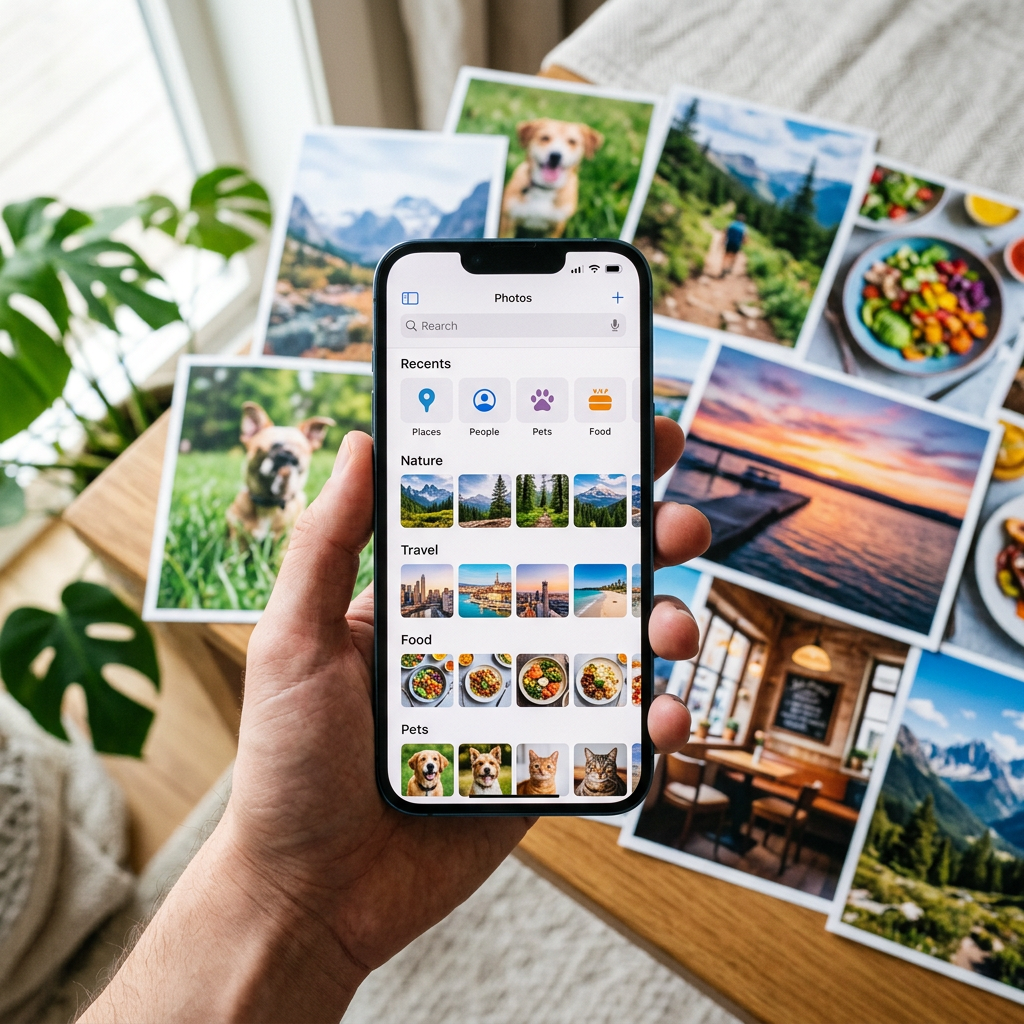
How to Enable Emergency Bypass on Your iPhone

Emergency Bypass on iPhone allows priority contacts to reach you during Focus modes, like Sleep, ensuring essential calls and texts come through. To set it up, edit a contact in the Contacts app, enable Emergency Bypass for both Ringtone and Text Tone, and save the changes.

IRAYMOND OGLESBY @RaymondOglesby2
April 14, 2026 – 4 minutes read time

What is emergency bypass on iPhone? Emergency Bypass allows specific contacts to reach you even when you have certain Focus enabled, such as Sleep Focus. When Emergency Bypass is enabled, your phone will still ring even when you have a Focus enabled to silence calls and texts. Here’s how to bypass your Focus settings or Silent mode with Emergency Bypass, so important contacts can still reach you in emergencies, regardless of other enabled settings.

Note!! This is a must-do tip you want to set up.

  • Use the Emergency Bypass iPhone feature to designate priority contacts on your iPhone.
  • Priority contacts on your iPhone can call, text, or both with Do Not Disturb on, so you are never out of touch.

This tip was performed on an iPhone 17 Pro running iOS 26.3.

Click here to learn how to update your iPhone to the latest iOS version.

First, open the Contacts app or search for the app. Refer to the image below:

Emerg Bypass 1
Selecting the Contacts app

Next, tap the contact you want to designate as an emergency contact who can reach you even when you have a Focus, such as Sleep, turned on. See the image below:

Note! If the contact has an asterisk to the right of the name, that person is already an emergency contact.

Emerg Bypass 2
Selecting a Contact

Next, tap Edit in the top right corner. See the following image:

Emerg Bypass 4
Selecting to Edit the contact

Now, tap  Ringtone. Refer to the image below:

Emerg Bypass 4
Selecting the Ringtone option

Next, toggle on Emergency Bypass. This will allow phone calls from that person to always go through. See the image below:

Emerg Bypass 5
Enabling the Emergency Bypass toggle

Now, repeat these steps for Text Tone to allow texts to bypass your Focus status as well. See the following image:

Emerg Bypass 6
Selecting the Text Tone option

Next, tap the checkmark icon when you are done. Refer to the image below:

Emerg Bypass 7
Tapping the Done checkmark

Now, when you tap the checkmark, the contact will have Emergency Bypass On for Rungtone and Text Tone. See the image below:

Emerg Bypass 8
Emergency Bypass is now on for the contact

Now you know how to set an Emergency Bypass contact on iPhone to let priority contacts on iPhone contact you even when you have a Focus mode set. You can repeat these steps for all the emergency bypass contacts you would like to add.

Technology is constantly evolving, and smartphone and desktop tech rarely remains static. Therefore, the information in this post is only accurate as of the date it was written. Blog posts that are older than six months may contain instructions that are no longer compatible with your device or operating system. We hope that the content from previous posts continues to function as intended. Thank you for reading TechSavvy.Life, where technology works for you.

The art challenges the technology, and the technology inspires the art.

 – John Lasseter

That’s it. Please feel free to share this post! One way to share is via Twitter.

Just click the Tweet icon below. This will launch Twitter where you click its icon to post the Tweet.

Checkout TechSavvy.Life for blog posts on smartphones, PCs, and Macs! You may email us at contact@techsavvy.life for comments or questions.

We value your feedback! Was this post helpful? Please share your comments with us. If you have a tech question related to your computer or smart device, feel free to reach out. Just send an email to contact@techsavvy.life, and be sure to include the device, app, and version you are using. To assist us further, you can also attach screenshots related to your inquiry.

Author’s eBook

The author’s Vietnam eBook, “Battle for Tra Bong Vietnam: Events and Aftermath,” is available on Kindle devices and the Kindle App for desktop, laptop, and smartphone. The apps are free.

The author’s Vietnam eBook on the Battle for Tra Bong Vietnam: Events and Aftermath

Customize Your iPhone Lock Screen Shortcuts

You can now customize your iPhone Lock Screen shortcuts by swapping the default flashlight or camera icons with shortcuts like the timer or alarm app. This feature allows for quicker access to preferred apps without unlocking your device, though changes must be made for each Lock Screen individually.

RAYMOND OGLESBY @RaymondOglesby2
April 7, 2026 – 4 minutes read time

If you have ever wanted to customize the shortcut buttons at the bottom of your Lock Screen, you are in luck! You can now swap out your iPhone Flashlight shortcut or Camera shortcut to pretty much any shortcut of your choosing.

With the addition of the Action button and now Camera Control buttons, the usefulness of having your Camera and Flashlight as your Lock Screen shortcuts is rapidly waning. Fortunately, you can swap these shortcuts out for different options.

It’s important to note that the shortcut will only be for that Lock Screen. If you have multiple Lock Screens, the others will have the a Flashlight and Camera defaults unless you manually change them.

Note! you can only swap out the default icons; not add new ones. (Sad, come on Apple, add this feature!). But you can add app shortcuts (widgets) below the Clock area.

  • Swap out the default flashlight and camera controls for other shortcuts, like the timer or alarm app.
  • Keep your favorite shortcuts right on your Lock Screen.
  • Access apps or actions quickly without unlocking your iPhone.

Let’s explore how to swap out the default Lock Screen shortcuts on your iPhone.

This tip was performed on an iPhone 17 Pro running iOS 26.3.

Click here to learn how to update your iPhone to the latest iOS version.

First, long-press on your Lock Screen. Refer to the image below:

LS Shortcuts 1
Long press on the lock screen

Now, tap Customize. See the image below:

LS Shortcuts 2
Tap the Customize button

Next, tap the minus symbol on the top left corner of the shortcut you want to replace. See the following image:

LS Shortcuts 3
Tap a shortcut icon

Now, tap the plus icon where the shortcut just was. Refer to the image below:

LS Shortcuts 4
Tap the shortcut icon plus sign

Next, scroll through your new shortcut options and tap the shortcut you want to add. See the image below:

LS Shortcuts 5
Select a shortcut control

Now, tap Done to finalize your Lock Screen. See the following image:

LS Shortcuts 6
Tap Done when finished

Next, you can now tap that iPhone Lock Screen shortcut to launch the new app or function you selected. Refer to the image below:

LS Shortcuts 7
Tap on your new shortcut icon to open

That’s how to change shortcuts on iPhone Lock Screen. These can easily be swapped out by following this same step procedure each time. Remember, you’ll have to do it individually for each Lock Screen.

Technology is constantly evolving, and smartphone and desktop tech rarely remains static. Therefore, the information in this post is only accurate as of the date it was written. Blog posts that are older than six months may contain instructions that are no longer compatible with your device or operating system. We hope that the content from previous posts continues to function as intended. Thank you for reading TechSavvy.Life, where technology works for you.

Technological progress has merely provided us with more efficient means for going backwards.

– Aldous Huxley

That’s it. Please feel free to share this post! One way to share is via Twitter.

Just click the Tweet icon below. This will launch Twitter where you click its icon to post the Tweet.

Checkout TechSavvy.Life for blog posts on smartphones, PCs, and Macs! You may email us at contact@techsavvy.life for comments or questions.

We value your feedback! Was this post helpful? Please share your comments with us. If you have a tech question related to your computer or smart device, feel free to reach out. Just send an email to contact@techsavvy.life, and be sure to include the device, app, and version you are using. To assist us further, you can also attach screenshots related to your inquiry.

Author’s eBook

The author’s Vietnam eBook, “Battle for Tra Bong Vietnam: Events and Aftermath,” is available on Kindle devices and the Kindle App for desktop, laptop, and smartphone. The apps are free.

The author’s Vietnam eBook on the Battle for Tra Bong Vietnam: Events and Aftermath

QuickTake: Record Video on iPhone in Photo Mode

The post explains how to quickly record videos on an iPhone using the QuickTake feature without switching from Photo mode. Users can directly access the Camera app from the Lock Screen, press and hold the Shutter button to record, and easily return to Photo mode after stopping the recording.

IRAYMOND OGLESBY @RaymondOglesby2
March 31, 2026 – 3 minutes read time

How do you take a video in picture mode on an iPhone? Use Apple’s QuickTake, the fastest way to record a video on the iPhone. 

When you find the perfect moment for a video, you do not always have time to switch between Photo and Video mode on your iPhone.Here’s how to record on an iPhone quickly right from Photo mode, and directly from your Lock Screen.

  • Record video on your iPhone without leaving photo mode.
  • Makes recording video quick and easy, so you do not miss important moments.

This tip was performed on an iPhone 17 Pro running iOS 26.3.

Click here to learn how to update your iPhone to the latest iOS version.

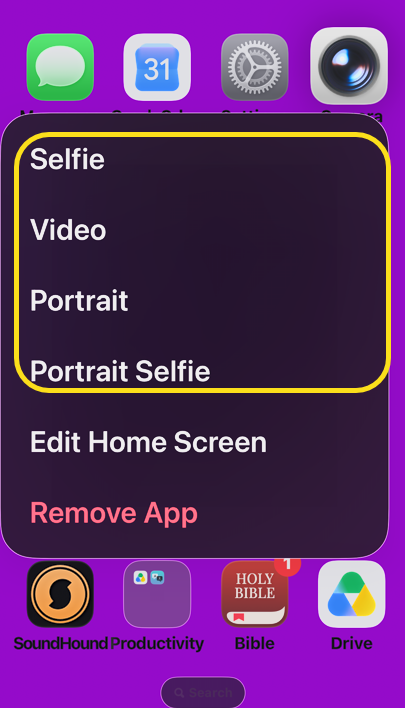
First, open the Camera app directly from your Lock Screen. Refer to the image below:

Video 1
Selecting the Camera icon

Next, in Photo mode, press and hold the Shutter button; your iPhone will begin video recording. See the image below:

Video 2
Press and hold the Shutter button

Now, you can drag the Shutter button to the right to temporarily lock your camera into Video mode. See the following image:

Video 3
Drag the Shutter button to the right

Next, when you are finished, tap the red square or release the Stutter button (if you did not slide it to the right) to stop recording. Refer to the image below:

Video 4
Tap or release the Shutter button

Now, when you are finished recording, your Camera app will return to Photo mode.

You now know how to record a video on an iPhone! The Camera app is truly versatile and perfect for capturing life’s most precious and exciting moments.

Technology is constantly evolving, and smartphone and desktop tech rarely remains static. Therefore, the information in this post is only accurate as of the date it was written. Blog posts that are older than six months may contain instructions that are no longer compatible with your device or operating system. We hope that the content from previous posts continues to function as intended. Thank you for reading TechSavvy.Life, where technology works for you.

Books may look like nothing more than words on a page, but they are actually an infinitely complex imaginotransference technology that translates odd, inky squiggles into pictures inside your head.

– Jasper Fforde

That’s it. Please feel free to share this post! One way to share is via Twitter.

Just click the Tweet icon below. This will launch Twitter where you click its icon to post the Tweet.

Checkout TechSavvy.Life for blog posts on smartphones, PCs, and Macs! You may email us at contact@techsavvy.life for comments or questions.

Author’s eBook

The author’s Vietnam eBook, “Battle for Tra Bong Vietnam: Events and Aftermath,” is available on Kindle devices and the Kindle App for desktop, laptop, and smartphone. The apps are free.

The author’s Vietnam eBook on the Battle for Tra Bong Vietnam: Events and Aftermath

Quick Access: View Notifications on iPhone Lock Screen

The article discusses how to quickly view notifications from the Lock screen on an iPhone 17 Pro running iOS 26.3. It outlines two methods: swiping up on the Lock screen or tapping the unread notification count. Additionally, it provides a setup guide for enabling notification previews.

RAYMOND OGLESBY @RaymondOglesby2
March 24, 2026 – 3 minutes read time

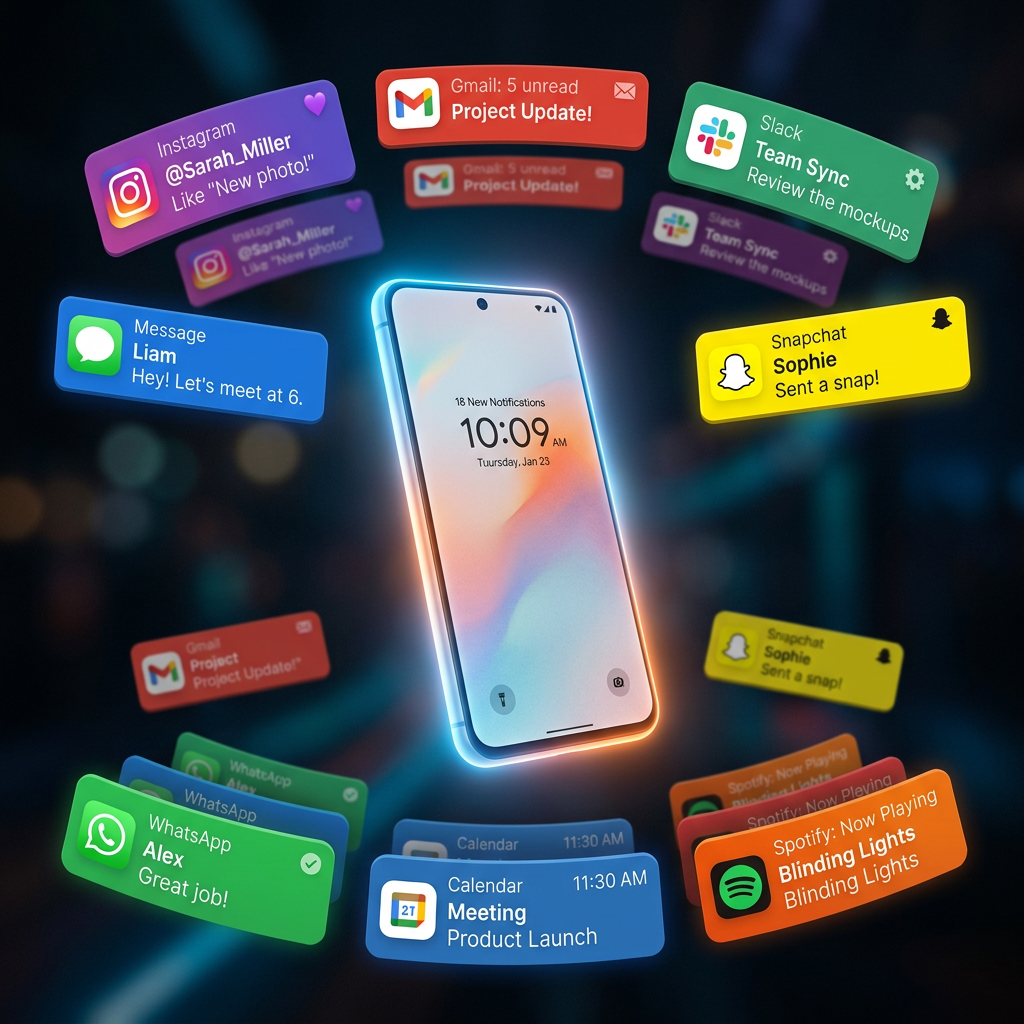
Want to view notifications fast? There are two ways of doing this from your Lock screen. We used to open my iPhone to view notifications; now there’s a faster way. Let’s explore this nifty feature.

View your notifications quickly.
See the number of unread notifications from the Lock screen.

This tip was performed on an iPhone 17 Pro running iOS 26.3.

Click here to learn how to update your iPhone to the latest iOS version.

First, open Settings, then tap Notifications. Refer to the image below:

Notifications 1
Selecting the Notifications option

Next, under Display As, tap on the Count option. See the below image;

Notifications 2
Selecting the Count option

Now, scroll down to Notification Style section and tap on the Mail option. See the following image

Notifications 3
Selecting the Mail option

Next, on your Mail screen:

Enable Allow Notifications toggle
Checkmark Notification Cebter toggle
Enable Badges toggle

Refer to the image below:

Notifications 4
Enabling three items

Now, under Settings, tap Face ID & Passcode option. See the image below:

Notifications 6
Selecting the Face ID & Passcode option

Next, enable the Notification Center toggle. See the following image:

Notifications 7
Enabling the NotificationCenter toggle

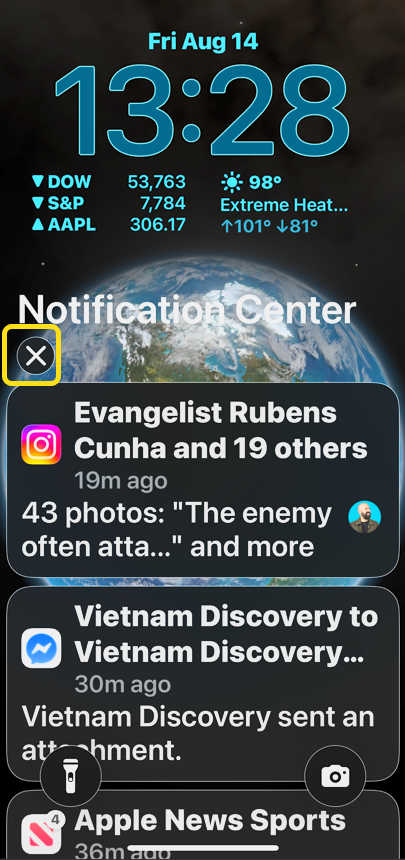
Now that you have finished the setup process, there are two ways to view your notifications on the Lock screen. On your activated Lock screen, hold your finger near the bottom and slowly swipe up until the Notification Center appears. Refer to the image below:

Notifications 5
Slowly swipe up to reveal Notification Center

Or if you have unread Notifications, the number will be displayed at the bottom of your Lock screen. Just tap on it to view your notifications. See the image below:

Notifications 8
Tap on Notification to reveal the Notification Center

Technology is constantly evolving, and smartphone and desktop tech rarely remains static. Therefore, the information in this post is only accurate as of the date it was written. Blog posts that are older than six months may contain instructions that are no longer compatible with your device or operating system. We hope that the content from previous posts continues to function as intended. Thank you for reading TechSavvy.Life, where technology works for you.

We are stuck with technology when what we really want is just stuff that works.

– Douglas Adams

– Douglas AdamsThat’s it. Please feel free to share this post! One way to share is via Twitter.

Just click the Tweet icon below. This will launch Twitter where you click its icon to post the Tweet.

Checkout TechSavvy.Life for blog posts on smartphones, PCs, and Macs! You may email us at contact@techsavvy.life for comments or questions.

We value your feedback! Was this post helpful? Please share your comments with us. If you have a tech question related to your computer or smart device, feel free to reach out. Just send an email to contact@techsavvy.life, and be sure to include the device, app, and version you are using. To assist us further, you can also attach screenshots related to your inquiry.

Author’s eBook

The author’s Vietnam eBook, “Battle for Tra Bong Vietnam: Events and Aftermath,” is available on Kindle devices and the Kindle App for desktop, laptop, and smartphone. The apps are free.

The author’s Vietnam eBook on the Battle for Tra Bong Vietnam: Events and Aftermath

Master Image Search on iPhone and iPad

The Photos app on iOS 18 features an improved search function, allowing users to find pictures using specific search terms like dates, locations, or objects. Users can now easily search for text or items within photos, enhancing the efficiency of locating images from vacations or other events.

RAYMOND OGLESBY @RaymondOglesby2
March 10 2026 – 4 minutes read time

You can use multiple search terms to find specific pictures in the Photos app. We use this time-saving feature to search for specific pictures from vacations, entering a date and location to see all videos and photos from each trip.

With iOS 18, Apple completely revamped the Photos app, introducing a brand-new search function. Previously, you could use search terms from one or more of the following categories: date, location, business name, events, people, pets, captions, and type of photo. Now, you can do an image search on your iPhone for objects or text that show up in your photos. For example, we often forget our license plate number when paying for public parking. We know we have photos of it, so we can just go into the Photos app, type “license plate,” and our phone will show me all the photos of our license plate. Let’s explore how to image search on your iPhone and iPad using multiple keywords.

  • Learn how to search photos on your iPhone and iPad to find Photos of nearly anything.
  • Do an iPhone photo search to find objects or text that appear in your photos.

This tip works on iPhones running iOS 18 or later, but was tested on an iPhone 17 Pro running iOS 26.3.

Click here to learn how to update your iPhone to the latest iOS version.…

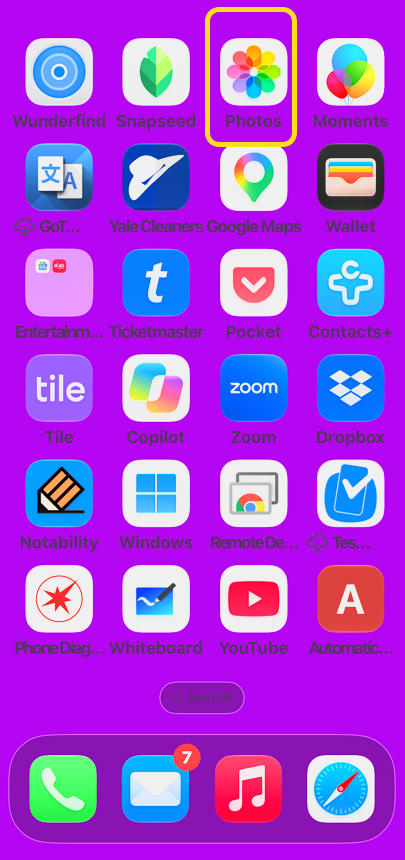
First, open the Photos app. Refer to the image below:

Search Photos 1
Selecting the Photos app

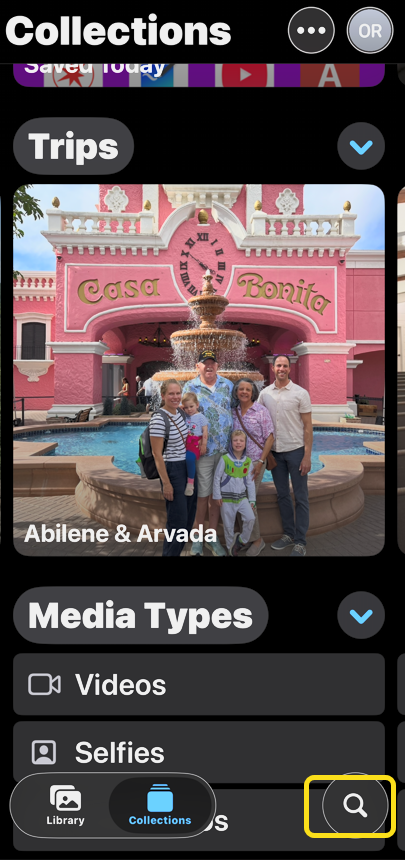
Next, tap the Search icon. See the image below:

Search Photos 2
Selecting the Search icon

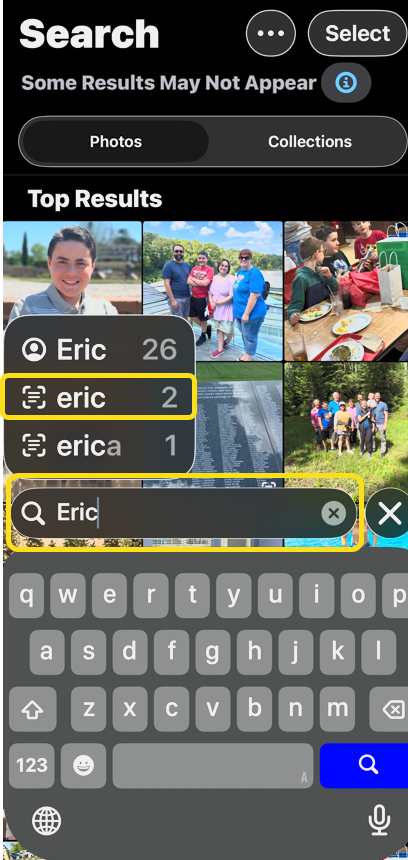
Now, you will see some personalized suggestions, which you can tap. Or you can tap the Search bar to type in your own search terms. See the following image:
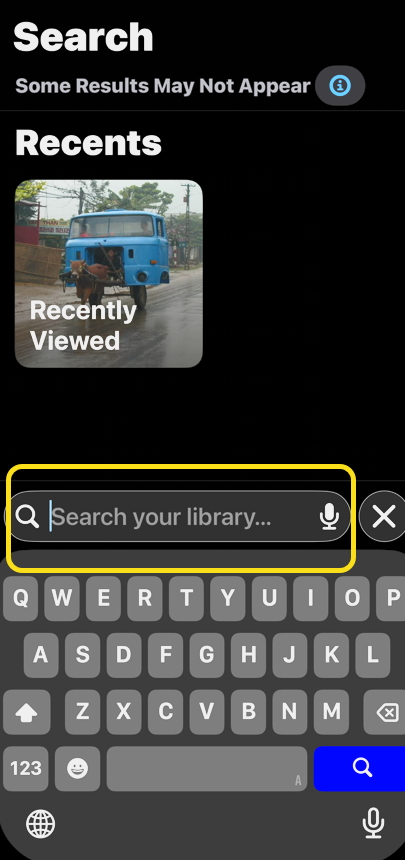
Search Photos 3
Selecting the Search bar

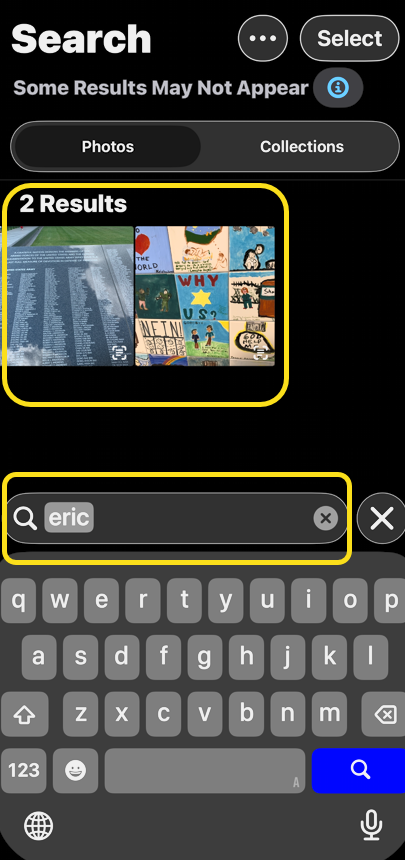
Next, once you enter a search term, you will see all the photos in your library that match. For example, we searched “Raymond December 2025”, and now we can see all my photos of myself, Raymond, from December 2025. Notice that it found blurred text and rotated images. Refer to the image below:

Search Photos 4
Entering your search criteria into the Search bar

That’s how to search photos on the iPhone or iPad. Try it out yourself! Put in a few search terms and see what you get. It’s super easy to find the exact photo you are looking for every time.

Technology is constantly evolving, and smartphone and desktop tech rarely remains static. Therefore, the information in this post is only accurate as of the date it was written. Blog posts that are older than six months may contain instructions that are no longer compatible with your device or operating system. We hope that the content from previous posts continues to function as intended. Thank you for reading TechSavvy.Life, where technology works for you.

The art challenges the technology, and the technology inspires the art.

. – John Lasseter

That’s it. Please feel free to share this post! One way to share is via Twitter.

Just click the Tweet icon below. This will launch Twitter where you click its icon to post the Tweet.

Checkout TechSavvy.Life for blog posts on smartphones, PCs, and Macs! You may email us at contact@techsavvy.life for comments or questions.

We value your feedback! Was this post helpful? Please share your comments with us. If you have a tech question related to your computer or smart device, feel free to reach out. Just send an email to contact@techsavvy.life, and be sure to include the device, app, and version you are using. To assist us further, you can also attach screenshots related to your inquiry.

Author’s eBook

The author’s Vietnam eBook, “Battle for Tra Bong Vietnam: Events and Aftermath,” is available on Kindle devices and the Kindle App for desktop, laptop, and smartphone. The apps are free.
The author’s Vietnam eBook on the Battle for Tra Bong Vietnam: Events and Aftermath

Quick Guide to Sharing Contacts on iPhone

The post explains how to easily share iPhone contacts through the Contacts app without the need for manual entry. Users can customize which parts of the contact card to share and choose various sharing methods like email or AirDrop. It emphasizes simplicity and efficiency in sharing contact information.

RAYMOND OGLESBY @RaymondOglesby2
March 3, 2026 – 3 minutes read time

You can share iPhone contacts (also known as a contact card) directly from the Contacts app on your iPhone, and it does not involve copying and pasting or tediously typing it out!

When you add people to your contacts, a contact card is automatically created on your iPhone for each contact so that all of the contact’s information is grouped into one place. This makes it simple to share or send a contact on iPhone. Let’s explore how to share a contact on iPhone.

  • Learn how to share contacts on iPhone so you can send your own or someone else’s contact card; no more typing out numbers!
  • Customize which parts of the contact card you want to share; you can leave off the email address, phone number, first name, and/or last name.

This tip was performed on an iPhone 17 Pro running iOS 26.2.1.

Click here to learn how to update your iPhone to the latest iOS version.

First, open the Contacts app. In our example, we are selecting a contact group from Contacts. Refer to the image below:

Contacts 1
Opening your Contacts app

Next, tap the contact you wish to share. See the image below:

Contacts 2
Selecting a contact

Now, tap Share Contact. See the following image:

Contacts 3
Selecting the Share Contact option

Next, tap the blue dot next to any part of the contact card you do NOT wish to share, then tap the check mark in the blue circle at upper right. Refer to the image below:

Contacts 4
Unselect items you do NOT want to share and save your results

Now, tap a sharing method, such as email, text message, AirDrop, and more. See the image below:

Contacts 5
Selecting a sharing method

Next, choose a recipient and tap the Send icon to share the contact. See the following image:

Contacts 6
Selecting a recipient and sending the contact info

Now you know how to send contact information on iPhone to recipients using the contact card on your phone! It’s never been easier to share a contact on iPhone.

Technology is constantly evolving, and smartphone and desktop tech rarely remains static. Therefore, the information in this post is only accurate as of the date it was written. Blog posts that are older than six months may contain instructions that are no longer compatible with your device or operating system. We hope that the content from previous posts continues to function as intended. Thank you for reading TechSavvy.Life, where technology works for you.

It’s supposed to be automatic, but actually, you have to push this button.

– John Brunner

That’s it. Please feel free to share this post! One way to share is via Twitter.

Just click the Tweet icon below. This will launch Twitter where you click its icon to post the Tweet.

Checkout TechSavvy.Life for blog posts on smartphones, PCs, and Macs! You may email us at contact@techsavvy.life for comments or questions.

We value your feedback! Was this post helpful? Please share your comments with us. If you have a tech question related to your computer or smart device, feel free to reach out. Just send an email to contact@techsavvy.life, and be sure to include the device, app, and version you are using. To assist us further, you can also attach screenshots related to your inquiry.

Author’s eBook

The author’s Vietnam eBook on the “Battle for Tra Bong Vietnam: Events and Aftermath” can be accessed from a Kindle device or the Kindle App for a desktop or smartphone. The apps are free.

The author’s Vietnam eBook on the Battle for Tra Bong Vietnam: Events and Aftermath

How to Disable ChatGPT on Your iPhone

Apple has integrated ChatGPT into iPhones through Apple Intelligence, enhancing user interaction with Siri. Users can disable this feature for privacy concerns or to avoid supporting ChatGPT. The process involves modifying settings in the Apple Intelligence menu. Overall, users can maintain privacy while utilizing AI functionalities.

InRAYMOND OGLESBY @RaymondOglesby2
February 24, 2026 – 3 minutes read time

Apple Intelligence enhances how you use your iPhone, including when you speak to Siri. Thanks to a collaboration between Apple and OpenAI, you can now use ChatGPT on your iPhone with Apple Intelligence. But if you have privacy concerns or prefer not to support ChatGPT, you can disable it.

Does the iPhone have ChatGPT? Apple has natively integrated ChatGPT on iPhone, so that if Apple Intelligence fails to find an answer for you, it can defer to ChatGPT. This works without a ChatGPT account or subscription and allows you to use the AI chatbot a bit more anonymously than if you were to use the app. However, some may still have reservations about using AI unnecessarily or having their searches logged by ChatGPT. If you do not want to use ChatGPT on your iPhone, you can disable it. Let’s explore how to turn off AI on your iPhone.

  • Maintain privacy by preventing ChatGPT from accessing your information.
  • Avoid supporting ChatGPT if you oppose its environmental impact.

This tip was performed on an iPhone 17 Pro running iOS 26.2.

Click here to learn how to update your iPhone to the latest iOS version.

First, open the Settings app, and tap the Apple Intelligence option. Refer to the image below:

ChatGPT 1
Selecting the Apple Intelligence option

Now, scroll down to Extensions and tap ChatGPT. See the below image:

ChatGPT 2
Selecting the ChatGPT option

Next, switch off the toggle next to Use ChatGPT to disable it. See the following image:

ChatGPT 3
Turn Off the ChatGPT toggle

Now, when ChatGPT is turned off, you will see a Set Up prompt instead of a toggle. Refer to the below image:

ChatGPT 4
The Use ChatGPT option is now in Set Up mode

Next, when ChatGPT disabled, your iPhone will continue to prompt you to set it up, so tap the toggle next to Setup Prompts to turn this off as well. See the below image:

ChatGPT 5
Turn Off the Setup Prompts toggle

Note! If you want to enable ChatGPT, go back to Extensions and tap the ChatGPT toggle to on. 

That’s how to turn off ChatGPT on iOS. Now you can rely exclusively on the privacy of Apple Intelligence for all your AI needs.

Technology is constantly evolving, and smartphone and desktop tech rarely remains static. Therefore, the information in this post is only accurate as of the date it was written. Blog posts that are older than six months may contain instructions that are no longer compatible with your device or operating system. We hope that the content from previous posts continues to function as intended. Thank you for reading TechSavvy.Life, where technology works for you.

The technology you use impresses no one. The experience you create with it is everything.

 – Sean Gerety

That’s it. Please feel free to share this post! One way to share is via Twitter.

Just click the Tweet icon below. This will launch Twitter where you click its icon to post the Tweet.

Checkout TechSavvy.Life for blog posts on smartphones, PCs, and Macs! You may email us at contact@techsavvy.life for comments or questions.

We value your feedback! Was this post helpful? Please share your comments with us. If you have a tech question related to your computer or smart device, feel free to reach out. Just send an email to contact@techsavvy.life, and be sure to include the device, app, and version you are using. To assist us further, you can also attach screenshots related to your inquiry.

Author’s eBook

The author’s Vietnam eBook, “Battle for Tra Bong Vietnam: Events and Aftermath,” is available on Kindle devices and the Kindle App for desktop, laptop, and smartphone. The apps are free.
The author’s Vietnam eBook on the Battle for Tra Bong Vietnam: Events and Aftermath

Malicious Browser Extensions to Uninstall Now

A cybersecurity firm has identified 17 malicious browser extensions, including “Google Translate in Right Click,” which collectively garnered over 840,000 downloads. Mozilla and Microsoft have removed these from their stores, but users must uninstall them manually. The extensions pose risks across several popular web browsers.

RAYMOND OGLESBY @RaymondOglesby2
February 17, 2026 –3 minutes read time

The most popular malicious extension, dubbed Google Translate in Right Click, was downloaded more than 500,000 times from app stores. Another, Translate Selected Text with Google, racked up almost 160,000 downloads.

If you have been using browser extensions to download YouTube videos or images from Pinterest, translate text in real time, check Amazon price histories, or even enhance colors, you might have some uninstalling to do.

Cybersecurity firm LayerX has uncovered 17 malicious browser extensions that were downloaded more than 840,000 times in total, with some remaining active in the wild for up to five years. Instances were recorded across Firefox, Google Chrome, and Microsoft Edge browsers.

Mozilla and Microsoft have removed all of the extensions from their official stores at the time of writing. However, if you have already installed one, you will need to uninstall it manually.

Here is the list of extensions you should remove:

Google Translate in Right ClickTranslate Selected Text with Google
One Key TranslateTranslate Selected Text with Right Click
Cool CursorScreenshot Clipper
Ads Block UltimateConvert Everything
Amazon Price HistoryRSS Feed
Color EnhancerFloating Player – PiP Mode
YouTube Download, Instagram Downloader
Save Image to Pinterest on Right ClickFull Page Screenshot
Youtube Download 

If you want to view all your extensions in Chrome, click the three-dot icon in the upper right, move to More tools, and select Extensions. Alternatively, click the Extensions button on the toolbar and select Manage extensions. This will take you to a page where you can manage all your installed extensions. Refer to the image below:

Extensions 1
Accessing Manage Extensions option

You can click Details to view information on a specific extension. If you turn off an extension switch, this will temporarily disable it. Otherwise, click Remove to uninstall the extension completely. See the image below:

Extensions 2
Disable, Remove, or view Details for an Extension

Technology is constantly evolving, and smartphone and desktop tech rarely remains static. Therefore, the information in this post is only accurate as of the date it was written. Blog posts that are older than six months may contain instructions that are no longer compatible with your device or operating system. We hope that the content from previous posts continues to function as intended. Thank you for reading TechSavvy.Life, where technology works for you.

Technology is a gift of God. After the gift of life it is perhaps the greatest of God’s gifts. It is the mother of civilizations, of arts and of sciences.

 – Freeman Dyson

That’s it. Please feel free to share this post! One way to share is via Twitter.

Just click the Tweet icon below. This will launch Twitter where you click its icon to post the Tweet.

Checkout TechSavvy.Life for blog posts on smartphones, PCs, and Macs! You may email us at contact@techsavvy.life for comments or questions.

We value your feedback! Was this post helpful? Please share your comments with us. If you have a tech question related to your computer or smart device, feel free to reach out. Just send an email to contact@techsavvy.life, and be sure to include the device, app, and version you are using. To assist us further, you can also attach screenshots related to your inquiry.

Author’s eBook

The author’s Vietnam eBook, “Battle for Tra Bong Vietnam: Events and Aftermath,” can be accessed on a Kindle device or the Kindle App for a desktop, laptop, or smartphone. The apps are free.
The author’s Vietnam eBook on the Battle for Tra Bong Vietnam: Events and Aftermath

Improve iPhone Text Size for Better Readability

This post offers guidance on enhancing readability on iPhones and iPads through accessibility settings. Users can learn to bold text, adjust size, and add navigation aids like button borders and on/off labels. The tutorial outlines steps for changing these settings, ensuring a more user-friendly experience for visually impaired individuals.

RAYMOND OGLESBY @RaymondOglesby2
February 10, 2026 – 4 minutes read time

Are you tired of squinting while looking at content on your iPhone? Good news! You can change the display and text size on your iPhone and iPad for easier readability.

Apple’s accessibility settings allow individuals to customize their display settings so they can more easily navigate and view content on their devices. Follow the steps below to learn how to bold text on your iPhone and iPad, change text size, and add button shapes and toggle labels.

  • Make text larger and bolded for easier readability of text messages, emails, and more.
  • Add borders to buttons and on/off labels to toggles for easier navigation.

This tip was performed on an iPhone 17 Pro running iOS 26.2.

Click here to learn how to update your iPhone to the latest iOS version.

First, open the Settings app. Refer to the image below:

Font 1
Accessing Settings

Next scroll down and tap Accessibility. See the image below:

Font 2
Selecting the Accessibility option

Now, tap Display & Text Size. See the following image:

Font 3
Selecting the Display & Text Size option

Next, if you want the text on your iPhone or iPad to be bolded, tap the Bold Text toggle to enable it. The toggle is green when enabled. Refer to the image below:

Font 4
Enabling the Bold Text toggle

Now, to change the text size, tap Larger Text.See the image below:

Font 5
Selecting the Larger Text option

Next, tap to enable the Larger Accessibility Sizes toggle. Once enabled, apps that allow you to change the text size will display your preferred font size. See the following image:

Font 6
Enabling the Larger Accessibility Sizes toggle

Now, once you have set your preferred font size, tap the back icon to return to main Display & Text Size menu. Refer to the image below:

Font 8
Go back to main screen

Next. to set your preferred text size, drag the slider left to decrease font size or right to increase font size. See the image below:

Font 7
Drag the slider to increase or decrease font size

Now, if you want to add on/off labels to toggles, you can also tap to enable the On/Off Labels toggle. The “I” indicates the toggle is on, and “O” indicates it is off. See the following image:

Font 9
Enabling the On/Off Labels toggle

Finally, you can toggle on Show Borders (our favorite) to get thin borders around buttons that would otherwise lack a clear border. Refer to the image below:

Font 10
Enabling the Show Borders option

Technology is constantly evolving, and smartphone and desktop tech rarely remains static. Therefore, the information in this post is only accurate as of the date it was written. Blog posts that are older than six months may contain instructions that are no longer compatible with your device or operating system. We hope that the content from previous posts continues to function as intended. Thank you for reading TechSavvy.Life, where technology works for you.

The most technologically efficient machine that man has ever invented is the book.

– Northrop Frye

You are finished. Please feel free to share this post! One way to share is via Twitter.

Just click the Tweet icon below. This will launch Twitter where you click its icon to post the Tweet.

Checkout TechSavvy.Life for blog posts on smartphones, PCs, and Macs! You may email us at contact@techsavvy.life for comments or questions.

We value your feedback! Was this post helpful? Please share your comments with us. If you have a tech question related to your computer or smart device, feel free to reach out. Just send an email to contact@techsavvy.life, and be sure to include the device, app, and version you are using. To assist us further, you can also attach screenshots related to your inquiry.

AAuthor’s eBook

The author’s Vietnam eBook on the “Battle for Tra Bong Vietnam: Events and Aftermath” can be accessed on a Kindle device or the Kindle App for a desktop or smartphone. The apps are free.
The author’s Vietnam eBook on the Battle for Tra Bong Vietnam: Events and Aftermath

How to Control Background App Refresh on iPhone

Background App Refresh can consume data and battery life on your device. Users can optimize its usage by enabling it only when connected to Wi-Fi. This setting helps preserve cellular data and battery life while keeping apps up-to-date when needed. Instructions for adjusting these settings are provided for iPhone users.

RAYMOND OGLESBY @RaymondOglesby2
February 3 , 2026 – 4 minutes read time

Background App Refresh can siphon off your data and battery without you noticing. But you can choose to turn Background App Refresh on only when your device is connected to Wi-Fi. That way, you can enjoy the perks of the feature without worrying about how much data it’s using.

For years, it has been recommended to turn off Background App Refresh on your device to save battery life and cellular data. Background App Refresh automatically refreshes apps you have open in the background, so when you go back to them, the page is already up to date and loaded. This can consume data and battery life. Here’s how to set background app refresh to Wi-Fi only on iPhone.

Note! All iPhone users should setup this tip. Why Apple does not make this the default is beyond us.

  • Save battery life by preventing apps from constantly refreshing.
  • Ensure you do not use up extra cellular data by allowing apps to refresh only over Wi-Fi.

This tip was performed on an iPhone 17 Pro running iOS 26.2.

Click here to learn how to update your iPhone to the latest iOS version.

First, open Settings, and select General. Refer to the image :

Refresh 1
Selecting the General option

Next, tap Background App Refresh. See the image below:

Refresh 2
Selecting the Background App Refresh option

Now, select Background App Refresh again. See the following image:

Refresh 3
Selecting the Background App Refresh option again

Next, select Wi-Fi to turn on Background App Refresh only when your device is connected to Wi-Fi. Refer to the image below:

Refresh 4
Turning Wi-Fi on

Now, you can enable/disable background refresh per app by tapping its toggle. see the image below:

efresh 5
Disable Background App Refresh

That’s how to adjust the settings for background app refresh on iPhone. If you want to know how to turn off background app refresh completely, just select Off in the last step. This is a good option if you do not want your apps updating without you knowing. This can stop updates you actually do not want from being installed on your phone (which can be a huge advantage), but it will be annoying when you open an app you need to use now, only to get a notification that you will have to update before you can use it.

Technology is constantly evolving, and smartphone and desktop tech rarely remains static. Therefore, the information in this post is only accurate as of the date it was written. Blog posts that are older than six months may contain instructions that are no longer compatible with your device or operating system. We hope that the content from previous posts continues to function as intended. Thank you for reading TechSavvy.Life, where technology works for you.

Our technological powers increase, but the side effects and potential hazards also escalate.

. – Alvin Toffler

That’s it. Please feel free to share this post! One way to share is via Twitter.

Just click the Tweet icon below. This will launch Twitter where you click its icon to post the Tweet.

Checkout TechSavvy.Life for blog posts on smartphones, PCs, and Macs! You may email us at contact@techsavvy.life for comments or questions.

We value your feedback! Was this post helpful? Please share your comments with us. If you have a tech question related to your computer or smart device, feel free to reach out. Just send an email to contact@techsavvy.life, and be sure to include the device, app, and version you are using. To assist us further, you can also attach screenshots related to your inquiry.

Author’s eBook

The author’s Vietnam eBook on the “Battle for Tra Bong Vietnam: Events and Aftermath” can be accessed from a Kindle device or the Kindle App for a desktop or smartphone. The apps are free.
The author’s Vietnam eBook on the Battle for Tra Bong Vietnam: Events and Aftermath