The Shake to Undo allows you to undo or redo an action, especially typing, by shaking your device. Mistakes are inevitable typing on your iPhone”s small screen. You get the annoying Undo Typing pop-up dialog message. This Shake to Undo feature is on by default. If you find this is being triggered unintentionally, you can disable this feature.
The Shake to Undo allows you to undo or redo an action, especially typing, by shaking your device. Mistakes are inevitable typing on your iPhone”s small screen. You get the annoying Undo Typing pop-up dialog message. This Shake toUndo feature is on by default. If you find this is being triggered unintentionally, you can disable this feature. Let’s explore how to disable.
This is for the iPhone and iPad
Copyright Scott Adams, Inc./Distributed by Universal Uclick for UFS
Check out TechSavvy.Life for their blog posts on smartphone apps, PCs. and Macs!
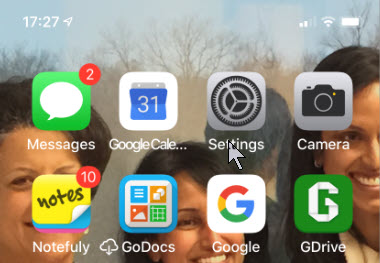
First, launch the Settings app by tapping on the Gear icon, usually found on the first page of your Home screen. Refer to below image:
Accessing the Settings app
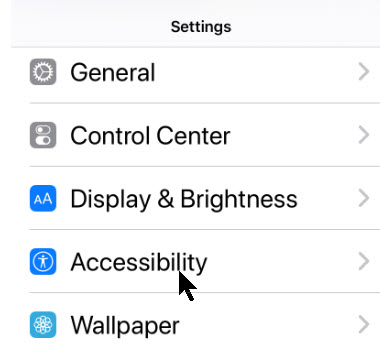
Next, tap on Accessibility. See below image;
Accessing the Accessibility option
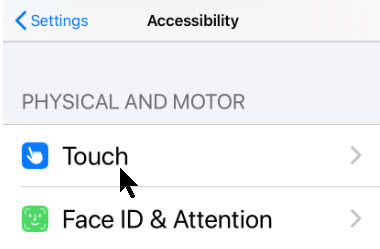
Now, tap Touch. See following image:
Accessing the Touch option
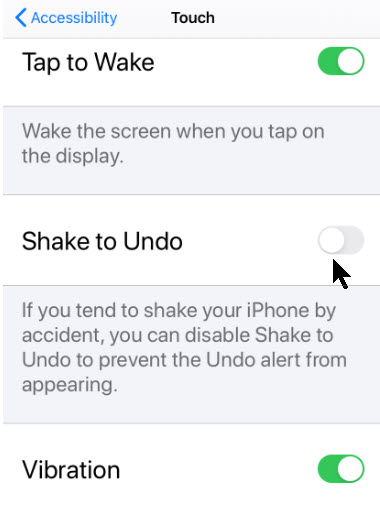
Next, scroll down until you see a toggle labeled Shake to Undo. Tap the toggle to turn it off. Refer to below image:
Disabling the Shake to Undo option
Alternative Methods
Tap to Undo: Double-tap three fingers on the screen to undo typing. In some apps, the text you’ve just typed disappears. In others, you might see an Undo button pop-up that you need to tap.
Swipe to Undo: Swipe left with three fingers on the screen to undo typing. Just like above, some apps will immediately erase what you last typed, and others will present an Undo button pop-up. If so, just tap it.
That’s it. This should make your typing less intrusive by eliminating the pop-up message on your iPhone or iPad.
I have found TechSavvy.Life blog posts extremely helpful. Check them out for posts on smart phone apps, Macs and PCs!
Please feel free to leave a comment. I would love hearing from you. Do you have a computer or smart device tech question? I will do my best to answer your inquiry. Please mention the device, app and version that you are using. To help us out, you can send screenshots of your data related to your question.
The author’s Vietnam eBook on the Battle for Tra Bong: Events and Aftermath
As an amateur video/photographer, I would take videos of ballroom dancer’ s showcase routines or competitions with the accompanying audio track and publish the video on YouTube, only to have YouTube block the audio due to copyrights. I would spend hours getting the video and audio “just right” for YouTube. If I had known about the copyrights, I would not have spent so much time on the productions. Sometimes you might want to share such videos without infringing on the copyrights or you find the audio distracting.
As an amateur video/photographer, I would take videos of ballroom dancer’ s showcase routines or competitions with the accompanying audio track and publish the video on YouTube, only to have YouTube block the audio due to copyrights. I would spend hours getting the video and audio “just right” for YouTube. If I had known about the copyrights, I would not have spent so much time on the productions. Sometimes you might want to share such videos without infringing on the copyrights or you find the audio distracting.
Fortunately, there is a quick way to silence the audio using the Photos app on your iPhone or iPad.
This is for the iPhone and iPad
Copyright Scott Adams, Inc./Distributed by Universal Uclick for UFS
Check out TechSavvy.Life for their blog posts on smartphone apps, PCs. and Macs!
First, open the Photos app on your iPhone or iPad. Now, locate the video you would like to silence and tap on its thumbnail to open. Refer to below image:
Locate a video
Next, tap the Edit icon in the upper-right corner of your screen. See below image:
Edit a video
Disable the Audio
If the audio is enabled, a yellow speaker icon will appear in the upper-left corner of your screen. To disable the audio, tap the icon. See following image;
Disable the audio for a video
Unlike other speaker icons on the iPhone or iPad, this is not simply a mute button. Tapping the yellow speaker icon removes the audio track from the video file so that the audio will be silent when you share it.
With the audio disabled, the icon will change to a grayed-out speaker icon with a diagonal strike mark through it. Refer to below image;
Audio disabled for a video
To save your change, tap Done in lower right-hand of your screen. See below image:
Save your change
In Photos, you will see a grayed-out speaker icon on the toolbar if a video has no audio track. See following image:
Audio has been disabled
If the icon looks like a crossed-out speaker, it could mean that you phone is merely silenced. If so, simply turn the sound back on and make sure the speaker icon is fully grayed out before sharing. Now you can share the video without the audio component.
Restore the Audio
The Photos app saves the original videos you edited, so you can undo your changes.
After sharing, launch the Photos app and inspect the video you would like to restore the sound. Tap Edit in the upper right-hand corner of the screen, then tap Revert at the bottom right. The audio for that video will be restored. Refer to below image:
Select to revert back to the original
You will receive a confirmation message. Simply click the Revert to Original button. See below image;
Message to revert back to original
I have found TechSavvy.Life blog posts extremely helpful. Check them out for posts on smart phone apps, Macs and PCs!
Please feel free to leave a comment. I would love hearing from you. Do you have a computer or smart device tech question? I will do my best to answer your inquiry. Please mention the device, app and version that you are using. To help us out, you can send screenshots of your data related to your question.
The author’s Vietnam eBook on the Battle for Tra Bong: Events and Aftermath
The decision to listen to Autoplay videos should be in your control. Fortunately, with iOS 13+ you are able to control Autoplay. Whether you want to enjoy Autoplay videos as you browse or you want to shut them down until you’re ready, here is a way you can finally control the noise.
The decision to listen to Autoplay videos should be in your control. Fortunately, with iOS 13+ you are able to control Autoplay. Whether you want to enjoy Autoplay videos as you browse or you want to shut them down until you’re ready, here is a way you can finally control the noise.
By default, Apple mutes your personal photos and videos in iOS 13+. What’s particularly annoying about this feature is that your iPhone will still Autoplay videos, but it won’t enable the volume by default.
The bad news is that there doesn’t currently seem to be a way to Autoplay with volume via your phone’s settings. The good news is that there is a way to get around this feature. Let’s explore how to do this.
This is for the iPhone and iPad running iOS 13 and above
Copyright Scott Adams, Inc./Distributed by Universal Uclick for UFS
On your IPhone or iPad, open Settings. Next, scroll down to the Photos tab. Refer to below image:
Accessing the Photos option
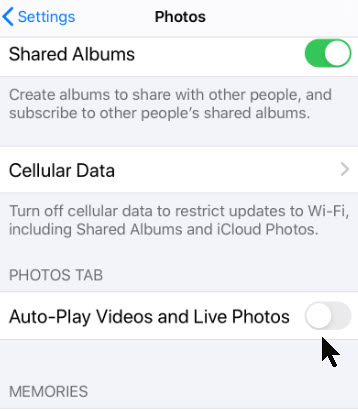
Now, toggle off Auto-Play Videos and Live Photos.
Turning off Autoplay
It’s important to understand what this actually does. Basically, your personal collection of live photos and videos will no longer play automatically when you load them. The good news is that when you do choose to play them, the volume will be enabled. This is the best way to enjoy audio from the start without having to manually toggle it each time.
That’s it. I hope you like this post. If so, please let us know by leaving a comment.
I have found TechSavvy.Life blog posts extremely helpful. Check them out for posts on smart phone apps, Macs and PCs!
Please feel free to leave a comment. I would love hearing from you. Do you have a computer or smart device tech question? I will do my best to answer your inquiry. Please mention the device, app and version that you are using. To help us out, you can send screenshots of your data related to your question.
The author’s Vietnam eBook on the Battle for Tra Bong: Events and Aftermath
Whether you’re underground between subway stops, caught in a dead zone, or your internet is out, the most reliable way to catch up on your digital reading is to make sure it’s downloaded and accessible offline.
Whether you’re underground between subway stops, caught in a dead zone, or your internet is out, the most reliable way to catch up on your digital reading is to make sure it’s downloaded and accessible offline.
If you have an iPhone or iPad linked to an iCloud account, you can save articles to your Reading List for later reading offline using a feature buried in Settings. Let’s explore how to do this.
This is for iPhone and iPad using Safari browser
Copyright Scott Adams, Inc./Distributed by Universal Uclick for UFS
First we need to make sure iCloud is set up to save your Safari bookmarks and Reading List. To do that, open Settings and tap on your name at the very top. Refer to below image:
Accessing Settings
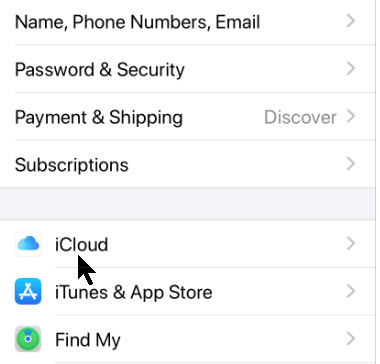
Next, tap iCloud. See below image:
Accessing iCloud
In iCloud settings, scroll down until you see Safari. Tap the toggle (it will turn green) to enable if it’s not already on. See following image:
Accerssing Safari for iCloud
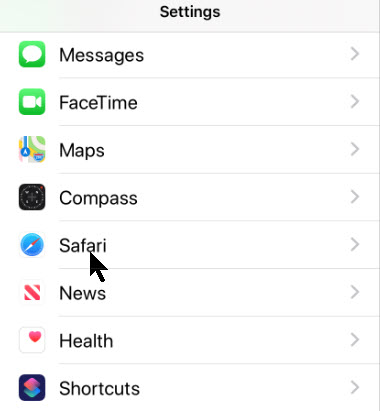
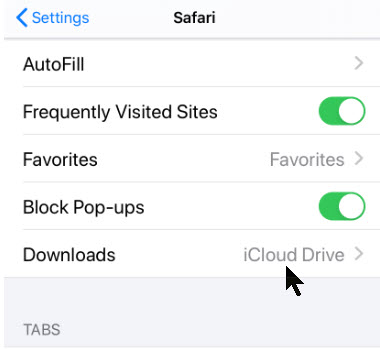
Return back to the Settings main screen. Scroll down to the Safari option and tap to open. Note! This is a different setting than the one mentioned above. Refer to below image:
Accessing Safari from Settings
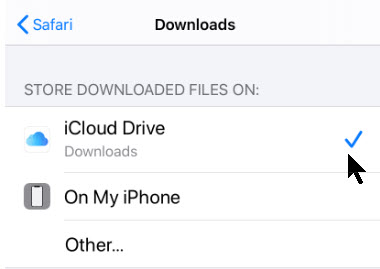
Now, scroll down to the Downloads option and ensure that iCloud Drive option is selected. In my example, the option is selected. See below image:
Accessing Downloads
If not selected, tap the Downloads option and select iCloud Drive from the two available options. See following image:
Accessing Downloads options
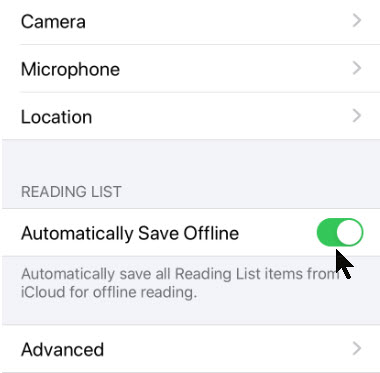
Continue to scroll down until you find the Reading List section. There you will see the toggle for Automatically Save Offline. Simply enable this toggle. When enabled, the toggle color will turn green. Refer to below image:
Enabling offline reading
Save to the Reading List
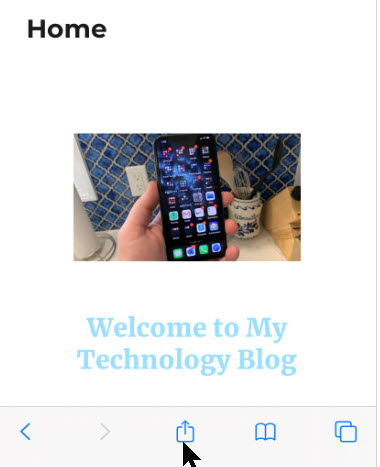
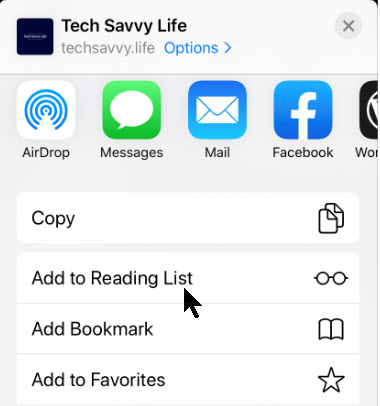
Now exit Settings and launch Safari. Whenever you’d like to save a web page to your Reading List for offline viewing, tap on the Share button at the bottom of your screen. See below image:
Accessing the Share button
A pop-up menu will appearr. Select the Add To Reading List option. See following image:
The Add to Reading List option
View Your Reading List
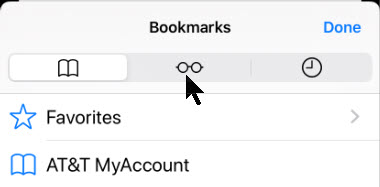
To view your Reading List later, tap the Bookmarks button at the bottom of your screen. Refer to below image:
Accessing the Bookmarks button
Now, tap on the tab that looks like a pair of glasses in the uipper center of your screen. See below image:
Accessing your offline Reading List
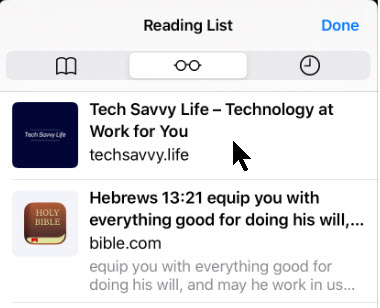
From here, you can tap on any one of the items you’ve saved and it should load even if no internet connection is available. See following image for my offline reading list:
Previewing your offline Reading List
I hope you found this post helpful. If so, please leave a comment and or a tweet.
I have found TechSavvy.Life blog posts extremely helpful. Check them out for posts on smart phone apps, Macs and PCs!
Please feel free to leave a comment. I would love hearing from you. Do you have a computer or smart device tech question? I will do my best to answer your inquiry. Please mention the device, app and version that you are using. To help us out, you can send screenshots of your data related to your question.
The author’s Vietnam eBook on the Battle for Tra Bong: Events and Aftermath
The Apple iPhone has a built in browser called Safari. The icon for Safari is usually located in the bottom right of the Home screen. Starting with iOS 9 through the current version, iOS 13, you can have up to 500 tabs open in Safari.
This is a repost on Apple iPhone and its open tabs in Safari web browser
The Apple iPhone has a built in browser called Safari. The icon for Safari is usually located in the bottom right of the Home screen. Starting with iOS 9 through the current version, iOS 13, you can have up to 500 tabs open in Safari.
This is for iPhone, iPad and Mac or similar devices
To chose all your tabs or the current one is not obvious. Here’s how to close these open tabs in Safari.
Tap on the Safari icon to open
In the lower right hand corner you will see an icon represented by two rectangles.
Press down on the icon and hold
You will see several options. Tap “Close All xxx Tabs” where xxx is a number
Confirm you want to close the tabs
Your tabs will now be closed. That it’s.
I Would Like to Hear from You
Please feel free to leave a comment. I would love hearing from you. Do you have a computer tech question? I will do my best to answer your inquiry. Please mention the app and version that you are using. To help me out, you can send screenshots of your data related to your question.
The author’s Vietnam eBook on the Battle for Tra Bong: Events and Aftermath
There’s a hidden feature to view the weather report on your iPhone lock screen. This feature is built-in on an Android device.
There’s a hidden feature to view the weather report on your iPhone lock screen. This feature is built-in on an Android device. Let’s explore how to enable this on your iPhone.
We are going to use the Do Not Disturb Scheduled option available in iOS 12 and later. When enabled, you will see the weather report on the first tap of the lock screen after the Do Not Disturb time has passed. The Do Not Disturb feature automatically mutes all incoming notifications.
This is for the iPhone with iOS 12+
Copyright Scott Adams, Inc./Distributed by Universal Uclick for UFS
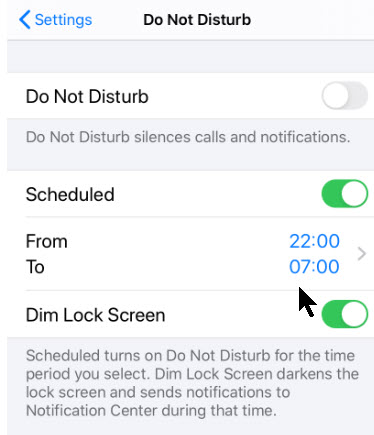
Open the Settings app, go to Do Not Disturb section. Next, toggle the Scheduled option. Set the From and To time. Important! You want to set the “To” time frame to 10-15 minutes before you wake up. Finally, toggle the Dim Lock Screen. Refer to below image:
Setting the Do Not Disturb time frame
We are dimming the lock screen and sending all new notifications to the Notifications Center until the Do Not Disturb schedule is over.
Let’s go back to Settings and tap the Privacy option. Now, tap the Location Services option. Next, scroll down to the Weather app. See below image:
The Weather app
Now, tap the While Using the App button to enable. This gives the Weather app permission to see your location, so it show you the weather report. See following image:
Setting permission for the Weather app
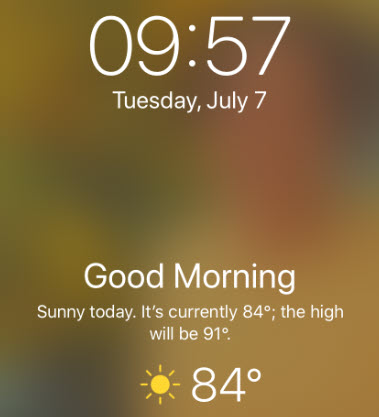
The next morning, after the Do Not Disturb time has passed, you will see the day’s weather report on your lock screen. Refer to below image:
The Weather screenshot
I have found TechSavvy.Life blog posts extremely helpful. Check them out for posts on smart phone apps, Macs and PCs!
Please feel free to leave a comment. I would love hearing from you. Do you have a computer or smart device tech question? I will do my best to answer your inquiry. Please mention the device, app and version that you are using. To help us out, you can send screenshots of your data related to your question.
The author’s Vietnam eBook on the Battle for Tra Bong: Events and Aftermath
Yes, it is coming for your iPhone and Android smartphones. As a matter of fact, some of the features have already been available in iOS 13.5 and above for the iPhone that was released in May 2020. Google and Apple are working with public health organizations on contact-tracing apps.
Yes, it is coming for your iPhone and Android smartphones. As a matter of fact, some of the features have already been available in iOS 13.5 and above for the iPhone that was released in May 2020. Google and Apple are working with public health organizations on contact-tracing apps.
The piece that is missing, for now, is authorized apps from your health authorities. This is where you’ll report any sickness. Apple and Google are not releasing apps; they are collaborating to allow these apps to work across iOS and Android to collect data and send out alerts.
The following guidelines are for the iPhone. Android devices will be similar.
This is for iPhone and Android smartphones. Screenshots are from the iPhone
Copyright Scott Adams, Inc./Distributed by Universal Uclick for UFS
Conventional contact tracing is a technique used by public health authorities to measure and slow the spread of infectious diseases. It requires manually gathering information from infected individuals about the people they have previously been in contact with. These people can then be notified by public health authorities to take appropriate safety measures, such as undertaking self-quarantine and getting tested to break the chain of transmission. While this process will continue to be important to contact tracing efforts, systems that are being developed can alleviate some of the challenges with this process.
First there is a significant organizational burden from a manual process, as many public health workers are needed to perform these tasks. Second, the process can be slow as it requires finding and interviewing infected individuals and then reaching out and talking to their high risk contacts; all of whom may not be able to remember or know all of the people that they came in contact with in the past days to weeks.
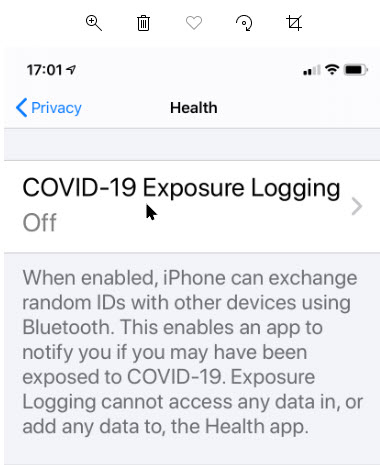
The contact tracing is called “COVID-19 Exposure Logging” and is automatically turned off. When contact tracing apps are installed, you can enable the feature.
Setting Up On iPhone
First, launch Settings. Refer to below image:
The Settings icon
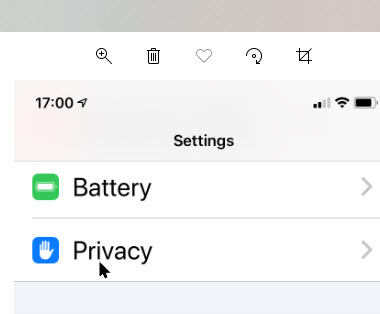
Next, scroll down to the Privacy option and tap it. See below image:
The Privacy option
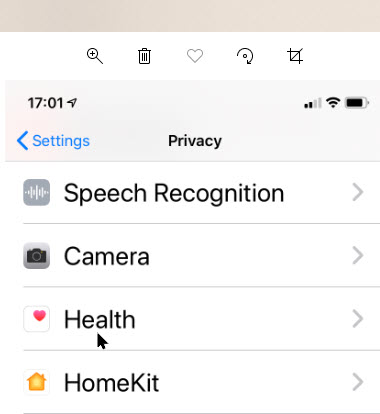
Now, tap the Health option. See following image:
The Health option
You wil see the COVID-19 Exposure Logging option; just tap it. Refer to below image:
COVID-19 Exposure Logging option
How It Works
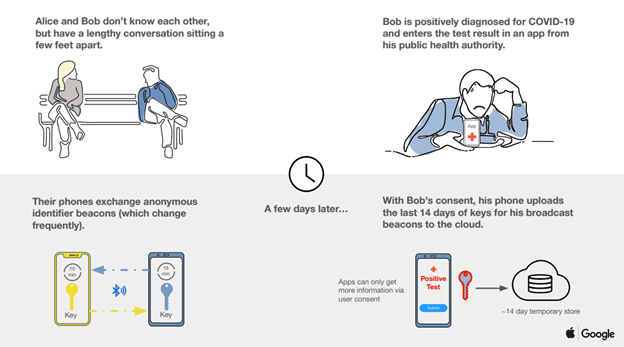
Once enabled, users’ devices will regularly send out a beacon via Bluetooth that includes a random Bluetooth identifier; basically, a string of random numbers (IDs) that are not tied to a user’s identity and change every 10-20 minutes for additional protection. Other phones will be listening for these beacons and broadcasting theirs as well. When each phone receives another beacon, it will record and securely store that beacon on the device. Refer to below diagram:
Contact Tracing Diagram
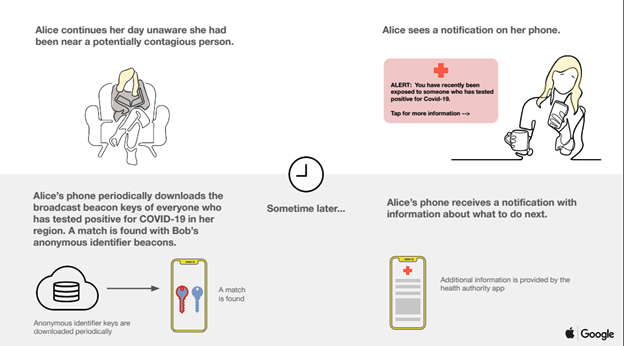
At least once per day, the system will download a list of the keys for the beacons that have been verified as belonging to people confirmed as positive for COVID-19. Each device will check the list of beacons it has recorded against the list downloaded from the server. If there is a match between the beacons stored on the device and the positive diagnosis list, the user may be notified and advised on steps to take next. See below diagram:
Contact Tracing Diagram
Active Apps
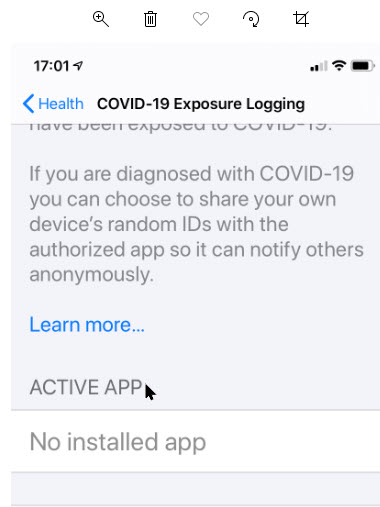
Now, scroll down to the Active App section. Here you will find your installed apps that works with contact tracing. Once available from local, state or federal authorities, you will need to install the apps then they will appear here. (As of this writing, there is one app available from Center for Disease Control; for a list of States that will participate or have an app available, click here . See below image:
Active Apps for contact tracing that are installed
For these apps to work, you will need your phone’s Bluetooth and location tracking features turned on, though your actual physical location is not tracked; the apps will not know where in the world you are or how many times you have left the house today. They’ll only know which random IDs your phone has come into contact with.
Check for Exposure
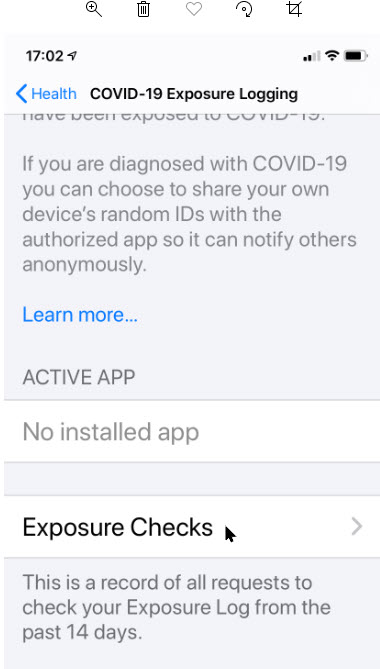
To see if the option is working, tap on Exposure Checks. See following image:
Accessing Exposure Checks option
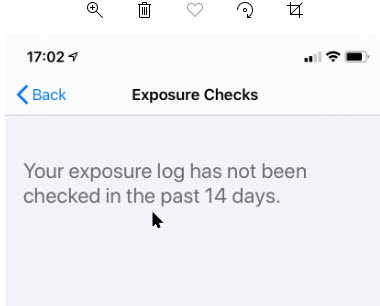
Now, you will see the following image about any exposure within the last 14 days. Refer to below image:
Checking to see if you have been exposed
The Fine Print
Now, tap the Back button then tap on the Learn More blue link. See below image:
Accessing the Terms andConditions
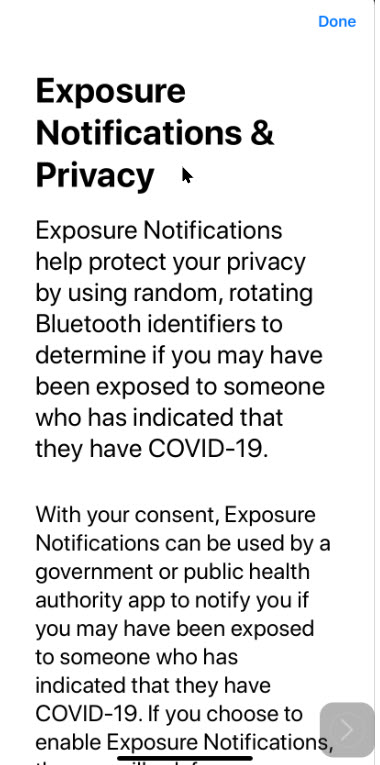
Information on Exposure Notifications & Privacy terms and conditions will be displayed. See following image:
The Terms and Conditions for contact tracing and exposure
I have found TechSavvy.Life blog posts extremely helpful. Check them out for posts on smart phone apps, Macs and PCs!<
Please feel free to leave a comment. I would love hearing from you. Do you have a computer or smart device tech question? I will do my best to answer your inquiry. Please mention the device, app and version that you are using. To help us out, you can send screenshots of your data related to your question.
The author’s Vietnam eBook on the Battle for Tra Bong: Events and Aftermath
Most of the content you read on your iPhone is likely on the web. There are some hidden features that can make your reading a more enjoyable experience.
Most of the content you read on your iPhone is likely on the web. There are some hidden features that can make your reading a more enjoyable experience.
I am legally blind in one eye and have a hard time seeing the big E. I wear one contact to aid my sight. This post is of special interest to me and hope it’s of help to you.
This is for the iPhone running iOS 13+
Copyright Scott Adams, Inc./Distributed by Universal Uclick for UFS
We know that Safari is the default browser for the iPhone. It comes as a standard app and for a reason. The app has a Reader View, unlike third-party apps. This view reformats web pages making them easier to read. It removes all the distractions and just shows you the content.
Some browsers might offer Reader View but the popular browser Google Chrome doesn’t.
When you land on a web page or similar content, the address bar will display Reader View Available for 2-3 seconds. If you tap on the icon in upper left hand corner, you will enter Reader View immediately. Refer to below image:
Reader View available for this site
If you are fast, tap and hold “AA” for a second to jump straight to Reader View. If you miss it, you can tap the “AA” in the address bar and choose Show Reader View. See below image:
Shoe Reader View
While you’re in Reader View, you can tap “AA” again to see some options. Tap the smaller “A” to shrink the text, or the larger “A” to enlarge it.
For more options, tap the “AA” again. Refer to below image:
Reader Virw options
Here you can change the Font from the list that appears and change screen color from white to black. See following image for the font list:
Available fonts
Also, you can access the settings for the website by tapping Website Settings. Here, you can enable Use Reader Automatically. This forces Safari to enter Reader View whenever you visit any page on that domain in the future. Click Done when finished. See below image:
Available Website settings
When you change these settings, they’ll change for all the websites you view in Reader View. To get back to the original webpage, tap “AA” again, and then choose Hide Reader View (refer to third image above)..
Tap and hold “AA” to return to the originally formatted website. Safari will remember your choice for future visits. If the dialog box is still visible, just tap outside the box and it will disappear.
Safari Web Page to PDF or Print
You can save pages as readable PDF documents or print them. To save as PDF:
Enable Reader View
Tap Share
Tap Options on upper part of screen
Tap PDF
Tap Done
Select Save to Files from the Actions list
This also works to print via Share > Print.
Make Text Easier to Read
If you’d like to make text easier to read across your whole system, rather than having to rely on Reader View, your iPhone also includes a lot of accessibility options. For these options:
Go to Settings
Tap Accessibility
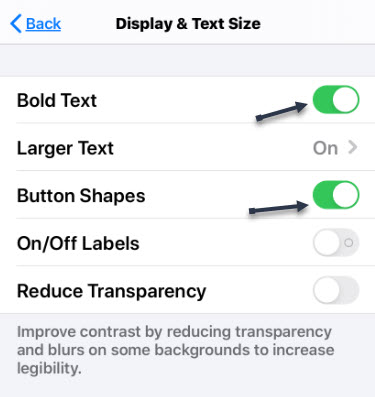
Tap Display and Text Size
See following image:
Setting the text
Bold Text option makes text easier to read without increasing its size. However, you can also tap Larger Text, and then slide the slider to increase text size. Any apps that use Dynamic Type (like most of the content on Facebook, Twitter and news stories) will apply this setting.
Button Shapes places the outline of a button beneath any text that is also a button. This can help with readability and navigation. Other options you might want to enable include:
Increase Contrast – Makes text easier to read by increasing the contrast between the foreground and background
Smart Invert – Inverts the color scheme (except on media, like photos and videos)
Classic Invert – The same as Smart Invert, except it also inverts the color scheme on media
Ensure that Auto Brightness is enabled to save battery and improve performance. Refer to below image:
Other settings
Let iPhone Read to You
Do you want to listen instead of reading? Apple’s phones and tablets include an accessibility option that will read the current screen, web page or copied text aloud. While this is an accessibility feature for the visually impaired, it has broader applications for handling written content.
To enable this feature:
Go to Settings
Tap Accessibility
Tap Spoken Content
Enable Speak Selection and Speak Screen
See following image:
Setting iPhone speech
Speak Selection toggle allows you to highlight text, and then tap Speak button to read the text . Speak Screen toggle will read the entire screen aloud whenever you swipe down from the top with two fingers. If this is proving to be probmatic as it is for me, see next paragraph for another method. Additionally, you will want to adjust SPEAKING RATE by moving the slider. See below image:
Setting the Speaking Rate
To have the Speak Screen playback controller visible, enable Speach Controller. Instead of swiping your fingers, just tap the playback button to read your content. You can drag and reposition this small box anywhere you want it. Tap it to see options to silence speech, skip backward or forward through an article, pause the speaking or increase/decrease the speed at which the text is being read. Refer to below image:
The speech playback controls
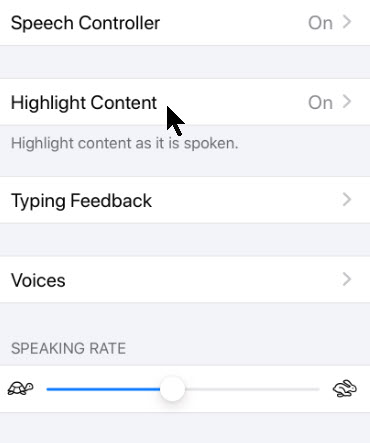
If you wish to highlight the content as it reads, enable the Highlight Content button and adjust its options. See below image:
Other options
Tap Voices to customize the voices you hear. Most voice selections require a download. The default, English, will mirror your current Siri settings. Refer to below image:
The Speak Screen feature works best when paired with Reader View. In regular view, your iPhone will also read descriptive image text, menu items, adverts, and other things that can be distracting. By triggering Reader View first, you can cut straight to the content.
Speak Screen works intuitively based on whatever is currently on the screen. For example, if you’re reading an article, and you are halfway through, triggering Speak Screen will begin reading based on how far down the page you are. The same is true for social feeds, like Facebook or Twitter.
Ask Siri for News
You can just say “give me the news” to Siri at any time to see and hear a list of headlines from the News app. You can also launch the News app (or your favorite alternative), and then have your iPhone read aloud with Speak Screen or Speak Selection. See below image:
Asking Siri for the news
Siri will give you an alternative news source to switch to, if available, and it will be remembered the next time you ask for an update.
Enable Different Modes
Using your iPhone at night in a dark room became a lot more pleasant with the arrival of Dark Mode on iOS 13+. To enable this feature:
Go to Settings
Tap Display and Brightness
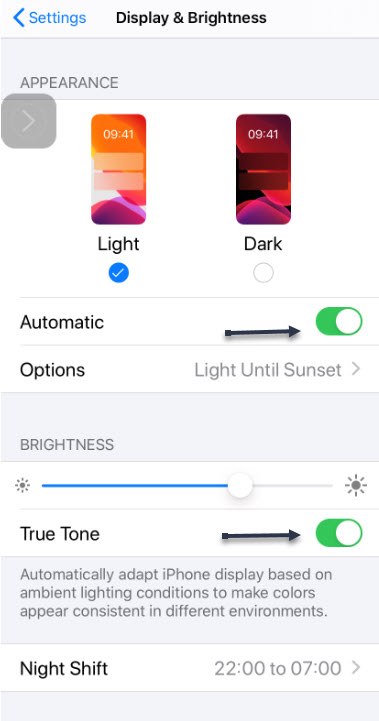
Choose Automatic to enable when it gets dark outside
Set Options to your preference
Below the Dark Mode setting option is a toggle for True Tone. If you enable this setting, your iPhone will automatically adjust the white balance onscreen to reflect your ambient environment. This means the screen will look a lot more natural. True Tone makes reading less jarring, particularly under fluorescent or incandescent lighting.
Finally, Night Shift removes blue light from the screen to simulate the setting sun, which might help your body naturally switch off at the end of the day.
Its recommended you enable all five (Automatic, Options, Dark Mode, True Tone and Night Shift) options. Refer to below image:
Enable readable options
Keep in mind that Night Shift will also change how your photos and videos are displayed until you turn it off again, so we recommend no serious editing when it’s enabled.
Please feel free to leave a comment. I would love hearing from you. Do you have a computer or smart device tech question? I will do my best to answer your inquiry. Please mention the device, app and version that you are using. To help us out, you can send screenshots of your data related to your question.
The author’s Vietnam eBook on the Battle for Tra Bong: Events and Aftermath
We are going to explore how to print to PDF while on the go, do custom printing options like labels and manage existing print jobs through AirPrint right on your iOS 13+ devices.
We are going to explore how to print to PDF while on the go, do custom printing options like labels and manage existing print jobs through AirPrint right on your iOS 13+ devices. iOS 13+ has a very robust printing subsystem that can allow you to export PDFs and more.
In this blog post, we’ll delve into how to print custom items like labels. We’ll also see how to print to PDF instead of paper and how to manage printer jobs and viewing ink supply levels.
iOS 13+ can handily help in this situation, and it works in any app that supports printing or sharing. We will be using Safari browser in our examples.
This is for Apple devices supporting iOS 13+
Copyright Scott Adams, Inc./Distributed by Universal Uclick for UFS
To print to PDF using any app that supports printing:
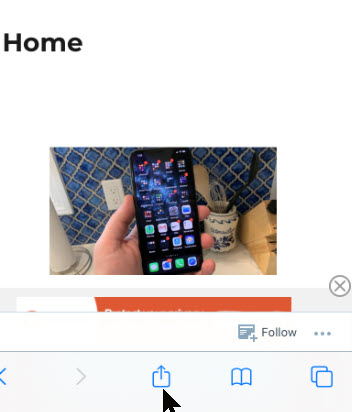
Select the Share(or Print) button in the app. When browsing in Safari, just tap the Share button in the bottom toolbar. Refer to below image:
The Share ibutton
Next, scroll down and tap Print. See below image:
The Print option
Using two fingers, pinch your fingers apart as if zooming on the Print Preview. This will generate a PDF and show a new view. Refer to below image:
Print Preview
In this Print Preview PDF view, tap the Share button in upper right-hand corner. See following image:
The Share button
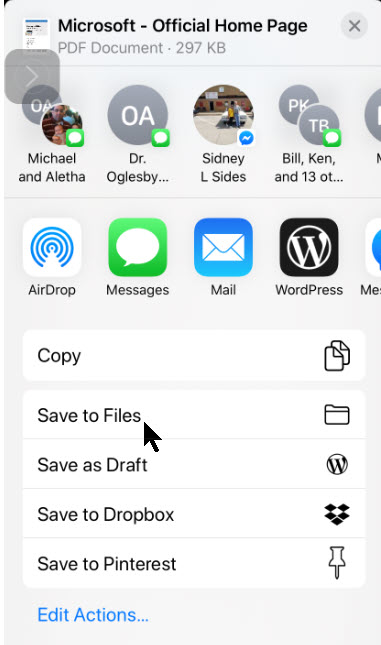
Select your choice to save the PDF to Files, send as an iMessage or an email. Refer to below image:
The Save to Files option
Sharing a PDF from Print Preview is easy and works on all apps where printing is supported.
Printing Labels
For now, the only way to print labels for contacts is through third-party apps. This feature has been built-into Macs for years.
If you are using Avery Labels for printing contact sheets, there are two apps worth mentioning. Click on the links below to download from the AppleApp Store.
Both of these apps have numerous features. You can print multiple contacts or a single contact on a sheet, select templates from Avery and others, add a graphic to your labels, design your label, manually adjust alignment, and much more.
Managing Your Print Jobs and Ink Levels
You can check the ink or toner levels to ensure you have plenty for your print project. Once you have spooled a print job, you can monitor its status or cancel it.
Check Your Ink Levels
With iOS and iPadOS you are able to view your ink or toner levels without a computer. This is easily to do.
Select the Share (or Print) button in the app. Refer to image one above.
Next, scroll down and tap Print. Refer to image two above.
Now, tap the right hand arrow beside an available printer name. See following image:
Selecting your printer
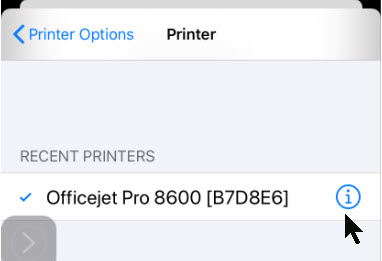
Select the “i” with an enclosed circle button beside the available printer name. Refer to below image:
Your selected printer
If there is no printer listed, you do not have a wireless printer and/or lack support for the AirPrint feature; you may skip this section. Nearly all modern day printers support AirPrint.
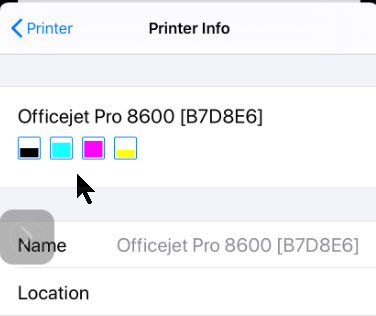
You will now be viewing the Printer Info which contains ink levels, name and location (if supplied by the printer or printer server). See following image:
Your printer ink levels
Viewing ink or toner levels can be done from the iOS or iPadOSPrint Setup dialog in any app that supports it.
Manage Print Jobs
When you print with AirPrint, you are able to manage your print jobs. Once a print job has been started, you can look at the status of the job and/or cancel the job. This can be done by opening the App Switcher (double-tap the Home button if you have one). For Face ID devices, swipe up partially on the screen, hold, then release.
You’ll see the printer job app at the top of the screen. Just tap it to see the print details like how many pages are being printed and which page is active in the queue. Tap the Cancel Printing button to stop any active print jobs. See below image:
An active print job
If the print queue is empty,, you will receive a message about no print jobs. Refer to below image:
No active print jobs
When printing in IOS or iPadOS, a new app will appear in the App Switcher for non-Face ID and Face ID devices to manage print jobs.
I have found TechSavvy.Life blog posts extremely helpful. Check them out for posts on smart phone apps, Macs and PCs!
Please feel free to leave a comment. I would love hearing from you. Do you have a computer or smart device tech question? I will do my best to answer your inquiry. Please mention the device, app and version that you are using. To help us out, you can send screenshots of your data related to your question.
The author’s Vietnam eBook on the Battle for Tra Bong: Events and Aftermath
Maybe you’d like to checkout a website without leaving a record of it on your iPhone or iPad. Safari includes a Private Browsing Mode that allows you to do this.
Maybe you’d like to checkout a website without leaving a record of it on your iPhone or iPad. Safari includes a Private Browsing Mode that allows you to do this. Lets explore this Safari feature.
While using Private Browsing Mode on your iPhone or iPad, Safari will not save your browsing history, AutoFill form information, cookie changes and recent searches when you close each Private Browsing window. We will cover this later, but its important to note that you must close each window of your private browsing session.
Private Browsing Mode does not protect your browsing history from the host of your network (such as your business or school), your ISP or websites that might use your IP address to track you.
This is for iPhone and iPad using Safari web browser
Copyright Scott Adams, Inc./Distributed by Universal Uclick for UFS
First, open Safari. You should see a toolbar at bottom of the screen, if not, tap to reveal the toolbar.
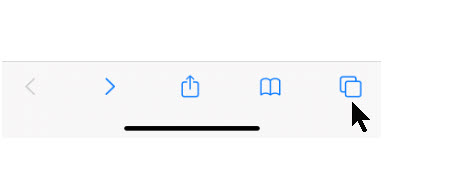
Next, tap the New Window icon in lower right hand corner. Refer to below image:
The Safari New Window icon
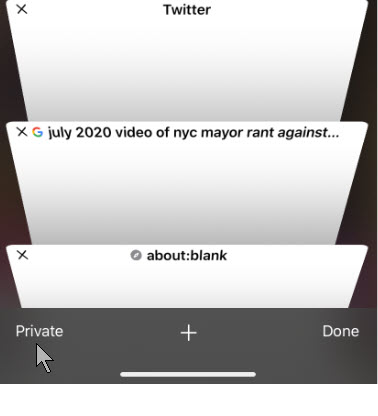
Your screen will display your open browser windows. Now, tap the Private button in lower left-hand corner. See below image:
The Safari Private button
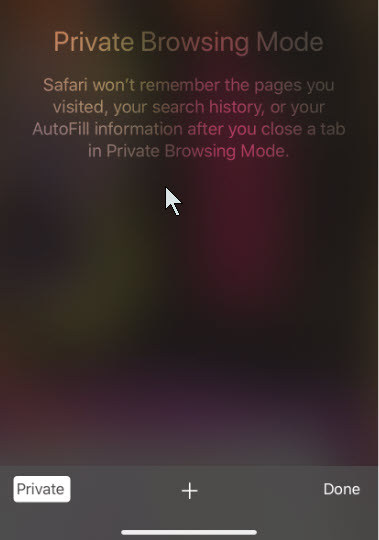
Your Private Browsing Mode is now setup. At the bottom of the screen, tap the plus “+” button to open a Private window. Note! You will not see the below screen again as long as your device is logged in, you will just go in or our of Private Browsing Mode. See following image:
To enter Private Browsing Mode., tap the plus button
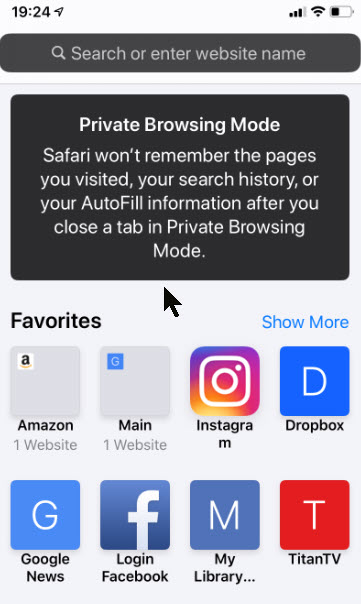
From here, you can type in an address or tap on a Favorites. In Private mode, you can use Safari as usual but it won’t track you locally. See below image:
Your Private Mode Browsing Mode entry screen
Exit Private Browsing Mode
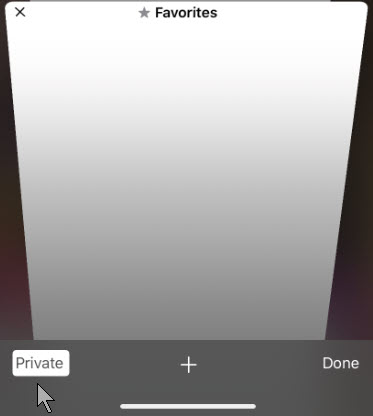
First, you need close each Private window you opened by clicking the “X” in upper left-hand corner.
Now, to exit Private Browsing Mode, tap the New Window icon, then tap the Private button in lower-left hand corner. The Private button will be in reverse color. You will be switched to non-Private Mode Browsing. Refer to below image:
Exiting Private Browsing Mode
I have found TechSavvy.Life blog posts extremely helpful. Check them out for posts on smart phone apps, Macs and PCs!
Please feel free to leave a comment. I would love hearing from you. Do you have a computer or smart device tech question? I will do my best to answer your inquiry. Please mention the device, app and version that you are using. To help us out, you can send screenshots of your data related to your question.
The author’s Vietnam eBook on the Battle for Tra Bong: Events and Aftermath





































 Tech Savvy Life