How to Recall a Sent Microsoft Outlook Message

Oops! You just sent a Microsoft Outlook message that you did not want to send. You realize for one reason or another that the message has a mistake or that it shouldn’t have been sent at all. You can fix your mistake by recalling the message. Using the recall feature, under the right conditions, your email is deleted without the recipient ever seeing the message. You can also send the recipient a replacement email with the correct information.

Oops! You just sent a Microsoft Outlook message that you did not want to send. You realize for one reason or another that the message has a mistake or that it shouldn’t have been sent at all. You can fix your mistake by recalling the message. Using the recall feature, under the right conditions, your email is deleted without the recipient ever seeing the message. You can also send the recipient a replacement email with the correct information.

For a message to be recalled, both you and the recipient must have a Microsoft 365 Business Account or Microsoft Exchange email account in the same organization. The email must not not have been read by the recipient.

However, even if you and the recipient use different email accounts, the recall feature is useful. Though the initial email won’t be deleted, the recipient receives a follow-up message indicating that you want to recall the previous email. That tells them that your initial one is incorrect for some reason. You should then follow-up your initial email and recall message with another email that contains the right information or corrects the initial one.

To summarize, three emails are involved. The initial email with incorrect information, the recall message email, then the follow-up email with the correct information.

This is for Windows 10 PCs, Macs and other devices that support Microsoft Outlook

Dilbert and Ideas
Copyright Scott Adams, Inc./Distributed by Universal Uclick for UFS

Check out TechSavvy.Life for similar blog posts!

Recall a Message

Let’s send an email. Open Outlook, start new email and address to a recipient, then send the email. Refer to below image:

Recall 1
Initial Outlook email

Now, let’s say you notice an error in your email and want to recall it. In our example, the vacation dates are incorrect.

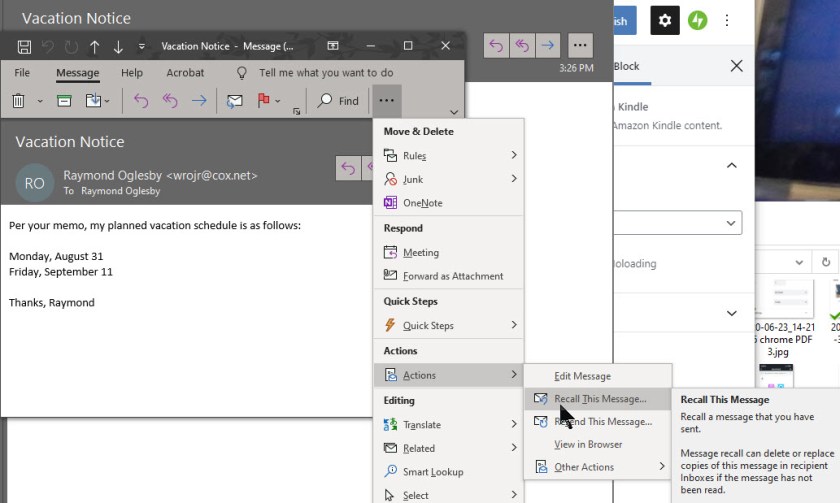
Open the email from your Sent Items folder. Select the Actions icon and click the option Recall This Message. See following image:
Recall 2
Recall initial Outlook email

The Recall This Message window opens to offer two options. Choosing Delete unread copies of this message tries to remove the message with no follow-up. Choosing Delete unread copies and replace with a new message provides the opportunity to send a follow-up message with the correct information. To learn of the recall’s success, ensure the box is checked for Tell me if the recall succeeds or fails for each recipient then click OK. Refer to below image:

Recall 3
Options for recalling initial Outlook email

If you chose the option to replace with a new message, a new email appears with the text from the initial email. You can fix any errors and send a corrected replacement message or a follow-up email with the corrected information. In my example, the recall message failed because I had already read the message. See following image:

Recall 4
Recall of initial Outlook email failed because recipent (me) had read the message

If you and the recipient use the same Microsoft 365 Business or Exchange, then the initial email should be deleted automatically. If so, you will receive an email saying the recall was successful for that recipient.

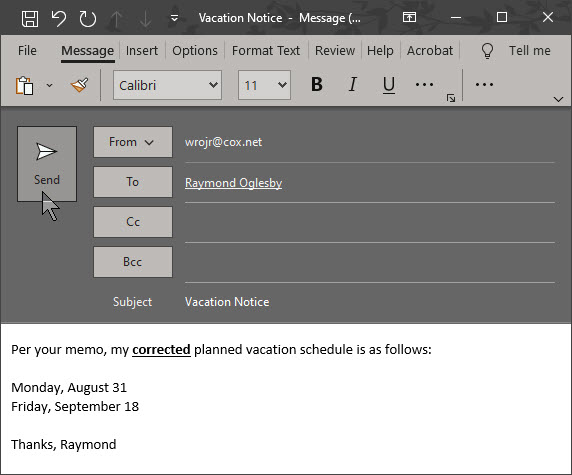
If you and the recipient use different email accounts, the initial emails remains in that person’s inbox. A follow-up email arrives that tells the recipient you would like to recall the message. You then have to rely on the recipient to delete or ignore the initial message. At this point, a third email could be sent with the corrected information. Refer to below image:
Recall 5
Corrected Outlook email

RELATED

Note! Coming soon if inactive
How to Recall an Email in Gmail

I have found TechSavvy.Life blog posts extremely helpful. Check them out for posts on smart phone apps, Macs and PCs!

I Would Like to Hear From You

Please feel free to leave a comment. I would love hearing from you. Do you have a computer or smart device tech question? I will do my best to answer your inquiry. Please mention the device, app and version that you are using. To help us out, you can send screenshots of your data related to your question.

The author’s Vietnam eBook on the Battle for Tra Bong: Events and Aftermath

How Do You Start Safari With a Blank Page?

In the “old days”, back to iPhone 4, Safari was slooooow to load. By default, Safari either loads the last page you visited or your bookmarks. This tip will start Safari with a blank page. Then you can immediately begin searching for a particular topic without having to wait for graphics and text to load or for installed apps.

This is the second post in a series on Apple iPhone and its Safari web browser. I am updating and republishing this post. I just read another long blog about how to stop Safari from opening apps upon startup. All you have to do is start Safari with a blank page. Here’s how to do this.

In the “old days”, back to iPhone 4, Safari was slooooow to load. By default, Safari either loads the last page you visited or your bookmarks. This tip will start Safari with a blank page. Then you can immediately begin searching for a particular topic without having to wait for graphics and text to load or for installed apps.

This is for iPhone, iPad, and Mac using Safari web browser

Following are the steps to do this:

  • Tap on Safari, usually located in bottom right of your Home page
  • Tap on URL field and type “about:blank” (without quotation marks)
  • Tap Go (for iOS13 or higher)
  • Tap on the bottom Share arrow icon and scroll
  • Select Add to Home Screen to create a bookmark
  • Label the bookmark to something like “Blank Safari” (without any quotation marks)
  • Tap Add (for iOS13 or higher)
  • You will see a white blank Safari icon on your Home page. If you have several pages, it will appear on an empty icon space
  • You can drag this icon to wherever you want
  • When you tap this icon, Safari will instantly load a blank page

Your blank Safari screen should look like the following image:

Safari Blank Page
Just highlight the about:blank URL and enter your search criteria.

I Would Like to Hear from You

Please feel free to leave a comment. I would love to hear from you. Do you have a computer tech question? I will do my best to answer your inquiry. Please mention the app and version that you are using. To help me out, you can send screenshots of your data related to your question.

The author’s Vietnam eBook on the Battle for Tra Bong Vietnam: Events and Aftermath

How to Record and Annouce Your Name on LinkedIn

Pronouncing a name correctly isn’t just polite. It’s a way of recognizing someone’s identity. LinkedIn has introduced a new feature that lets members add a 10-second audio recording of their name pronunciation. Other users will be able to hear the clip by pressing a small speaker icon on a member’s profile.

Pronouncing a name correctly isn’t just polite. It’s a way of recognizing someone’s identity. LinkedIn has introduced a new feature that lets members add a 10-second audio recording of their name pronunciation. Other users will be able to hear the clip by pressing a small speaker icon on a member’s profile.

To use the feature, you’ll have to record your name on a mobile device (iOS or Android), but you’ll be able to play name pronunciations on mobile or a desktop. Let’s explore how to enable this feature.

This is for devices supporting LinkedIn

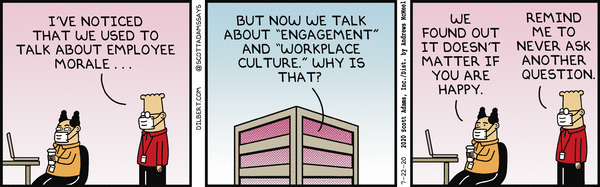
Dilbert and Morale
Copyright Scott Adams, Inc./Distributed by Universal Uclick for UFS

I like TechSavvy.Life!

Updating Your Profile

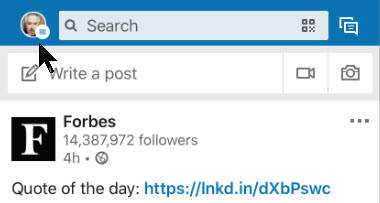
First, open the LinkedIn app on your smart device (iOS or Android). Next, from the the upper left hand corner, tap your Profile Photo. Refer to below image:

Linkedin 1
Accessing your Profile

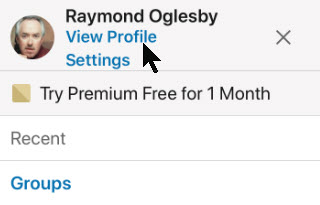
Now, in the top menu, select the View Profile blue link . See below image

Linkedin 2
Selecting viewing your Profile

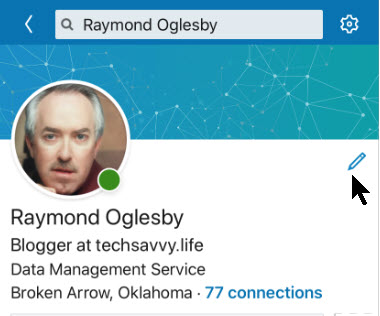
Next, tap on the Pencil icon next to your photo to edit your Profile. See following image:

Linkedin 3
Selecting edit your Profile

Next, tap on the Add Name Pronunciation blue link found under your First and Last name sections. Refer to below image:

Linkedin 4
Selecting add a recording of your name

Now, grant the LinkedIn app permission to access your smart device’s microphone. See below image:

Linkedin 5
Giving permission to access your microphone

Recording Your Name

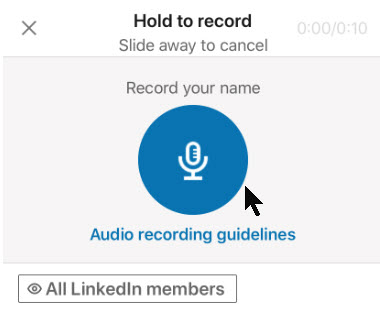
Press and hold on the blue microphone button to record your name. You have up to 10 seconds to record your first and last name. LinkedIn recommends that you limit background noise, speak slowly and pronounce clearly. Also, hold your phone about four inches from your mouth. See following image:

Linkedin 6
Recording your name

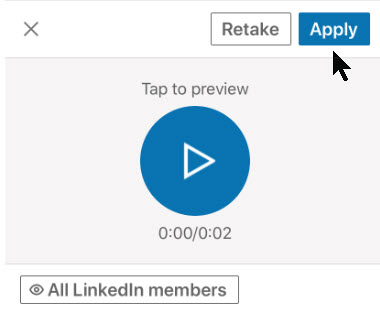
Tap the Play button to hear your audio recording played back to you. If you aren’t happy with it, select the Retake button. When you are satisfied with the recording, tap the Apply button. Refer to below image:

Linkedin 7
Saving your name recording

Choosing Your Audience

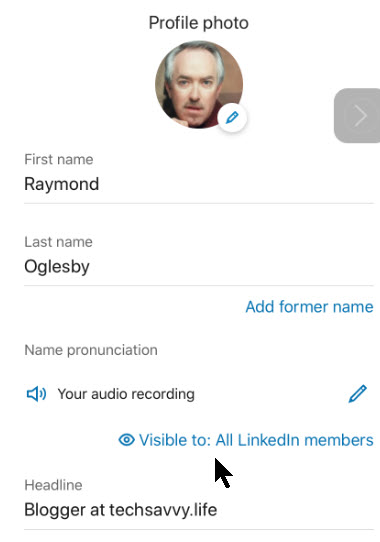
Before you leave the editing page, you can modify who can listen to your name pronunciation recording. To do so, tap the Visible To blue link at the bottom of the screen. See below image:

Linkedin 8
Accessing your audience

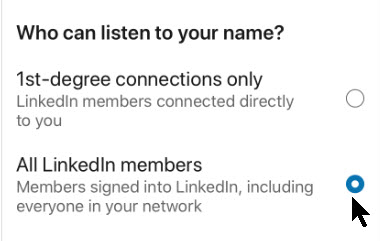
Here you have two sharing options to choose from. Either all Linkedin members can listen to your name (the default option) or only 1st-degree connections only. See following image:

Linkedin 9
Selecting your audience

Saving Your Changes

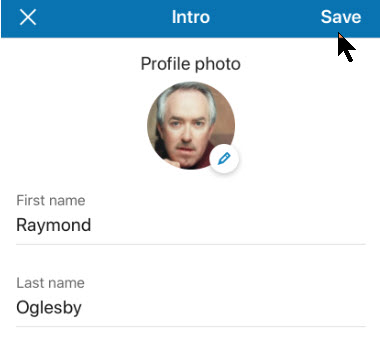
When you’re all set to exit the LinkedIn profile editing process, in the top right hand corner, tap the Save button. Refer to below image:

Linkedin 10
Saving your changes

View and Test Your Recording

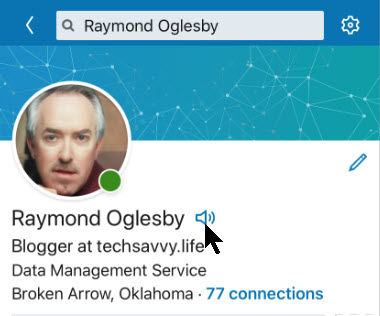
Now, you (or someone else) should see the tiny Audio icon next to your profile name. Select the icon to hear your name pronunciation. See following image:

Linkedin 11
Testing your name recording

That its. You and those you have selected can now hear the proper annunciation of your name.

I find TechSavvy.Life blog posts extremely helpful!

I Would Like to Hear From You

Please feel free to leave a comment. I would love hearing from you. Do you have a computer or smart device tech question? I will do my best to answer your inquiry. Please mention the device, app and version that you are using. To help us out, you can send screenshots of your data related to your question.

The author’s Vietnam eBook on the Battle for Tra Bong: Events and Aftermath

How to Turn Off AutoFit Table Columns Feature in Word

Microsoft Word will auto adjust table column widths to fit the content you are entering. This is the default setting for a Word table. There are times you may not want this, instead, you want to control the column widths.

The default setting may push the table beyond the right margin or a column widens unnecessarily.

So, let’s see how to turn off AutoFit option and do table adjustments yourself.

This is for Office 365 Microsoft Word on PCs, Macs and similar platforms. Other versions of Word will be similar.

Dilbert and Security
Copyright Scott Adams, Inc./Distributed by Universal Uclick for UFS

Turn Off AutoFit Feature

To turn off this feature, first, place your cursor anywhere in the table you want to change.

Next, go to the Layout tab located in right hand side, not to be confused with the other Layout tab to the left side of the screen. Note! This option only appears when you are in a table. Refer to below image:

Word AutoFit 1

Now, click AutoFit and select the Fixed Column Width option. See below image:

Word AutoFit 2

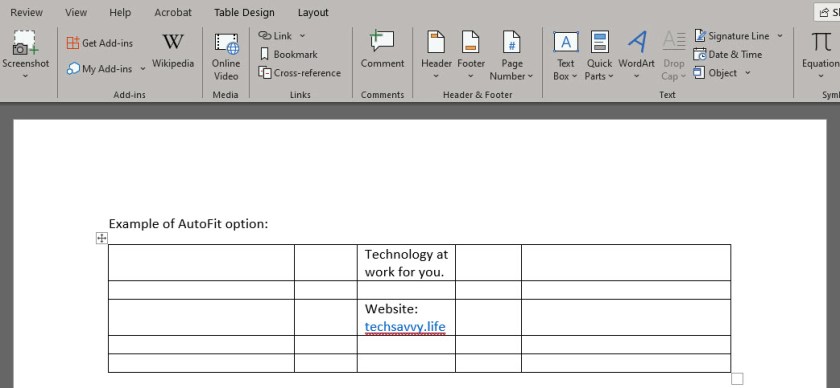
You can now drag the column borders to your desired width. The column borders you set will stay that way even if you enter longer text into them. See following image:

Word AutoFit 3

Now, you can control Word’s table column widths. That’s it.

I Would Like to Hear From You

Please feel free to leave a comment. I would love hearing from you. Do you have a computer or smart device tech question? I will do my best to answer your inquiry. Please mention the device, app and version that you are using. To help us out, you can send screenshots of your data related to your question.
The author’s Vietnam eBook on the Battle for Tra Bong: Events and Aftermath

How to Add Captions in Word

Word’s Caption feature allows you to insert captions after figures, tables or equations in your document. You can choose to have Word insert them automatically or do it yourself manually. Lets learn how to add and edit captions to set apart elements in your document.

You are not limited to figures, tables or equations; you can create a new label like Picture or Photo. If you are using Chapters in your document, you can add the Chapter number to your caption. Almost any object or inserted item in Word can be captioned.

This is for PCs, Macs and similar platforms that support Microsoft Word

Dilbert and Blockchain
Copyright Scott Adams, Inc./Distributed by Universal Uclick for UFS

Add a Caption

There are two ways to add a caption:

  1. Select the figure/table/equation, right click and select Insert Caption. (Note! This method works only for figures and tables, not equations.)
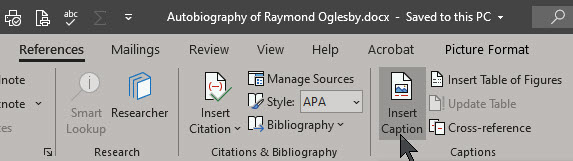
  2. Select the figure/table/equation, go to the References tab on the ribbon and select Insert Caption. See below image:
Word Caption 1

If you don’t select the object and choose References > Insert Caption the caption will be inserted where the cursor is placed.

Your Caption Options

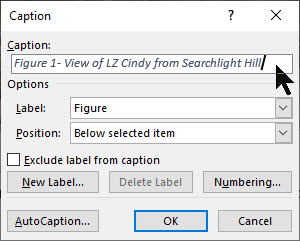
The Caption dialog box will now open, with a number of options for you to set. Refer to below image;

Word Caption 2

Below are the options to chose from:

Captions – type in the label you want

Label – or more correctly caption prefix.  Choose table, equation or figure. This will automatically add that label to the caption.

New Label – If you want your captions to have a label other than the ones provided, you can add a new one from the New Label option. (For example, Word provides the options Equation, Figure and Table, but if you are including photos in your document, you may prefer to label them Picture or Photo.)

Exclude Label from Captions – check this box and no label/prefix will be included. The caption will just contain the number and the text that you enter.

Position – caption to appear above or below the object. Only works if the object is selected before Insert Caption. Otherwise this field will be disabled and the caption placed where you have set your cursor.

AutoCaption certain types of objects can be automatically captioned when they are included in a document.

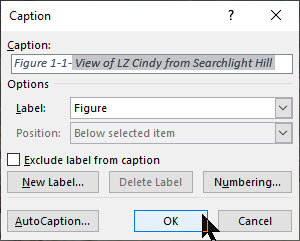
The caption will now appear in the specified location, with its number automatically allocated. See following image:

Word Capture 3
Figure 1- View of LZ Cindy from Searchlight Hill

Numbering Options for Your Captions

If you want to change the format of the numbering system on your captions, do this by clicking the Numbering button in the Caption dialog box. Refer to below image:

Word Capture 4

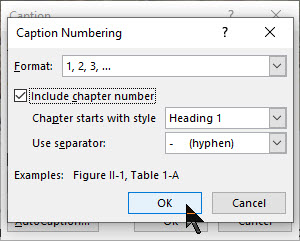
The Caption Numbering dialog box will open. See below image:

Word Capture 5

Format: Choose the numbering format you want to use:

  • Numerals (1, 2, 3, 4…)
  • Lowercase letters (a, b, c, d…)
  • Uppercase letters (A, B, C, D…)
  • Lowercase Roman numerals (i, ii, iii, iv…)
  • Uppercase Roman numerals (I, II, III, IV…)
  • And others depending on the installed language packs.

Include Chapter Number: If your document contains chapters, you can choose to have the numbering restart for each chapter and have the chapter number included in the caption numbering system.

First select the Caption in your Word document. Then you need to link the Style (e.g. Heading 1) with a multi-level list at Home > Paragraph > Multi-Level List > Define Multi-Level List > More. This adds automatic numbering to each style so the captions have a number to show. See following image;

Word Capture 6

Chapter Starts with Style: Select what level of heading you would like to signify a new chapter.

Use Separator:  Choose the separator that you would like to use between the chapter number and the caption number (hyphen, period, colon or em-dash).

Change Your Caption Settings

Changing the caption settings isn’t obvious because right-clicking doesn’t show an option to open the Caption dialog.

The trick is to select the whole caption then References > Captions > Insert Caption. Refer to below image:

Word Caption 7

This opens the Caption dialog with the current settings.

Updating Your Caption Numbering

At the core of captions are field codes. Updating the caption numbering is the same as any other field code updates.

Select the whole document with Ctrl+A then update fields with F9 (or right-click to choose Update Field).

Change Your Caption Text

The text after the caption label can be edited in the document. Just click in the caption text and type as usual. See following image;

Word Caption 8

I Would Like to Hear From You

Please feel free to leave a comment. I would love hearing from you. Do you have a computer or smart device tech question? I will do my best to answer your inquiry. Please mention the device, app and version that you are using. To help us out, you can send screenshots of your data related to your question.
The author’s Vietnam eBook on the Battle for Tra Bong: Events and Aftermath

How to Backup Facebook Photos and Videos

You have searched for a favorite photo or video on Facebook but are unable to locate it. Facebook has an option to backup most anything saved through its app. This would allow for easier searching instead of scrolling endlessly through Facebook posts.

You may have decided to deactivate your account for health reasons or you just want a backup. There is no such thing as “too many backups”. In my IT career, I have been “burned” by not having adequate backups resulting in lost time in recreating them.

Depending on how long you have been a Facebook user, the backup file can be quite large. If you have limited storage or on a free storage plan for your mobile device, you might consider backing up to a PC or Mac.

Using this post as a guide, I am backing up thirteen years of Facebook photos and videos on a Windows 10 PC. My backup file, in Zip format, was a 1.4 GB file.

This is for PCs, Mac, mobile devices and similar platforms using Facebook

Dilbert and Coronavirus
Copyright Scott Adams, Inc./Distributed by Universal Uclick for UFS

Accessing Facebook Settings

Launch Facebook. in the upper right hand corner, click on the Account icon. Next, click the Settings & Privacy option. See below image

Facebook Photo Backup 1
The Settings and Privacy option

Next, click on the Settings option. Refer to below image:

Facebook Photo Backup 2
The Settings option

Downloading Your Facebook Information

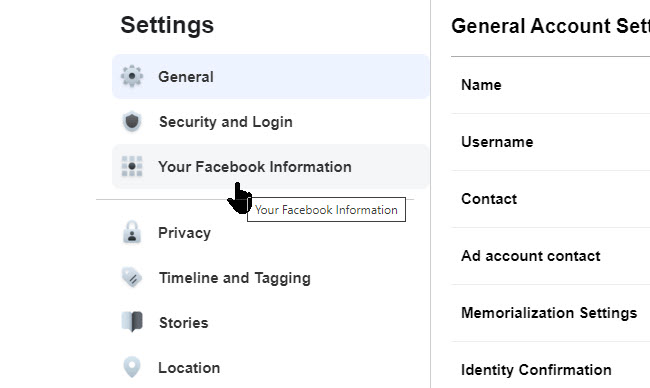
Then click on Your Facebook Information. See following image:

Facebook Photo Backup 3
The Facebook Information option

Next, click on Download Your Information. See below image:

Facebook Photo Backup 4
Download your information option

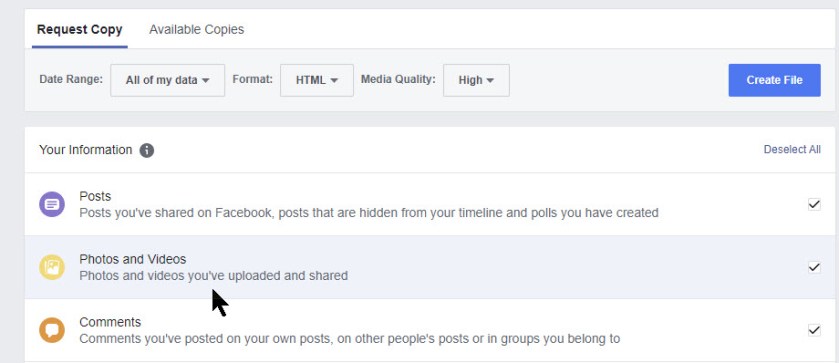
Selecting ONLY Photos and Videos

From here, click on Deselect All link. Then select only Photos and Videos option. From this screen there are many options on what to backup. For our purposes, we only want photos and videos. Refer to below image:

Facebook Photo Backup 5
Deselecting all, then selecting only photos and videos option

Once photos and videos have been selected and all other option are unselected, click the Create File button. See below image:

Facebook Photo Backup 6
Clicking the Create File option

Messages and Emails From Facebook

You will receive a pop-up message regarding the creation of your Facebook backup for photos and videos. Refer to below image:

Facebook Photo Backup 7
Facebook response to iyour request

Check your email that is associated with your Facebook account for the file request. See below image:

Facebook Photo Backup 8
Email from Facebook about your request

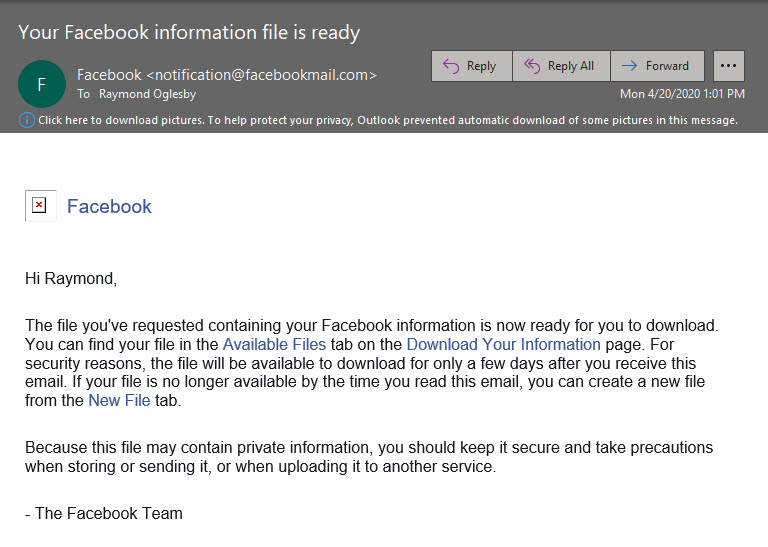
It may take several hours for Facebook to process your request. When the file is ready, you will receive an email that your file is ready. Follow the directions in the message. Refer to below image:

Facebook Photo Backup 9
Email from Facebook that your backup file is ready

Downloading Your Photos and Videos Backup

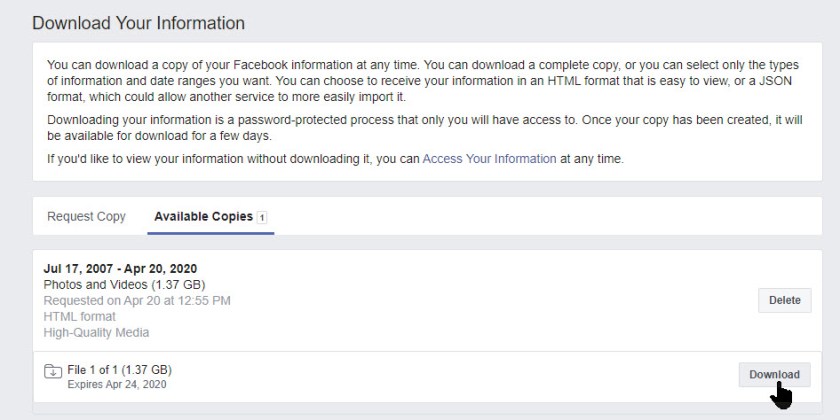
Click on the link for Download Your Information. Then, click the Available Copies tab. You should see information about your download file. Now, click the Download button. See following image:

Facebook Photo Backup 10
Download option to your Downloads folder

Facebook will ask you to enter your Password, then click Submit. See below image:

Facebook Photo Backup 11
Submitting your password

Viewing Your Downloaded Zip File via File Explorer

Your photos and videos backup file will be in your Downloads folder in Zip format. Below is a screenshot of my backup file. Notice it contains over 3000 files. Your backuped file number will depend on how often you post photos and videos and how many years on Facebook. Refer to below image:

Facebook Photo Backup 12
An example of your downloaded Facebook photos and videos file

What I would like to see is an option to select a date range for the backup instead of everything.

I Would Like to Hear From You

Please feel free to leave a comment. I would love hearing from you. Do you have a computer or smart device tech question? I will do my best to answer your inquiry. Please mention the device, app and version that you are using. To help us out, you can send screenshots of your data related to your question.
The author’s Vietnam eBook on the Battle for Tra Bong: Events and Aftermath

How to Remove Malware for Windows

If your Windows computer is being redirected to unwanted sites, advertisements are popping up while you browse the Internet, or a message saying a virus was detected, then it is possible that you have malware installed on your computer.

This is for Windows 7 through 10, also applies to Macs and mobile devices. The wording in this post is for Windows 10

Dilbert and Parents
Copyright Scott Adams, Inc./Distributed by Universal Uclick for UFS

Malware refers to any type of malicious software that tries to infect a computer or mobile device. Hackers use malware for any number of reasons such as, extracting personal information or passwords, stealing money or preventing owners from accessing their device.

Malware includes computer viruses, ransomware, worms, trojan horses, rootkits, keyloggers, dialers, spyware, adware, malicious BHOs, rogue security software and other malicious programs. The majority of malware threats are usually worms or trojans rather than viruses.

Following are some examples of an infected PC:

  1. Your web browser (e.g., Microsoft Internet Explorer, Mozilla Firefox, Google Chrome) freezes, hangs or is unresponsive
  2. You get redirected to web pages other than the one you intended to go to
  3. You receive numerous web-browser popup messages
  4. Strange or unexpected toolbars appear at the top of your web browser
  5. Your computer runs slower than usual
  6. Your computer freezes, hangs or is unresponsive
  7. Your computer restarts by itself (but not a restart caused by Windows Updates)
  8. You see unusual error messages (e.g., messages saying there are missing or corrupt files folders)

For several months, I had malware that crashed my PC on a daily basis. I read lots of help articles and followed its advice. I soon came to realize that no one piece of software will remove the malware. In my case, the virus would attach itself to a Dell executable (exe) file. I located the suspected file and renamed it, no luck here. So, I deleted the file; the suspected file would recreate itself with the virus attached. I did a scan of the Registry to find the infected file, it was not found. What the heck is going on? Then I came across an in-depth article on removing malware. In summary, to remove the malware, perform the following:

Restart your machine and stop all running programs

Download, install and run the following programs one at a time in order as shown below. There is a free or trial version for each software. Do not install any third-party tools associated with the installs. The softare title and links are as follows:

Malwarebytes

Avast

HitmanPro

Zemana

Now, restart your machine. The malware should be eliminated. Since this is a one-time removal, uninstall each program. If left installed and active, they will interfere with each other and cause other problems.

I Would Like to Hear From You

Please feel free to leave a comment. I would love hearing from you. Do you have a computer or smart device tech question? I will do my best to answer your inquiry. Please mention the device, app and version that you are using. To help us out, you can send screenshots of your data related to your question.
The author’s Vietnam eBook on the Battle for Tra Bong: Events and Aftermath

How to Use Word AutoText Feature

Creating and using custom AutoText entries for frequently used phrases is a great way to speed up your content creation in Microsoft Word. By default, Word has very few entries so you may want to add your own. The good news is you can set up these time-savers in just a few clicks!

The software does come with lots of AutoText Document fields, like Author, Company Info, Status and other built-in entries such as Headers, Footers, Tables, Watermarks, etc., that you can choose for your document. You can use these entries in addition to your own AutoText entries for your documents.

Note! Your AutoText entries maintain its formatting when inserted into a document.

This is for PCs, Macs and other platforms that support Word

Dilbert and Evolving Ted Talks
Copyright Scott Adams, Inc./Distributed by Universal Uclick for UFS

Creating an AutoText Entry

To begin, highlight the text in your Word document that you’d like to use to create your new AutoText entry. Refer to below image:

Word AutoText 1
Selecting the text for your AutoText entry

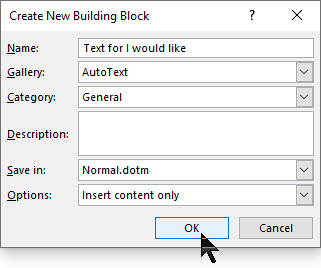
Press Alt+F3 to open the Create New Building Block window. Then, type in a name (within the 32-character limit) for your AutoText entry. Next, click OK. See following image:

Word AutoText 2
Saving your AutoText entry

Your AutoText entry will be saved. Now that was easy.

Using an AutoText Entry

To use your AutoText entry, place your cursor where you want to insert the text in your Word document. Navigate to the Insert tab and click the Explore Quick Parts icon in the Text group. See below image:

Word AutoText 3
Accessing your AutoText

A drop-down menu will be displayed. Hover your pointer over AutoText. Refer to below image:

Word AutoText 4
Selecting the AutoText feature

A list of AutoText entries will appear. Select the one you want to use. See below image:

Word AutoText 5
Inserting your custom AutoText entry

The entry you selected will be inserted into your document.

Deleting an AutoText Entry

If your AutoText list is getting crowded, or you made a mistake when you created a custom entry, you can delete them.

To do so, go back to the Insert tab and select the Text group. Then click the Explore Quick Parts icon, and then hover your pointer over AutoText.

From here, right-click the AutoText entry you want to delete. In the context pop-up menu that appears, click the option Organize and Delete. Refer to following image:

Word AutoText 6
Accessing the Delete option

The Building Blocks Organizer window will be displayed with your AutoText entry highlighted. At the bottom of this dialog box, click on Delete. See below image:

Word AutoText 7
The delete button at the end of the AutoText entries

A message box will appear asking you to confirm the deletion of your entry. To delete this entry, click Yes. Refer to below image:

Word AutoText 8
Confirming your custom AutoText deletion

Now your entry will be deleted. You have successfully adding, inserted and deleted an AutoText entry. That’s it.

I Would Like to Hear from You

Please feel free to leave a comment. I would love hearing from you. Do you have a computer or smart device tech question? I will do my best to answer your inquiry. Please mention the device, app and version that you are using. To help us out, you can send screenshots of your data related to your question.
The author’s Vietnam eBook on the Battle for Tra Bong: Events and Aftermath

How to Check Your Hard Drive Status

Your hard drive has been acting strange. It’s making clicking or screeching sounds, it’s unable to find files, crashes on boot, slow transfer speed or seems to be moving slowly. Your hard drive is dying.

Since it is a mechanical device it has moving parts unlike a Solid State Device (SSD) which has none. But even a SSD will eventually fail.

Even if your hard drive is healthy, over time, it will die. You should keep an eye on it’s health once in a while for your peace of mind. Let’s see how to do this.

This is for Windows 10 devices and Macs

Copyright Scott Adams, Inc./Distributed by Universal Uclick for UFS

To Tweet about this post, click the Tweet icon below to launch Twitter, then click its Tweet icon to post.

Check out TechSavvy.Life for their blog posts on smartphone apps, PCs. and Macs!

The Drive’s SMART Status

Most modern drives have a feature called S.M.A.R. T. (Self-Monitoring, Analysis and Reporting Technology) that monitors different drive attributes in an attempt to detect a failing disk. That way, your computer will automatically notify you before data loss occurs and the drive can be replaced while it still remains functional.

Check in Windows

In Windows 10, you can manually check the S.M.A.R.T. status of your drives from the Command Prompt. Just right-click the Start button, select Run, and type “cmd“, then click OK or type “cmd” into the Cortana search bar, then click OK. In the Command Prompt pop-up box, type:

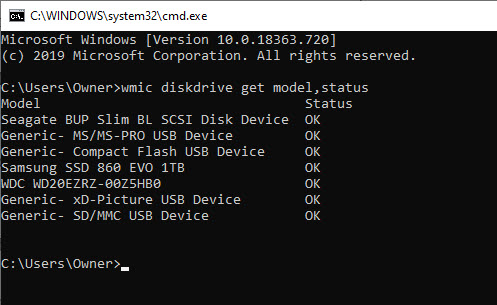
wmic diskdrive get model,status

It will return “Pred Fail” if your drive’s death is imminent; “Bad”, “Unknown” or “Caution” if its time to take care of a drive or “OK” if it thinks a drive is doing fine. Refer to below image:

Hard Drive Status
Checking your hard drives health

Check on a Mac

On a Mac, you can check S.M.A.R.T. status by opening the Disk Utility program, clicking on the drive and looking at “S.M.A.R.T. Status” in the bottom left, which will either read “Verified” or “Failing”.

SMART Status can be Misleading

However, this basic S.M.A.R.T. information can be misleading. You only know when your drive is near death, but you can start to experience problems even if the basic S.M.A.R.T. status is okay.

You can also use Defraggler program I discussed in a previous post. When you use the Analyze feature of the program, it will show your disk health. Click here for the post on using Defraggler.

Manufacture Check

If you want an even deeper, more accurate picture into your drive’s health, check its manufacturer’s website for a dedicated tool; for example, Seagate has SeaTools for its drives, Western Digital has Data Lifeguard Diagnostic for its drives and Samsung has Samsung Magician for its SSDs. These tools can sometimes take into account certain technologies specific to their hard drives and SSDs.

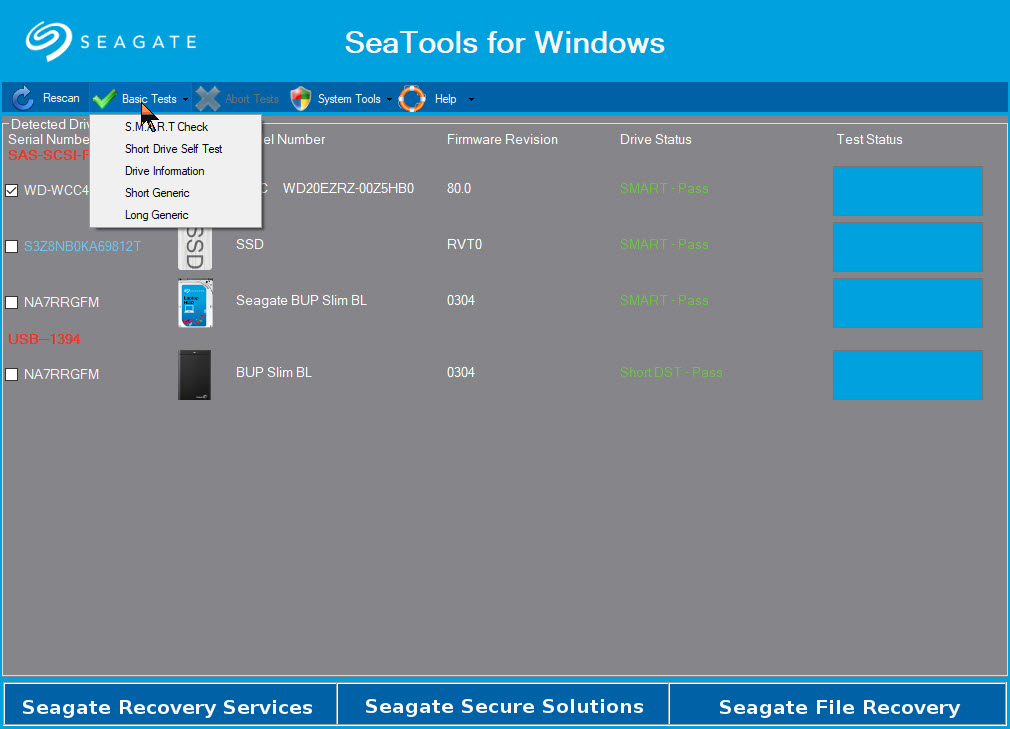
Note! You may find that the SeaTools (Seagate) utility is the only software you will need. In the below image, it can diagnose Samsung, Western Digital as well as Seagate using several methods:

Hard Drive Status 2
SeaTools for Windows options

Is Your Drive Almost Dead

Drives with the “Pred Fail” status won’t necessarily fail tomorrow. They could chug along for a year or be dead as a doornail in a few days if not hours.

If you’re getting warnings, it’s time to back up your files before your drive fails. Failure to act may cost you serious money to recover your data.

Now is not the time for a full backup, however: you don’t want to stress the drive with too many reads or it could fail while you’re backing up. Instead, plug in an external drive and copy your most important files onto it; family photos, work documents and anything else that can’t easily be replaced. Then, once you know those are safe, you can try doing a full drive clone with something like EaseUS Todo Backup Free.

I got a S.M.A.R.T. status of “Pred Fail” on my main hard drive. I quickly backed up my important files to an external drive. I never finished before it died. I tried the trick off turning my desktop on its side, then upside down. I got a little more life from the hard drive. Then I removed the hard drive and gently shook the device. I could hear the spindle sliding; then I knew if was totally dead. But it’s worth trying this trick.

Is Your Drive Dead

If your hard drive has already stopped working, things get a lot tougher and you’ll probably need a professional data recovery service which can cost $1,000 or more. But if you have pricelrss data on the drive, it may be worth it to you.

Prepare for Hard Drive Failure

It’s not a matter of “if” your hard drive will fail; it’s a matter of “when”. All hard drives fail eventually and if you want to avoid losing all your important files, you absolutely have to back up your computer regularly; including when the drive is healthy.

Take some time to set up an automatic, cloud based backup like Google Backup and Sync using Google Drive. It is one of the best things you can do to protect yourself from heartache later on. Or at least back up to an external drive using Windows 10 built-in File History Tool.

If your drive failed catastrophically with no warning, you can get back up and running in no time by having an up-to-date backup.

That’s it. Please feel free to share this post! One way to share is via Twitter, as mentioned below.

I hope you have found this post helpful. If so, click the Tweet icon below. This will launch Twitter where you click its icon to post the Tweet.

I have found TechSavvy.Life blog posts extremely helpful. Check them out for posts on smart phone apps, Macs and PCs!

The following is a previous Twitter feed so you can view how a Tweet will be displayed.

Display of your Tweet

I Would Like to Hear from You

Please feel free to leave a comment. I would love hearing from you. Do you have a computer or smart device tech question? I will do my best to answer your inquiry. Please mention the device, app and version that you are using. To help me out, you can send screenshots of your data related to your question.

The author’s Vietnam eBook on the Battle for Tra Bong: Events and Aftermath

How to View Excel Statistics

Microsoft Excel is getting a quick summary view of workbook statistics. This simple dialog box includes the boundaries of the sheets, tables, links, formulas and notes.

In a couple of clicks you can now view the workbook statistics.

This is for Excel in Office 365 on PCs and Macs

Dilbert and Data
Copyright Scott Adams, Inc./Distributed by Universal Uclick for UFS

First, open an existing Excel workbook. Navigate to the Review tab and click on it. In the menu bar, head to the Proofing group. You will see the icon Workbook Statistics, just click on it to view. Refer to below image:

Excel Workbook Statistics 1

There are details for current sheet and the entire workbook. It is similar to Microsoft Word’s Word Count feature.

I Would Like to Hear From You

Please feel free to leave a comment. I would love hearing from you. Do you have a computer or smart device tech question? I will do my best to answer your inquiry. Please mention the device, app and version that you are using. To help us out, you can send screenshots of your data related to your question.
The author’s Vietnam eBook on the Battle for Tra Bong: Events and Aftermath