I am Raymond Oglesby, an Information Technology (IT) specialist with 30 years in the field. I have taught Microsoft Applications and troubleshot computers in 15 countries and many States. My career was focused on mainframes and desktops from application development to implementation. I have written hundreds of programs for various architectures. I decided to start a blog to share my knowledge and experiences with you. I plan on updating this blog at least twice a week about smart phone apps to Windows.
Please feel free to leave a Comment or Tweet. I would love to hear from you. Do you have a computer tech question? I will do my best to answer your inquiry. Please mention the app and version that you are using. To help me out, you can send screenshots of your data related to your question.
Tired of getting robocalls all day long on your iPhone? Your iPhone lets you silence the harassment by turning on a feature called Silence Unknown Callers in Settings.
Tired of getting robocalls all day long on your iPhone? Your iPhone lets you silence the harassment by turning on a feature called Silence Unknown Callers in Settings. Let’s explore this nifty feature.
This is for the iPhone
Copyright Scott Adams, Inc./Distributed by Universal Uclick for UFS
What is an Unknown Caller
On your iPhone, an unknown caller is someone who is not in your Contacts list, which is an address book stored on your device that can be accessed through the Phone or Contacts apps. If you have called a number recently, your iPhone will not consider that number an unknown caller if they call you back.
Apple includes a feature with iOS 13 and up that allows you to silence rings and notifications from unknown callers, which is covered below. This does not include numbers you have called recently. Otherwise, if you want a caller not to be considered unknown (and thus not be silenced) you will need to add the number to your iPhone’s Contacts.
How to Silence Unknown Callers
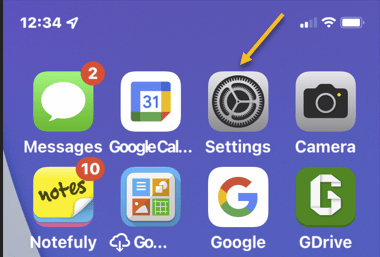
First, to silence these calls, open Settings on your iPhone by tapping the grey gear icon on your Home screen. Refer to the below image:
Accessing Settings
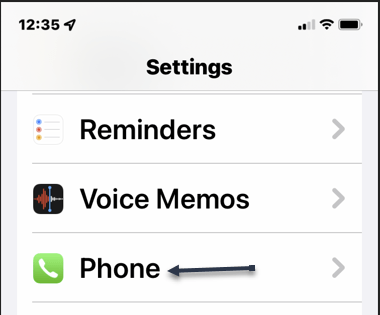
Next, in Settings, scroll down and tap Phone. See the below image:
Accessing Phone option
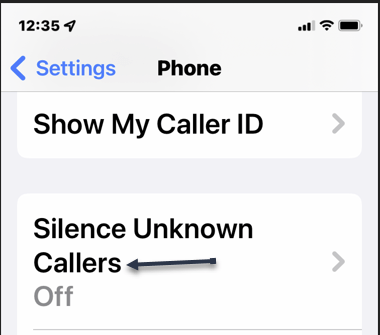
Now, in Phone settings, tap SilenceUnknown Callers. See the following image:
Accessing Silence Unknown Callers option
Next, in Silence Unknown Callers settings, enable the switch beside Silence Unknown Callers to ON. Refer to the below image:
Enable Silence Unknown Callers
Now, exit Settings. The next time you get a call from an unknown number, you will not hear a ring or a notification sound. The call will be sent to voicemail, and it will appear in your recent calls list in the Phone app. You may still get a notification if the caller leaves a voicemail.
If you are expecting an important call from an unknown number in the future, open
Settings > Phone > Silence Unknown Callers
and then switch Silence Unknown Callers to OFF. Incoming calls will no longer be silenced.
Quote For the Day
Only when the tide goes out do you discover who’s been swimming naked.
Warren Buffett
That was easy. Please feel free to share this post! One way to share is via Twitter.
Just click the Tweet icon below. This will launch Twitter where you click its icon to post the Tweet.
Checkout TechSavvy.Life for blog posts on smartphones, PCs, and Macs! You may email us at contact@techsavvy.life for comments or questions.
Please feel free to leave a comment. I would love to hear from you. Do you have a computer or smart device tech question? I will do my best to answer your inquiry. Just send an email to contact@techsavvy.life. Please mention the device, app, and version you are using. To help us out, you can send screenshots of your data related to your question.
The author’s Vietnam eBook on the Battle for Tra Bong Vietnam: Events and Aftermath
Want to change your cover image or add one to your Twitter account? If you have not inserted an image, you will see a blue blank area at top of your account.
Want to change your cover image or add one to your Twitter account? If you have not inserted an image, you will see a blue blank area at top of your account. Let’s explore how to add a cover image.
This is for devices using Twitter. Screenshots are from iPhone XR.
Copyright Scott Adams, Inc./Distributed by Universal Uclick for UFS
First, log in to Twitter, if not already logged in, and open Twitter. Here, tap your Profile icon. Refer to the below image:
Selecting your Profile icon
Next, in the pop-up window that opens, tap on Profile. See the below image:
Selecting the Profile option
Now, in the upper right-hand corner, tap the Edit profile link. See the following image:
Selecting Edit Profile link
Next, tap on the top of your screen or on an existing image to open your Photos. (On the desktop, click the Camera icon in the image area). Depending on your Twitter settings, you may not see any images. If so, tap on Manage to change your settings or the plus “+” sign to open your photos. Refer to the below image:
Selected image from Photos
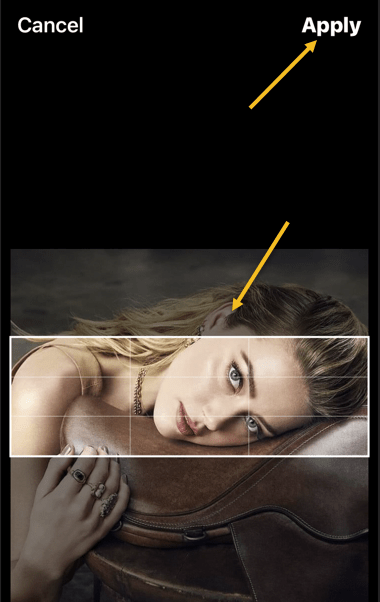
Now, position your image to your liking. Then in the upper right-hand corner, tap Apply. See the below image:
Position your image and Apply
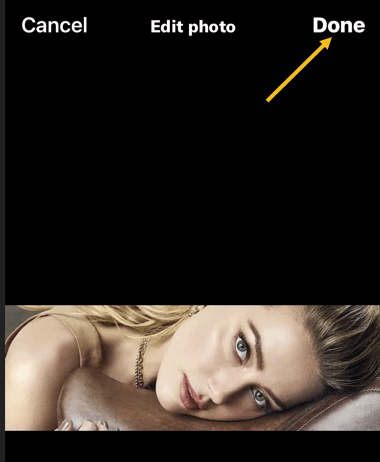
Next, in the upper right-hand corner, tap Done. See the following image:
Finish your change
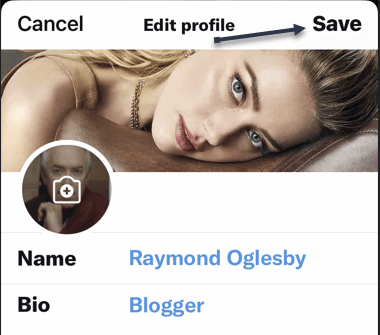
Now, tap Save in the upper right-hand corner. Refer to the below image:
Save your change
Instantly, your saved image is now your cover photo. See the below image:
Your finished image
Quote For the Day
We become what we repeatedly do.
Stephen Covey
That’s it. Please feel free to share this post! One way to share is via Twitter.
Just click the Tweet icon below. This will launch Twitter where you click its icon to post the Tweet.
Checkout TechSavvy.Life for blog posts on smartphones, PCs, and Macs! You may email us at contact@techsavvy.life for comments or questions.
Please feel free to leave a comment. I would love to hear from you. Do you have a computer or smart device tech question? I will do my best to answer your inquiry. Just send an email to contact@techsavvy.life. Please mention the device, app, and version you are using. To help us out, you can send screenshots of your data related to your question.
The author’s Vietnam eBook on the Battle for Tra Bong Vietnam: Events and Aftermath
You may already be familiar with Microsoft Word’s built-in spelling and grammar checker, flagging incorrect spelling, and (sometimes) bad grammar. If you are reviewing a document that’s riddled with errors, you can use these keyboard shortcuts to speed up the process.
RAYMOND OGLESBY @RaymondOglesby2 January 20, 2022 Updated: January 21, 2022
You may already be familiar with Microsoft Word’s built-in spelling and grammar checker, flagging incorrect spelling, and (sometimes) bad grammar. If you are reviewing a document that’s riddled with errors, you can use these keyboard shortcuts to speed up the process. Let’s explore using these shortcuts.
This is for devices using Microsoft Word
Copyright Scott Adams, Inc./Distributed by Universal Uclick for UFS
What the Checker Can and Can Not Do
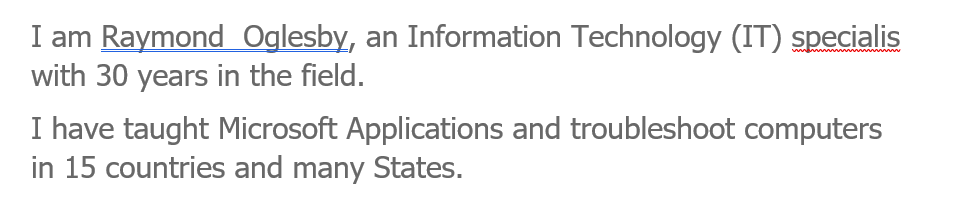
Word’s spelling and grammar checker is enabled by default. When a word is misspelled, Word flags it with a wavy, red underline. When there’s incorrect grammar or formatting, Word flags it with two blue underlines. Refer to the below image:
Spelling and Grammar example
In the above example, Word detected two spaces between “Raymond” and “Oglesby,” so it flagged it as a grammar issue. It also detected “specialist” was misspelled as “specialis,” so it flagged that as a spelling error.
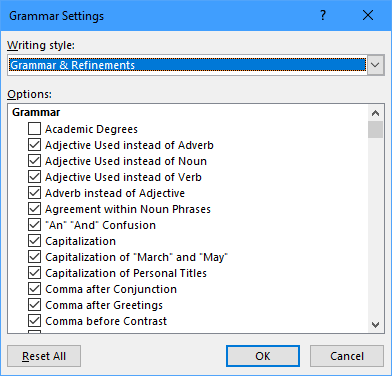
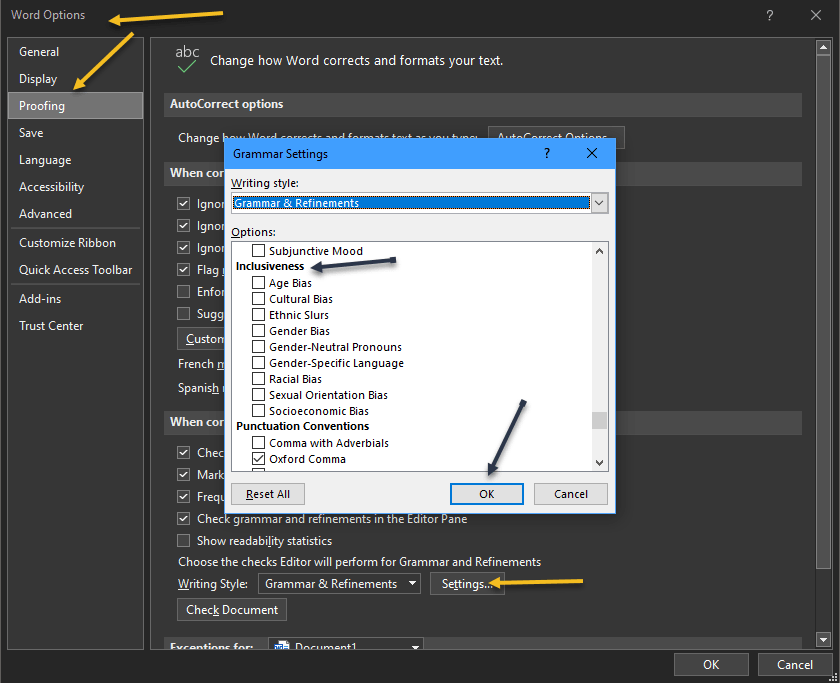
These are the basics that Word checks for by default. However, you can make Word’s spelling and grammar checker work harder by enabling some additional features in its Settings menu. Head to:
File > Options > Proofing > Settings
For example, you can have Word check for passive voice, split infinitives, superfluous expressions, and so on. See the below image:
Grammar Settings
If you scroll down, you can check for more grammar options, such as Inclusiveness:
More Grammar settings
You can also do things like, exclude specific words from the checker, check for inclusive language, ignore URLs, and much more.
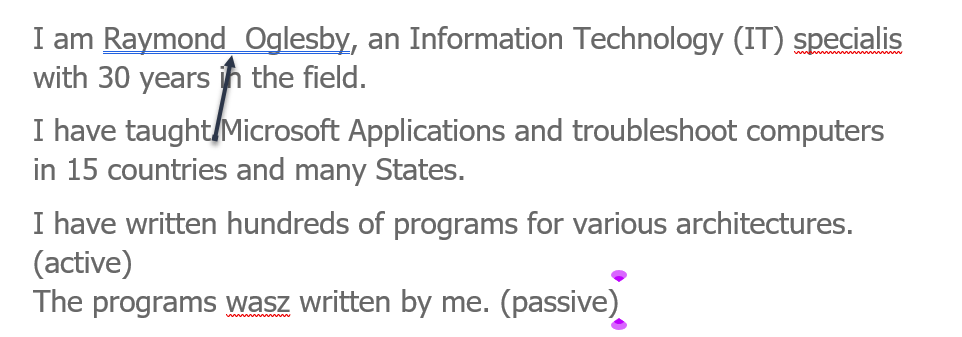
So what can Word’s spelling and grammar checker not do? As comprehensive as it may seem, it often fails when it comes to noticing the incorrect usage of a properly spelled word. For example, “troubleshoot.” See the following image:
Grammar error
In this case, Word failed to catch the incorrect usage of “troubleshoot,” it should be “troubleshot.” That said, you can count on Word to detect a lot of issues in a document, but you can not rely on it 100%. As a matter of good practice, always re-review your document before sending it out.
Using the Keyboard Shortcut
In Word, you can use the Alt+F7 shortcut to jump straight to the first error behind where the cursor currently is in the document. So, if you want to start with the first error, you will need to place your cursor at the beginning of the document, or in front of the first error. Refer to the below image:
Spelling error
When you press Alt+F7, Word highlights the spelling or grammar error and gives you the option to either correct or ignore the issue. Press the up or down arrow keys to highlight the desired option, and then press Enter to select it.
Note! you can only highlight spelling and grammar suggestions with your arrow keys. If you want to ignore the suggestion, you must click that option with your mouse. See the below image:
Highlight the Spelling error
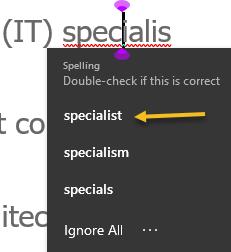
Spelling errors generally have more suggested corrections to choose from. See the following image:
Correction for the Spelling error
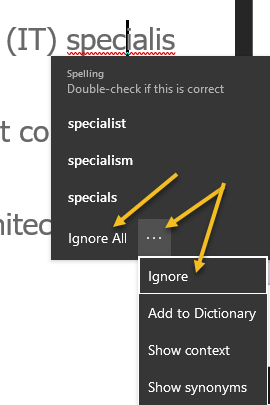
You can also ignore the spelling error, just as you would with the grammar error. The only difference is, with spelling, you can choose to:
Ignore every instance of that same error
Ignore just the specific error (even if it also exists elsewhere in the document)
Refer to the below image:
Ignore the Spelling error
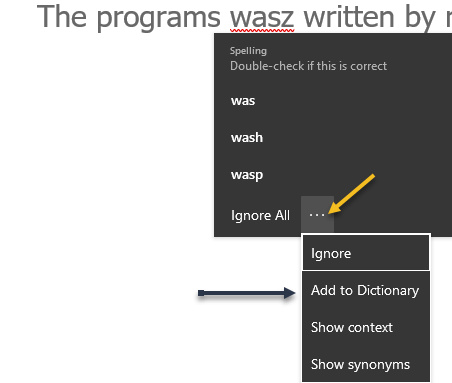
In addition, you can also add that word to the dictionary. When you do this, Word will no longer flag the word as an error. This is useful if the word happens to be a part of an in-house style guide or something similar.
Click the three dots to the right of Ignore All and then click Add to Dictionary from the drop-down menu. See the below image:
Add to the Dictionary
When you are ready to move on to the next error, just press Alt+F7 again. Continue doing this until all of the issues within the document have been checked.
Word’s grammar and spell checker is very useful for reviewing the content within a document, but it can be quite distracting when it’s throwing back errors while you are writing. If it’s too distracting for you, you can turn it off as you type.
Quote For the Day
Synergy is what happens when one plus one equals ten or a hundred or even a thousand! It’s the profound result when two or more respectful human beings determine to go beyond their preconceived ideas to meet a great challenge.
Stephen Covey
That’s it. Please feel free to share this post! One way to share is via Twitter.
Just click the Tweet icon below. This will launch Twitter where you click its icon to post the Tweet.
Check out TechSavvy.Life blog posts for smartphones, PCs, and Macs! You may emails us at contact@techsavvy.life for comments or questions.
Please feel free to leave a comment. I would love to hear from you. Do you have a computer or smart device tech question? I will do my best to answer your inquiry. Just send an email to contact@techsavvy.life. Please mention the device, app, and version you are using. To help us out, you can send screenshots of your data related to your question.
Author’s E-book
You can access the e-book from a Kindle device, the Kindle App for the desktop or smartphone, which is a free app.
The author’s Vietnam eBook on the Battle for Tra Bong Vietnam: Events and Aftermath
Instead of flipping photos after taking selfies, you can capture “mirror selfies” automatically as they appear in the preview on your iPhone. Let’s explore this feature.
The Camera app on the iPhone packs several features, including an option to automatically take mirror selfies. This feature is available on iPhones running at least iOS 14 or later.
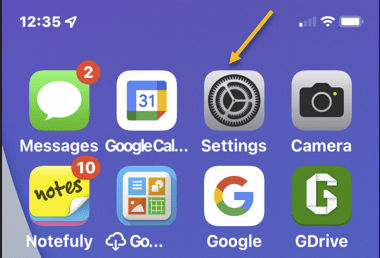
First, open the Settings app on your iPhone. Refer to the below image:
Accessing Settings
Next, in Settings, scroll down and tap Camera. See the below image:
Accessing the Camera
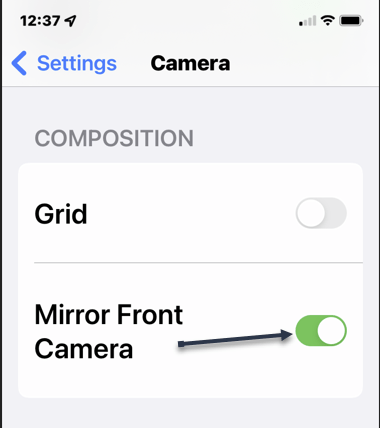
Now, scroll down to the Composition section and toggle the switch for Mirror Front Camera to ON. (On some iPhones, this option might be labeled Mirror Front Photos.) See the following image:
Enabling the Mirror Front Camera toggle
Next, open the Camera app on your iPhone. Turn the camera to face yourself and snap a selfie. The saved image will appear as you see yourself in the mirror, instead of flipped as it usually is. Note that your front camera automatically mirrors the front camera viewfinder, so this setting only affects the image that’s saved to your photo library.
Quote For the Day
To learn something but not to do is really not to learn. To know something but not to do is really not to know.
Stephen Covey
That was easy. Please feel free to share this post! One way to share is via Twitter.
Just click the Tweet icon below. This will launch Twitter where you click its icon to post the Tweet.
Check out TechSavvy.Life for blog posts on smartphones, PCs, and Macs! You may email us at techsavvy.life for comments or questions.
Please feel free to leave a comment. I would love to hear from you. Do you have a computer or smart device tech question? I will do my best to answer your inquiry. Just send an email to contact@techsavvy.life. Please mention the device, app, and version you are using. To help us out, you can send screenshots of your data related to your question.
Author’s E-book
You can access the e-book from a Kindle device, the Kindle App for the desktop or smartphone, which is a free app.
The author’s Vietnam eBook on the Battle for Tra Bong Vietnam: Events and Aftermath
Facebook automatically adds alternative text (alt text) to images you upload, but the descriptions are not always accurate. You can make your images more accessible to visually impaired users by writing accurate alt text for your images.
Facebook automatically adds alternative text (alt text) to images you upload, but the descriptions are not always accurate. You can make your images more accessible to visually impaired users by writing accurate alt text for your images. Let’s explore this feature.
This is for devices using Facebook. Screenshots are from iPhone XR.
Copyright Scott Adams, Inc./Distributed by Universal Uclick for UFS
Use the Mobile App
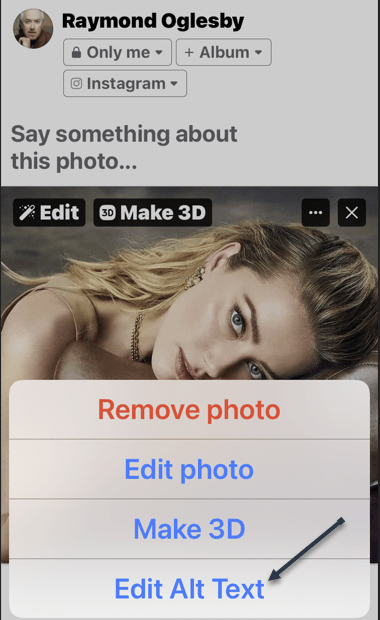
To add alt text to an image you are uploading using the Facebook mobile app, first, open the app on your smartphone, compose a new Facebook post, then select a photo from your device to upload. In the post preview, tap the three dots in the top right-hand corner of the image. Refer to the below image:
Selecting to edit a photo
Next, a menu will appear at the bottom of your screen. Here, tap the Edit Alt Text option. See the below image:
Selecting Edit Alt Text option
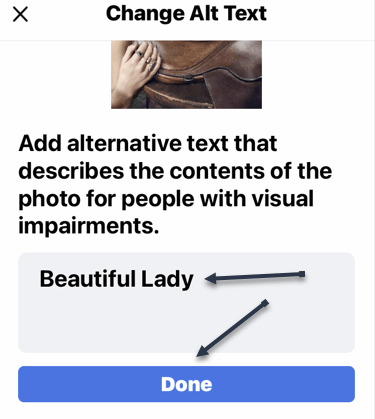
Now, you will be on the Change Alt Text screen. In the text box below your image, enter the text that accurately describes the image you are posting. Then, tap Done. See the following image:
Entering Alt Text and saving your change
The alt text is now added to the photo. Refer to the below image for our final image:
Your final image
Keep in mind that this alt text description can only be read if someone is using a Screen Reader to access Facebook; it will not be visible on the image.
Use the Desktop App
You can also add alt text to your images on Facebook from your computer. First, launch Facebook from any browser of your choice and then begin creating a new post with an image. Next, in the post preview, click Edit in the top left-hand corner of the image. Refer to the below image:
Selecting to edit a photo
Now, the Photo Detail window will appear. Here, click Alternative text at the bottom of the menu in the left-hand pane. See the below image:
Selecting Alternative Text option
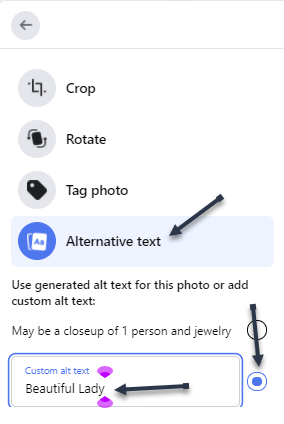
Next, the Alternative text menu will expand. Click the bubble next to the Custom Alt Text option to select it, and then enter the alt text for your image in the text box. See the following image:
Entering your custom Alternative text
Now, click the blue Save button at the bottom of the window. Refer to the below image:
Saving your change
The alt text is now added to the photo. Refer to the below image for our final image:
Your final image
Keep in mind that this alt text description can only be read if someone is using a Screen Reader to access Facebook; it will not be visible on the image.
Quote For the Day
Management is efficiency in climbing the ladder of success; leadership determines whether the ladder is leaning against the right wall.
Stephen Covey
That’s it. Please feel free to share this post! One way to share is via Twitter.
Just click the Tweet icon below. This will launch Twitter where you click its icon to post the Tweet.
Check out TechSavvy.Life blog posts on smartphones, PCs, and Macs! You may email us at contact@techsavvy.life for comments or questions.
Please feel free to leave a comment. I would love to hear from you. Do you have a computer or smart device tech question? I will do my best to answer your inquiry. Just send an email to contact@techsavvy.life. Please mention the device, app, and version you are using. To help us out, you can send screenshots of your data related to your question.
Author’s E-book
You can access the e-book from a Kindle device, the Kindle App for the desktop or smartphone, which is a free app.
The author’s Vietnam eBook on the Battle for Tra Bong Vietnam: Events and Aftermath
Working with images in Microsoft Word is not necessarily difficult, but there are some tricks to positioning your pictures. If you have two or more images that you want to overlap with each other, this post will show you how.
Working with images in Microsoft Word is not necessarily difficult, but there are some tricks to positioning your pictures. If you have two or more images that you want to overlap with each other, this post will show you how.
This is for devices using Microsoft Word
Copyright Scott Adams, Inc./Distributed by Universal Uclick for UFS
Adjust Image Layout
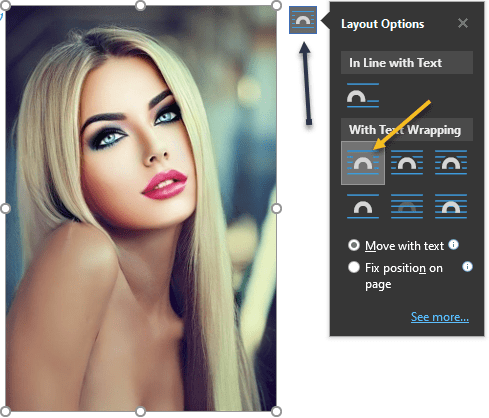
First, launch Microsoft Word and insert an image. You must be sure you are using a supported layout option. You can check this in three different ways.
Select the image and click the Layout Options icon that appears to the right of it.
Select the image, go to the Picture Format tab that appears, and click the Wrap Text drop-down arrow.
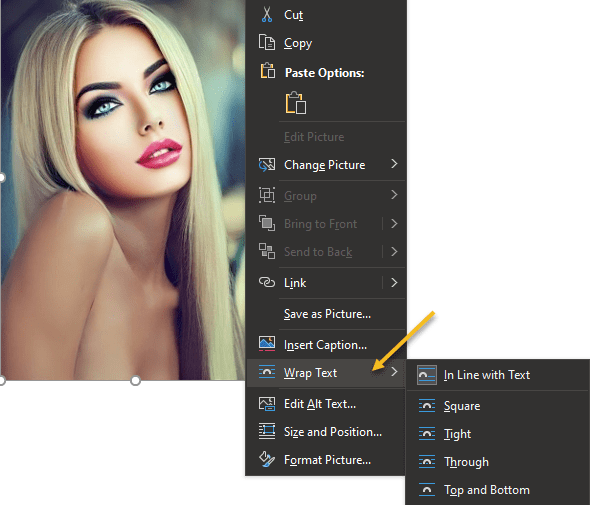
Right-click the image and move your cursor to Wrap Text to display the options in the pop-out menu.
Refer to the below image :
Selecting Wrap Text option
Next, as to layout options, select Square, Tight, Through, or one of the others; whichever works best for your document. Note! In Line with Text will not work. See the below image:
Selecting a Layout
Allow Images to Overlap
Now, you may notice when you drag an image close to another in your Word document, you cannot place it on top of another. The other picture may suddenly move out of the way to make room for the one you are dragging.
In order to overlay images in Word, you need to enable this option for each picture you want in the group.
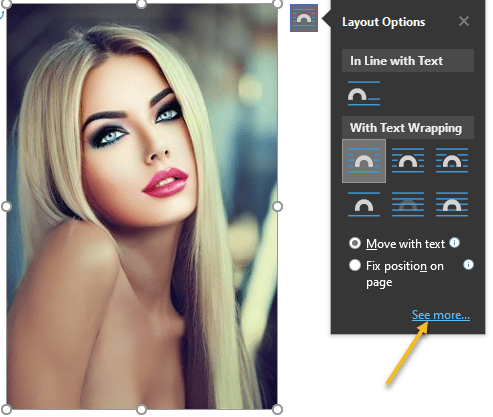
Select the image, click the Layout Options icon on the right, and click See More at the bottom.
Select the image, go to the Picture Format tab, click Position, and pick More Layout Options.
See the following image:
Selecting See more options
Next, when the Layout window opens, you should be on the Position tab. But if not, select it. At the bottom of the window below Options, check the box to Allow Overlap, then click OK. Refer to the below image:
Enabling Allow overlap
Now, insert another image(s) and place it next to or below the original image. Make sure you enable the overlap option for each image that you want to overlay.
Overlay Images
Once all of the above is in place, simply drag your images and overlap them as you please.
If you want a particular picture to be on top, right-click or go to the Picture Format tab and choose to Bring Forward or Bring to Front depending on the number of images you are using and how you want them positioned. See the below image:
Selecting Bring to Front option
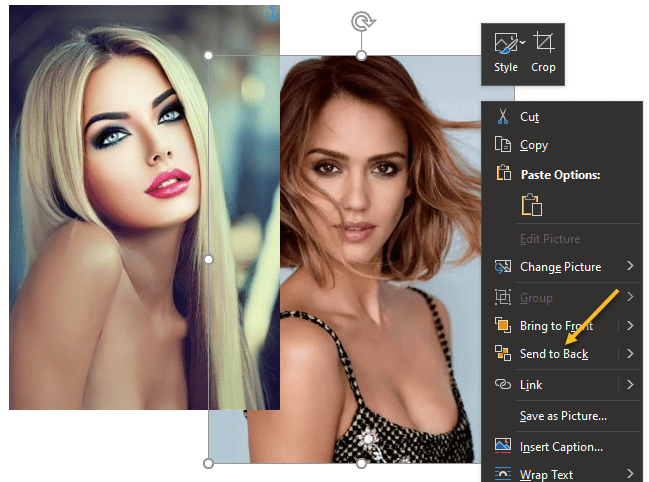
You can take similar action if you want an image in the back. Right-click or go to the Picture Format tab and choose to Send Backward or Send to Back. See the following image:
Selecting Send to Back option
Next, your final overlapped images will look similar to the below image where we are using the Bring to Front option:
The finished overlapping images
Overlapping images in Word is not too hard, as you can see. But it’s one of those hidden tricks that can make working with pictures much easier just like placing text on top of an image. I wish I knew about this trick before now.
Quote For the Day
Listen with the intent to understand, not the intent to reply.
Stephen Covey
You are finished. Please feel free to share this post! One way to share is via Twitter.
Just click the Tweet icon below. This will launch Twitter where you click its icon to post the Tweet.
Checkout TechSavvy.Life for blog posts on smartphones, PCs, and Macs! You may email us at contact@techsavvy.life for comments or questions.
Please feel free to leave a comment. I would love to hear from you. Do you have a computer or smart device tech question? I will do my best to answer your inquiry. Just send an email to contact@techsavvy.life. Please mention the device, app, and version you are using. To help us out, you can send screenshots of your data related to your question.
Author’s E-book
You can access the e-book from a Kindle device, the Kindle App for the desktop or smartphone, which is a free app.
The author’s Vietnam eBook on the Battle for Tra Bong Vietnam: Events and Aftermath
While using apps on your iPhone, these apps are often busy behind the scenes, using sensors and contacting internet domains without your knowledge. With iOS 15.2 or later, you can see a detailed report of these activities with the App Privacy Report.
While using apps on your iPhone, these apps are often busy behind the scenes, using sensors and contacting internet domains without your knowledge. With iOS 15.2 or later, you can see a detailed report of these activities with the App Privacy Report. Let’s find out.
This is for the iPhone running iOS 15.2 or higher
Copyright Scott Adams, Inc./Distributed by Universal Uclick for UFS
First, open Settings by tapping the grey gear icon. Refer to the below image:
Accessing Settings
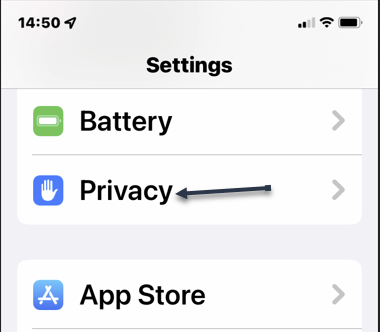
Next, on the Settings screen, tap Privacy. See the below image:
Accessing Privacy option
Now, in the Privacy settings, scroll down to the very bottom and tap App Privacy Report. See the following image:
Accessing App Privacy Report option
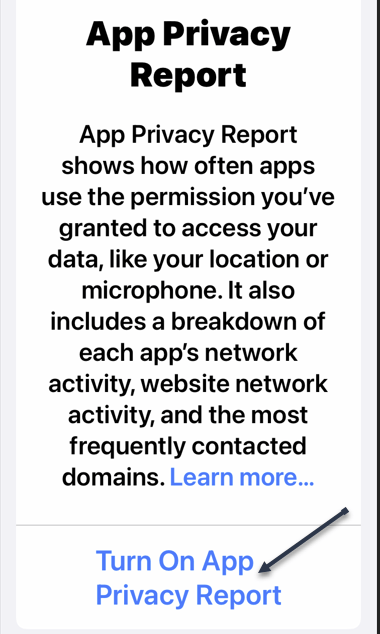
If you have not enabled Record App Activity, tap Turn On App Privacy Report link. Refer to the below image:
Enabling App Privacy Report
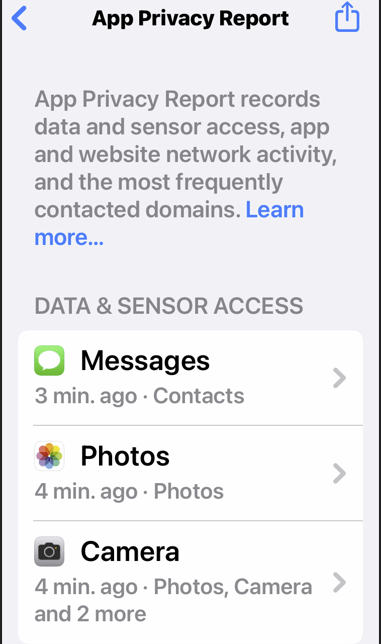
If you just enabled App Privacy Report, you will need to use your iPhone for a few days and let the App Privacy Report feature gather data. After that time (or if you have been using the Record App Activity feature in earlier versions of iOS 15), you will see a detailed report about Data & Sensor Access, App Network Activity, Website Network Activity, and Most Contacted Domains. Here’s what each section means:
Data & Sensor Access: This shows how many times an app accessed your iPhone’s sensors (and when), such as camera, location, contacts, screen recording, media library, photo library, or microphone.
App Network Activity: This shows how many internet domains an app has contacted and when each contact took place. It includes domains contacted directly by the app and those referenced by content within the app, such as websites that might pull in content from other domains.
Website Network Activity: This section shows the internet domains that have been contacted by websites you visited through a web browser within an app.
Most Contacted Domains: This shows a ranking of the internet domains that have been contacted the most by your apps. On the internal App Privacy Report details page in iOS 15.2 or higher, Apple notes that high-ranking domains on this list might be used by multiple apps to build a profile of you across different apps or services.
See the below image:
Your report
Next, at any time, you can tap any entry on the list to see more details. Tap Show All at the bottom of each privacy report section to get a complete list. See the following image:
Accessing Show All option
App Privacy Report Can Be a Risk
Enabling App Privacy Report on your iPhone will keep a detailed record of your internet activities on your iPhone (that is stored on your device). If you allow another person to access your iPhone, they can get a very detailed look at what you have been doing with your iPhone on the
Settings > Privacy > App Privacy
report page. If that’s the case, you might want to make sure that App Privacy Report is disabled.
Turn Off App Privacy Report
To disable App Privacy Report, navigate to
Settings > Privacy > App Privacy
then scroll down to the bottom of the page and tap Turn Off App Privacy Report. Refer to the below image:
Disabling App Privacy Report
After that, click OK in the pop-up message, and all existing privacy report activity will be deleted.
If your iPhone is locked down and never shared, App Privacy Report is a great tool to keep an eye on what apps have been doing behind the scenes.
Quote For the Day
Fear may come true that which one is afraid of.
Viktor E Frankl
You are finished. Please feel free to share this post! One way to share is via Twitter.
Just click the Tweet icon below. This will launch Twitter where you click its icon to post the Tweet.
Checkout TechSavvy.Life blog posts on smartphones, PCs, and Macs! You may email us at contact@techsavvy.life for comments or questions.
Please feel free to leave a comment. I would love to hear from you. Do you have a computer or smart device tech question? I will do my best to answer your inquiry. Just send an email to contact@techsavvy.life. Please mention the device, app, and version you are using. To help us out, you can send screenshots of your data related to your question.
Author’s E-book
You can access the e-book from a Kindle device, the Kindle App for the desktop or smartphone, which is a free app.
The author’s Vietnam eBook on the Battle for Tra Bong Vietnam: Events and Aftermath
Want to wipe your Gmail inbox clean? Using Gmail’s bulk delete option, you can delete all emails from your Gmail account at once in just a few clicks.
If you use the Gmail app on an iPhone, iPad, or Android phone, you can not delete all emails at once on your device. This means you will have to rely on the Gmail site to purge your inbox. Let’s explore how this is done.
This is for Windows, Mac, Linux, and Chromebook using Gmail
Copyright Scott Adams, Inc./Distributed by Universal Uclick for UFS
Deleting all your emails does not delete your Gmail account. You can still send and receive emails after you have deleted all your existing emails.
First, open a web browser on your Windows, Mac, Linux, or Chromebook computer and access the Gmail site. Log in to your Gmail account on the site if not already logged in.
Next, in the sidebar on the left, click All Mail. If you do not see this option, click More to reveal the option. Refer to the below image:
Accessing All Mail option
Now, in the pane on the right, you will see all your Gmail emails, including your archived emails. To delete these emails, you will have to first select all these emails. This is done by clicking the Select option (a square icon) at the top of the Gmail interface. See the below image:
Selecting up to 50 emails
Once check-marked, up to the default (50) emails will be highlighted for deletion.
Next, to select the emails that are not on this page, at the top of the emails list, click the Select all X conversations in All Mail, where “X” is the number of emails in the All Mail folder. See the following image:
Selecting to delete all emails
Now, all your emails are now selected. To start deleting them, at the top of the Gmail interface, click the Delete option (the trash icon). Refer to the below image:
Delete all emails
Next, you will see a Confirm bulk action pop-up message. Here, click OK. See the below image:
Confirming the deletion
Now, Gmail will start deleting and moving your emails to the Trash folder. To remove your emails for good, you will have to empty the Trash. To do so, in Gmail’s left sidebar, click the Trash folder. See the following image:
Selecting your Trash emails
In the pane on the right, at the top, click Empty Trash now. Refer to the below image:
Selecting to empty your Trash emails
Next, in the Confirm deleting messages pop-up message that opens, click OK. See the below image:
Confirm the deletion
You will receive a cute message from Google about how their servers “feel”. (By the way, servers have no “feelings”). See the following image:
The servers are “feeling unloved”
Now, all your emails except for the ones in the Spam folder are now deleted.
Next, to clear the spam emails, in Gmail’s left sidebar, click Spam. Then, in the pane on the right, click Delete all spam messages now. Refer to the below image:
Deleting Spam emails
Quote For the Day
If a window of opportunity appears, don’t pull down the shade.
Tom Peters
That’s it. Please feel free to share this post! One way to share is via Twitter.
Just click the Tweet icon below. This will launch Twitter where you click its icon to post the Tweet.
Check out TechSavvy.Life for blog posts on smartphones, PCs, and Macs! You may email us at contact@techsavvy.life for comments or questions.
Please feel free to leave a comment. I would love to hear from you. Do you have a computer or smart device tech question? I will do my best to answer your inquiry. Just send an email to contact@techsavvy.life. Please mention the device, app, and version you are using. To help us out, you can send screenshots of your data related to your question.
Author’s E-book
You can access the e-book from a Kindle device, the Kindle App for the desktop or smartphone, which is a free app.
The author’s Vietnam eBook on the Battle for Tra Bong Vietnam: Events and Aftermath
Most web browsers have a built-in Reader Mode that converts web pages into a more reader-friendly view. Strangely, Google Chrome does not have this feature; unless you know how to find it.
Most web browsers have a built-in Reader Mode that converts web pages into a more reader-friendly view. Strangely, Google Chrome does not have this feature; unless you know how to find it. Let’s explore this hidden feature.
This is for desktop devices using Google Chrome
Copyright Scott Adams, Inc./Distributed by Universal Uclick for UFS
Google Chrome has included a hidden Reader Mode since all the way back to version 75. However, it’s never been upgraded to a stable, standard feature. Even Microsoft Edge, which is also based on Chromium, has a Reader Mode.
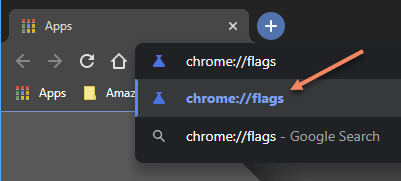
First, we will need to enable a Chrome feature flag. Open the Chrome browser on your computer and type:
chrome://flags
in the address bar, then click Enter. Refer to the below image:
Accessing Chrome flags
Next, search for Reader Mode in the text box at the top and enable the flag titled EnableReader Mode. See the below image:
Enabling Reader Mode
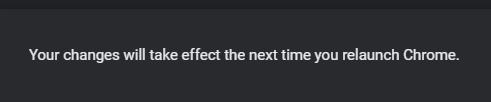
Now, after enabling the flag, see the Relaunch text at the bottom of the screen and restart Chrome to apply the change. See the following image:
Relaunch Chrome message
Next, when you visit a webpage that has a lot of text, you will see a little book icon on the right side of the address bar. Click it to switch to Reader Mode.
You can also click:
Menu > Enter Reader Mode
to activate it. Refer to the below image:
Activate Reader Mode
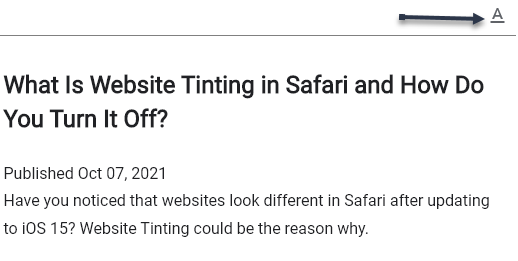
Now, you are looking at a much simpler, less cluttered view of the webpage. Images still appear, but ads and a few other items are removed. To adjust the view, click the A icon in the top right. See the below image:
Selecting the A icon to see more options
Next, you can change the font, text size, and background color. See the following image:
Your options
That’s all there is to it! You can now minimize distractions while reading long articles in Chrome. It’s strange that Google has kept this a hidden feature for years, but now you know how to enable it yourself.
Quote For the Day
If you carefully consider what you want to be said of you in the funeral experience, you will find your definition of success.
Stephen Covey
That’s it. Please feel free to share this post! One way to share is via Twitter.
Just click the Tweet icon below. This will launch Twitter where you click its icon to post the Tweet.
Checkout TechSavvy.Life for blog posts on smartphones, PCs, and Macs! You may email us at contact@techsavvy.life for comments or questions.
Please feel free to leave a comment. I would love to hear from you. Do you have a computer or smart device tech question? I will do my best to answer your inquiry. Just send an email to contact@techsavvy.life. Please mention the device, app, and version you are using. To help us out, you can send screenshots of your data related to your question.
Author’s E-book
You can access the e-book from a Kindle device, the Kindle App for the desktop or smartphone, which is a free app.
The author’s Vietnam eBook on the Battle for Tra Bong Vietnam: Events and Aftermath
Instagram is primarily used on smartphones, but you can also use it in a desktop browser on Windows or Mac. For years that meant only viewing your feed and messages, but it can also be used to upload photos too.
Instagram is primarily used on smartphones, but you can also use it in a desktop browser on Windows or Mac. For years that meant only viewing your feed and messages, but it can also be used to upload photos too.
As of October of 2021, Instagram added the long-awaited ability to post to Instagram from the website. You get nearly all of the same filters and editing tools that you can find in the iPhone and Android app, too. Let’s explore how this is done.
This is for Windows, PC, Mac, Linux, and Chromebook using Instagram
Copyright Scott Adams, Inc./Distributed by Universal Uclick for UFS
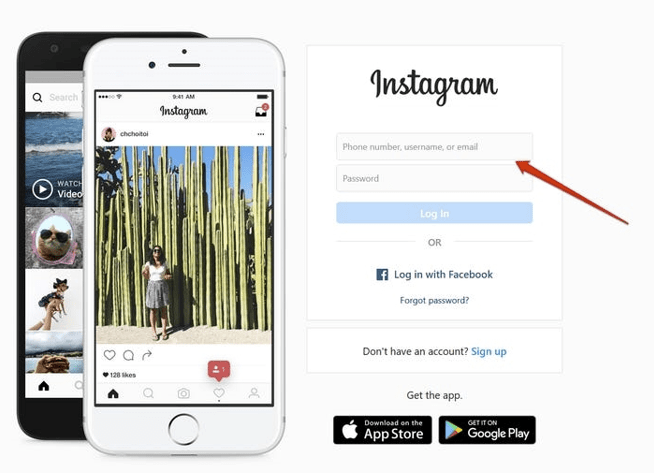
First, head on over to Instagram.com in a web browser such as Google Chrome or Safari. Sign in with your Instagram account if you are not already signed in. Refer to the below image:
Signing in to your Instagram account
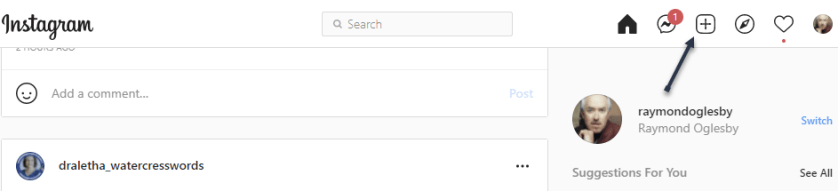
Next, click the plus “+” icon in the upper right-hand corner. See the below image:
Selecting to add a photo
Now, click Select From Computer and choose a photo from the file manager. See the following image:
Selecting a photo from your device
Next, there are a couple of options where you can adjust the Aspect Ratio, Zoom in on the photo, or Add more photos to create a slideshow. In our example, we made no adjustments. Click Nextwhen the photo is ready. Refer to the below image:
Optionally adjust your photo
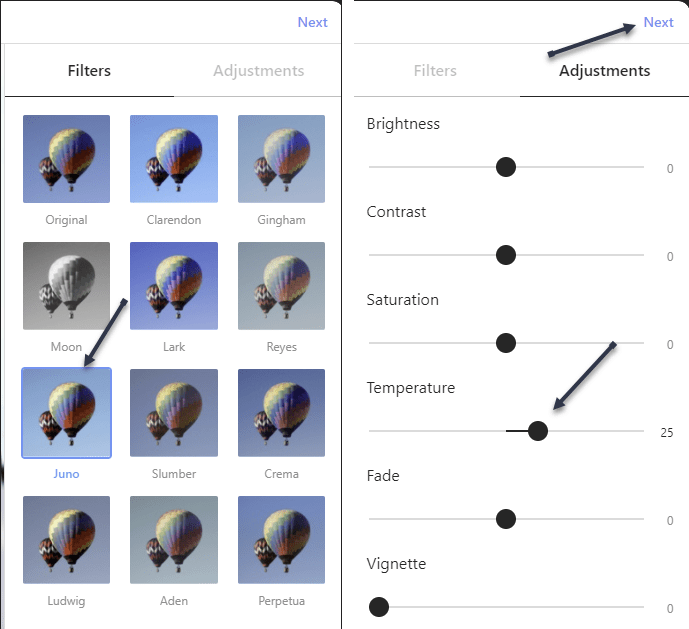
Now, you can choose a Filter or make some other adjustments to the photo. Click Next when the photo looks good. In our example, we set the Filter to Juno and increased the Temperature setting. See the below image:
Optional adjustments you can make
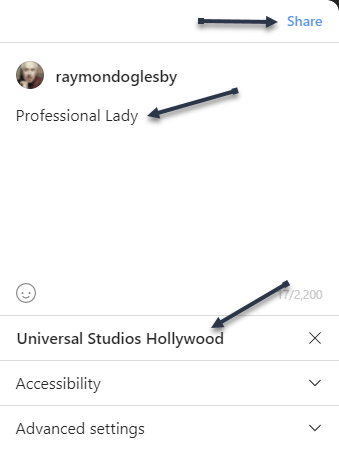
Next, write a Caption in the text box, add a Location if desired, and click Share. See the following image:
Setting a caption and location
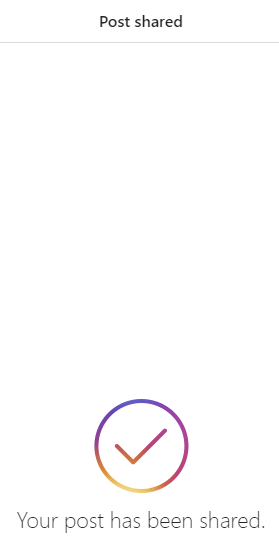
Now, you will be given a message about successfully sharing your Instagram post. Refer to the below image:
Post shared message
Your photo post will now be displayed on your Instagram account. Notice the warmer color and background from the original above. See the below image:
Your photo post on Instagram
You can now post photos to your Instagram feed right from your Windows PC, Mac, Linux, or Chrome OS computer. This is especially useful for uploading photos that you have transferred onto your computer,
Quote For the Day
If we keep doing what we’re doing, we’re going to keep getting what we’re getting.
Stephen Covey
You are finished. Personally, I like this feature since I have most of my photos on my computer. Please feel free to share this post! One way to share is via Twitter.
Just click the Tweet icon below. This will launch Twitter where you click its icon to post the Tweet.
Check out TechSavvy.Life for blog posts on smartphones, PCs, and Macs! You may email us at contact@techsavvy.life for comments or questions.
Please feel free to leave a comment. I would love to hear from you. Do you have a computer or smart device tech question? I will do my best to answer your inquiry. Just send an email to contact@techsavvy.life. Please mention the device, app, and version you are using. To help us out, you can send screenshots of your data related to your question.
Author’s E-book
You can access the e-book from a Kindle device, the Kindle App for the desktop or smartphone, which is a free app.
The author’s Vietnam eBook on the Battle for Tra Bong Vietnam: Events and Aftermath













































 Tech Savvy Life