In this Coronavirus pandemic, many people are working from home. Our local TV news and weather people have live audio and video streaming from their homes for the daily news broadcast. Working from home has become the new norm.
This will continue after the crisis is over. Instead of going to an office or to a clients location, you will collaborate through an audio and video service.
I researched some web sites for the top call services. They have a similar mix of apps, just in a different order. Some of the web sites have organizations I never heard of. So, I like the ranking from Office Watch. Click here to read their review.
This is for modern web browsers and apps on Apple, Android and Microsoft platforms
Their top seven online call services are as follows:
FaceTime – handles up to 32 people
Skype – up to 50 people
WhatsApp – handles 4 people
Signal – one-on-one calls only
Zoom and Meetings – up to 100 people for the free version; 1000 for their enterprise paid version
Microsoft Teams and Live Events – can handle 4 participates, up to 10,000 for the paid version
Google Hangouts – up to 150 people
I recommend Facetime or Skype for a small busines; Zoom for a medium business; and Zoom Meetings for a large enterprise. Facetime and basic Zoom are free. Click here to read the review of their rankings.
I Would Like to Hear From You
Please feel free to leave a comment. I would love hearing from you. Do you have a computer or smart device tech question? I will do my best to answer your inquiry. Please mention the device, app and version that you are using. To help us out, you can send screenshots of your data related to your question.
The author’s Vietnam eBook on the Battle for Tra Bong: Events and Aftermath
Is your business using Zoom for collaboration during the Coronavirus outbreak? Zoom has become a key tool for working at home and a top choice for vittual meetings. Zoom is free for one-on-one calls that last as long as you like. For three or more people, your calls are limited to 40 minutes. Zoom also has a paid version for an enterprise; it can handle 1000 people.There’s also a plan for small and medium businesses that supports up to 300 participates per call..
Zoom Meeting’s free account is generous. You can host up to 100 people on a call for free and you can see as many as 49 people on an active call in a gallery-style view. There’s no limit on how many meetings you can host.
So, how do we setup our contacts with coworkers using Zoom? In this post we offer insight on how to do this.
This post is for Windows 7 or greater, iPhone or iPad with iOS 7 or later, Android 4 or greater, Web browsers, Macs and the Zoom app or program
Copyright Scott Adams, Inc./Distributed by Universal Uclick for UFS
Before you Begin
Of course, you have already setup the app. Linking to other people in Zoom is necessary before you can call them. A person has to be added to your Zoom contacts list and they have to add you before a call is made.
Zoom contacts are separate from Outlook and other contacts list.
Zoom links people by matching email addresses. Some people have multiple email addresses; for example, personal and work or different ones for different purposes or multiple old email addresses.
Which Email Address to Use?
Before adding a person to your contacts list it’s a good idea to check with them on which email address they use to login to Zoom.
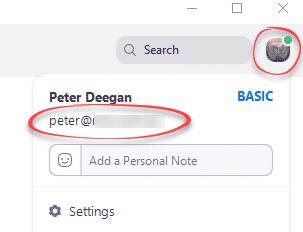
To check, they can click on their Zoom Profile in the top right where their name and address is displayed. Refer to below image:
Locate the correct email address
Invite a Contact
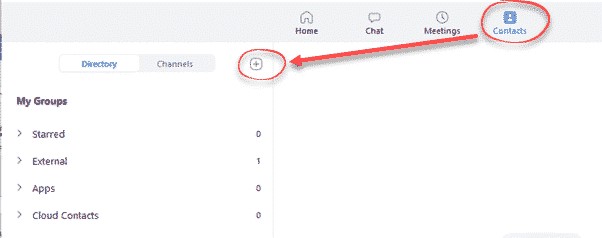
To link with someone, in the Zoom app, go to the Contacts section, then click the plus “+ “symbol. See following image:
Linking a Zoom contact
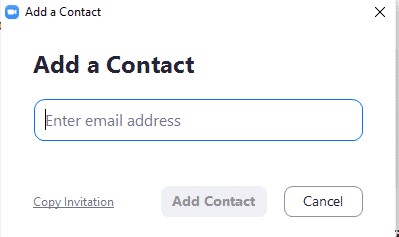
Enter the email address of the contact you want to add to Zoom. See below image:
Adding a Zoom contact
Then you have two options:
Add Contact – sends a contact request to that person’s Zoom account.
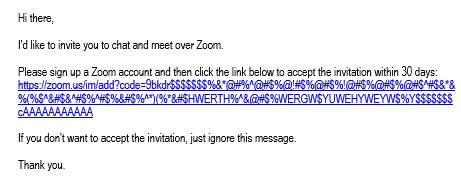
Copy Invitation – copies to your clipboard with web link. Paste that into an email or instant message.
Refer to below image:
Web address for the Zoom contact
There is no need to paste the entire text, change it to suit you. The web link is the important part to pass along. Make sure you include the whole web link; it’s a long link using multiple lines.
Accept a Contact Request
If a participate adds you to their Zoom contact list, you’ll see a pop-up alert. See following image:
Pop-up box for a contact request
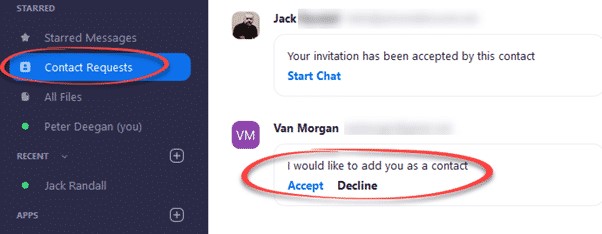
Or open your Zoom app/web page. Under Contacts look at Contact Requests. The request will be displayed with options to Accept or Decline. Refer to below image:
Accept or Decline a contact request
As you can see above, the Contact Requests you’ve made will also appear with their current status.
What to Do Next?
Now that you’ve linked with someone on Zoom, you can call them (voice, video, text, etc). If someone wants to invite you into a Zoom meeting, give them you Zoom linked email address.
That’s it on setting up your Zoom contacts. Try it out.
I Would Like to Hear from You
Please feel free to leave a comment. I would love hearing from you. Do you have a computer or smart device tech question? I will do my best to answer your inquiry. Please mention the device, app and version that you are using. To help me out, you can send screenshots of your data related to your question.
The author’s Vietnam eBook on the Battle for Tra Bong: Events and Aftermath
Do you need to give people credit for your PowerPoint presentation? If so, you can add these credits to your final slide by using the scrolling text animation feature. You can use an existing presentation or add this to your next one. In our example, we are using an existing PowerPoint slide show.
This is for PowerPoint for Office 365 Windows and Mac versions. Other versions of PowerPoint will be similar.
Setting Up the Slide
Open an existing presentation or create a new one
Navigate to the final slide
Click the Insert tab
Insert a blank text box by clicking the Text Box icon in the Text group. Your cursor will turn into an down arrow. After you click, the cursor changes to a crossbar. Click and drag the cursor to draw the text box. See followin image:
PowerPoint drawing the text box for the Credits
Entering Your Presentation Credits
Enter your credits. The text box will expand, if necessary, as you enter the names.
Highlight your entries
Select the Home tab
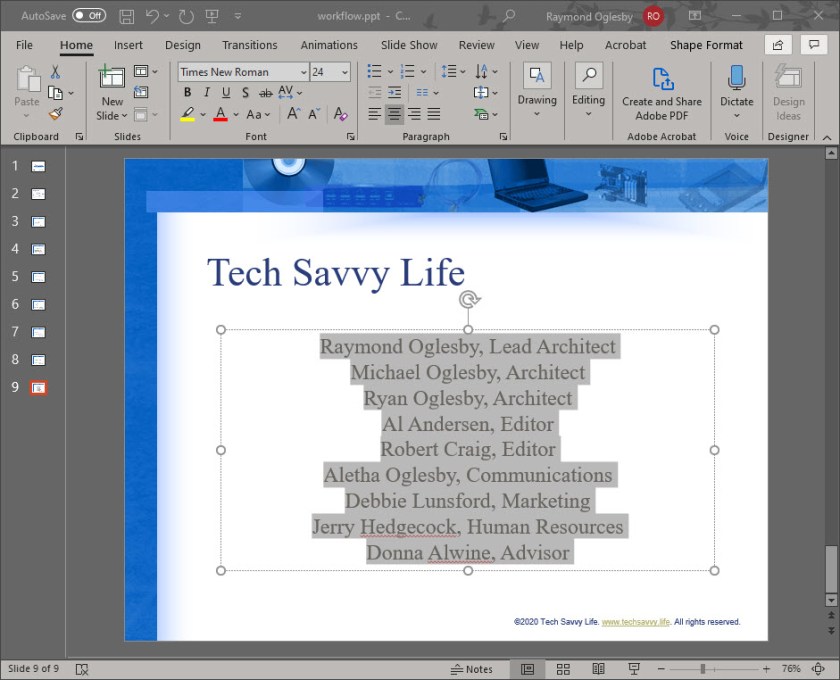
Since credits are usually centered, select the Center alignment icon in the Paragraph group. See following screen:
PowerPoint Credits completed and centered
Adding the Animation Effects
Now lets add the animation to the text box. With the textbox selected:
Click the Animations tab
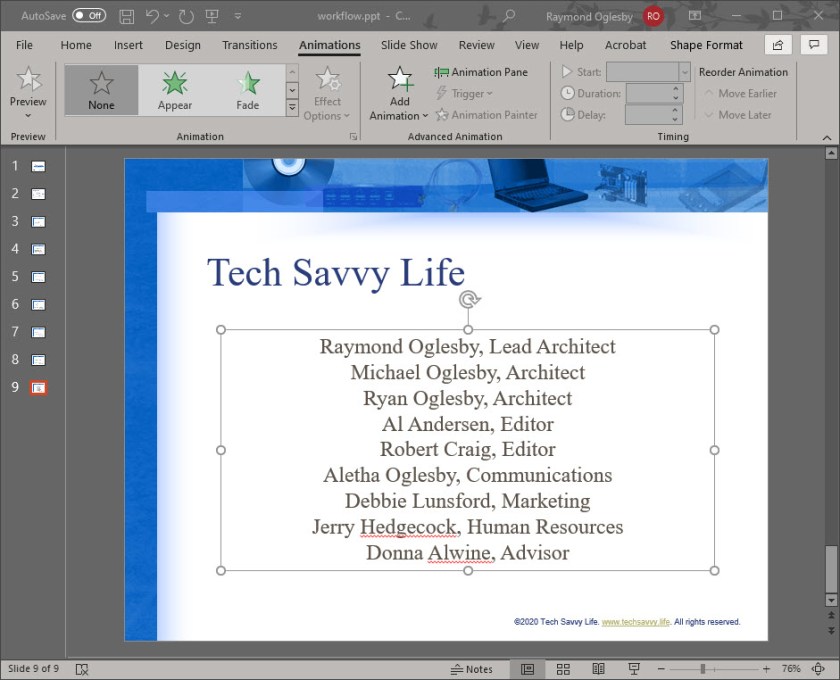
Select Add Animation button in the Advanced Animation group. See following image:
PowerPoint about to add the animations
A drop down menu will appear. Scroll to the bottom and select More Entrance effects. The Add Entrance Effect window will be shown. See following image:
PowerPoint Add Entrance Effect drop down menu
Setting the Credits Animation
Scroll down to the Exciting group and select Credits. You will see the credits animation scrolling effect in the background.
Click OK to save your changes
PowerPoint selecting the Credits animation
The rolling credits will be added to your presentation. You may now view your slideshow from the beginning or from the current slide to see the Rolling Credits in action.
Thats it. You are finished.
I Would Like to Hear from You
Please feel free to leave a comment. I would love hearing from you. Do you have a computer or smart device tech question? I will do my best to answer your inquiry. Please mention the device, app and version that you are using. To help us out, you can send screenshots of your data related to your question.
The author’s Vietnam eBook on the Battle for Tra Bong: Events and Aftermath
At times, you will want to entertain your guests before an event, like at a wedding or a trade show. You’ll want to loop your PowerPoint presentation so your guests aren’t staring at a blank screen. I have included a link to a sample slideshow using the loop feature.
This is for PowerPoint for Office 365 Windows and Mac versions. Other versions of PowerPoint will be similar.
Copyright Scott Adams, Inc./Distributed by Universal Uclick for UFS
Setting Up your Slideshow
First, open your PowerPoint presentation in which you would like to use the loop feature. Once open, navigate to the Set Up group of the Slide Show tab and select the Set Up Slide Show option.
The Set Up Show window will open. Check the box next to Loop continuously until Esc. After selection, click OK. Refer to below image:
Setting the Loop feature
When you play your slideshow, it will loop until you press the “Esc” key. Now we want to set up the presentation for automatic slide transitions.
Applying the Loop Feature
Navigate back to the Set Up group of the Slide Show tab and select the Set Up Slide Show option. There is one option you need to set, the Using Timings, if Present under the Advance Slides group.
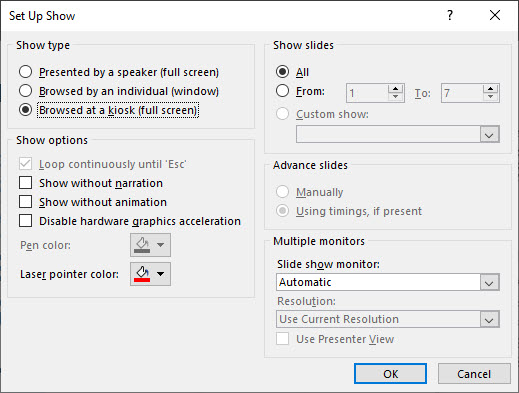
Now, under the Show Type group, select Browsed at a kiosk (full screen). The Loop continuously until Esc option will be enabled automatically (we turned it on above) Also, select the Using timings, if present option. Select OK to proceed. See following image:
Setting the kiosk feature
By setting the Browsed at a kiosh (full screen) option, the Forward and Back keys are locked, thus allowing unattended playback without the fear of someone breaking it.
Setting Up Transitions
Now, lets setup the timings of your slides. Click on the Transitions tab and check the box next to After and set the timing for slide transition. In my example, I have the timining set to 10 seconds. If On Mouse Click is enabled, it won’t work because we have previously selected to loop the slideshow until the presenter has pressed the “Esc” key. To finish the loop feature, select the Apply To All option. See following image:
Now when you play your presentation, it will continuously loop until you press the “Esc” key.
Please feel free to leave a comment. I would love hearing from you. Do you have a computer or smart device tech question? I will do my best to answer your inquiry. Please mention the device, app and version that you are using. To help us out, you can send screenshots of your data related to your question.
The author’s Vietnam eBook on the Battle for Tra Bong: Events and Aftermath
During our time of social distancing, you can still reach out to your friends or relatives using FaceTime video or audio on your iPhone or iPad.
You can use FaceTime over Wi-Fi or over cellular on iOS 12.1 or later devices. Also, you need an iPhone 6s or later. FaceTime supports up to 32 people simultaneously.
This is for iPhone or iPad
Turn on FaceTime
Open the FaceTime app and sign in with your Apple ID. You can also do this from Settings > FaceTime
If you’re using an iPhone, FaceTime automatically registers your phone number. To also register your email address on your iPhone or iPad, go to Settings > FaceTime> Use your Apple ID for FaceTime and sign in with your Apple ID.
Make a FaceTime Call
To make a FaceTime call, you need the person’s phone number or registered email address. There are a few ways to make a FaceTime call:
In the FaceTime app, tap the plus button and type the person’s phone number or email address. Tap the number or address, then tap Audio or Video
If you have the person’s phone number or email address saved in your Contacts, you can start typing their name and tap the name when it appears. Then tap Audio or Video
You can also start a FaceTime video call from your iPhone during a phone call. Tap the FaceTime icon in the iPhone app to switch to FaceTime.
Now you don’t have to be alone, you can reach out to people using your Apple smart devices.
I Would Like to Hear From You
Please feel free to leave a comment. I would love hearing from you. Do you have a computer or smart device tech question? I will do my best to answer your inquiry. Please mention the device, app and version that you are using. To help me out, you can send screenshots of your data related to your question.
Do you get frustrated when your smart device switches to landscape from portrait mode (or vice versa) when you don’t want it to? There is a way to prevent this behavior through Orientation Lock.
This is for iOS devices iPhone and iPad running iOS 7 and above
Set the Lock
To do this, launch the Control Center by one of the following ways:
1. iPhone 10 and above – Swipe down from upper right hand corner
2. iPhone 8 or earlier – Swipe up from bottom of screen
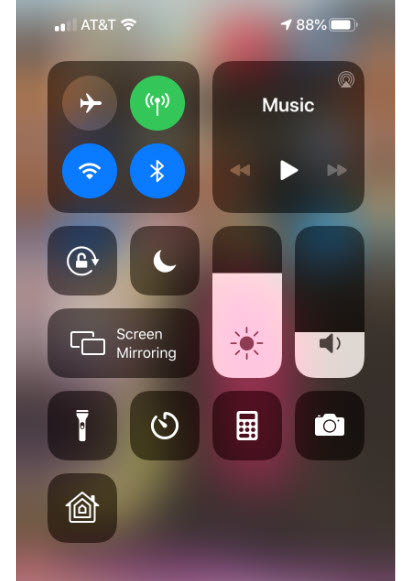
See below image:
The Orientation Lock screen
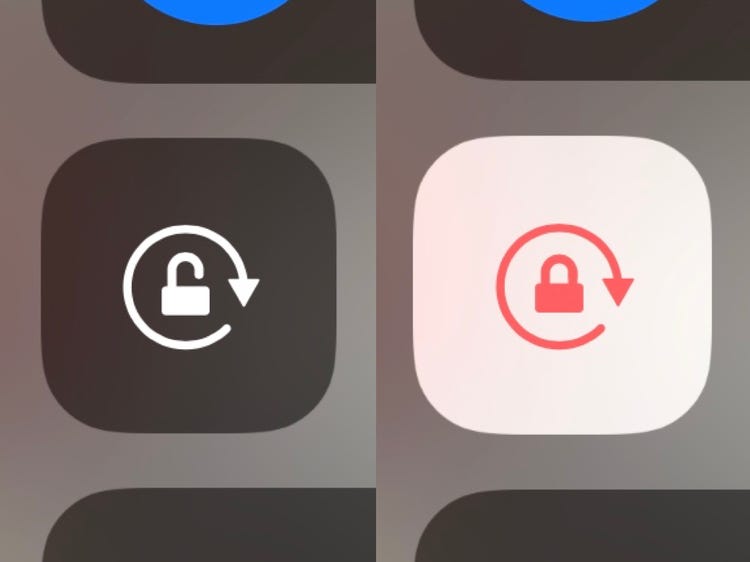
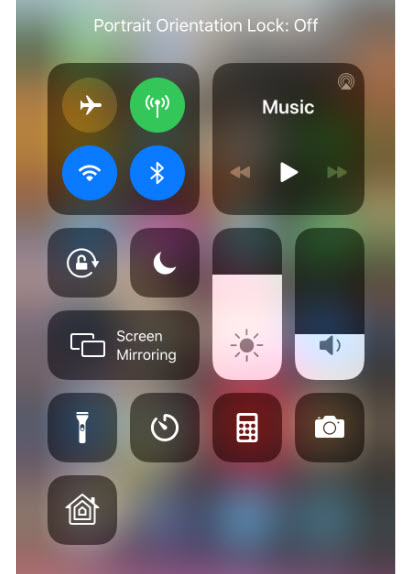
Tap the Orientation Lock icon (the one with an open lock and a curved arrow) to set the lock to its current position. A brief message will appear at the top to confirm the lock and the icon will be highlighted. Refer to following image:
Turning on the Orientation Lock
Swipe to close Control Center
Verify the Lock
Launch the Control Center. A small lock icon will be displayed in the Status Bar next to the Battery Level icon. See following image:
Verifying the Orientation Lock is on
Swipe to close Control Center
Turn Off the Lock
Launch the Control Center
Tap the Orientation Lock icon
A brief message will appear at the top to confirm the lock is turned off and the icon will no longer be highlighted. See following image:
Turning off the Orientation Lock
Swipe to close the Control Center
Note!Not all apps support screen rotation. Some apps only work in portrait or landscape mode. This is particularly true of some games and video apps. For those apps, your screen rotation settings don’t matter. The app will only display in the orientation it supports.
I Would Like to Hear from You
Please feel free to leave a comment. I would love hearing from you. Do you have a computer tech or smart device question? I will do my best to answer your inquiry. Please mention the device, app and version that you are using. To help us out, you can send screenshots of your data related to your question.
The author’s Vietnam eBook on the Battle for Tra Bong: Events and Aftermath
Normally, we chose an adjacent range of cells with headers for printing in Excel. However, there are occasions we want to print nonadjacent cell ranges. There are some of us who didn’t realize you could do this in a single print area. Let’s see how this is done.
This is for Excel for Office 365 Windows and Mac versions. Other versions of Excel will be similar.
Copyright Scott Adams, Inc./Distributed by Universal Uclick for UFS
First Method of Selecting Cells
One method is holding down the “Cntl” key while selecting the range of cells you want in your Print Area.
Select your first range of cells
Press and hold the “Cntl” key
Select additional ranges of cells
Release the “Cntl” key
Click the PageLayout tab
Click Print Area
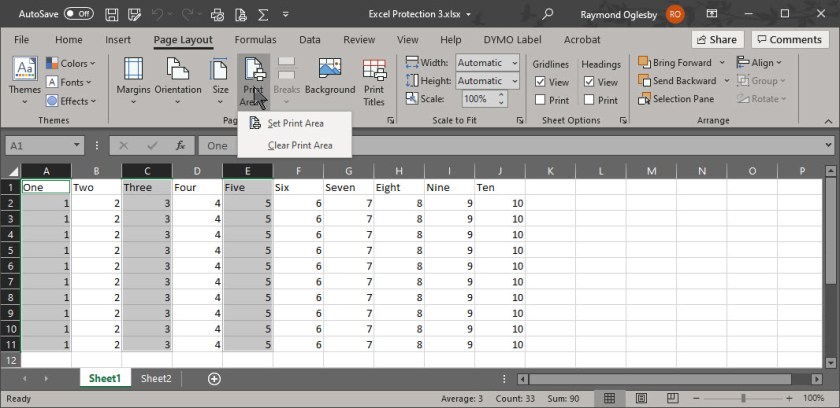
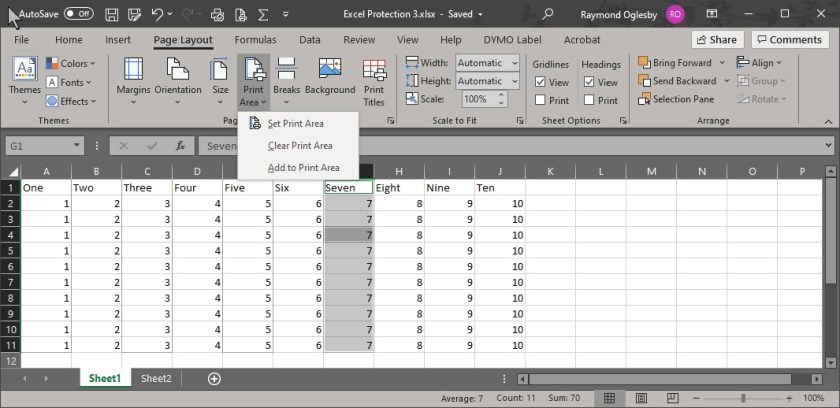
Click Set Print Area. See following image for my selection of nonadjacent cells in Print Area:
Selecting nonadjacent cells Print Area
Please note that each range you selected will print on a separate page in the same order that you selected regardless of cells location. Also, your current page settings will apply to all your pages. For example, you are unable to mix Landscape and Portrait printing.
Second Method of Selecting Cells
Another method is adding nonadjacent cells to an existing Print Area.
Select a range of cells you want to add to your Print Area
Click the Page Layout tab
Click Print Area
Click Add to Print Area. Refer to below image:
Adding a nonadjacent cell range to Print Area
As with the first method, each range will print on a separate page in the order selected and with the same print settings.
Locate the Print Area
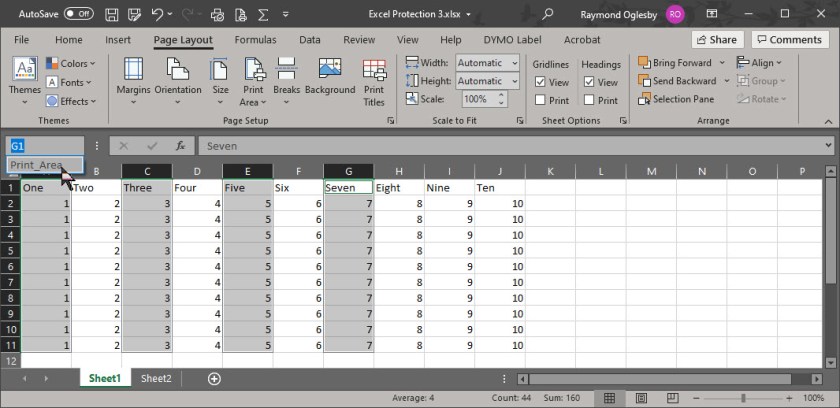
In the Name box to the left of the Formula bar, click it’s drop down arrow and select Print_Area. See following image:
Using the Name box to show the Print Area
Alternatively, from the View tab, click Page Break Preview in the workbook Views group to see the Print Area.
Click Normal to return to default Excel view.
Two Methods on Printing Your Ranges
You may not want each nonadjacent cell range printed on a separate page. You have two options:
Move the cell ranges adjacent to each other and reset your Print Area
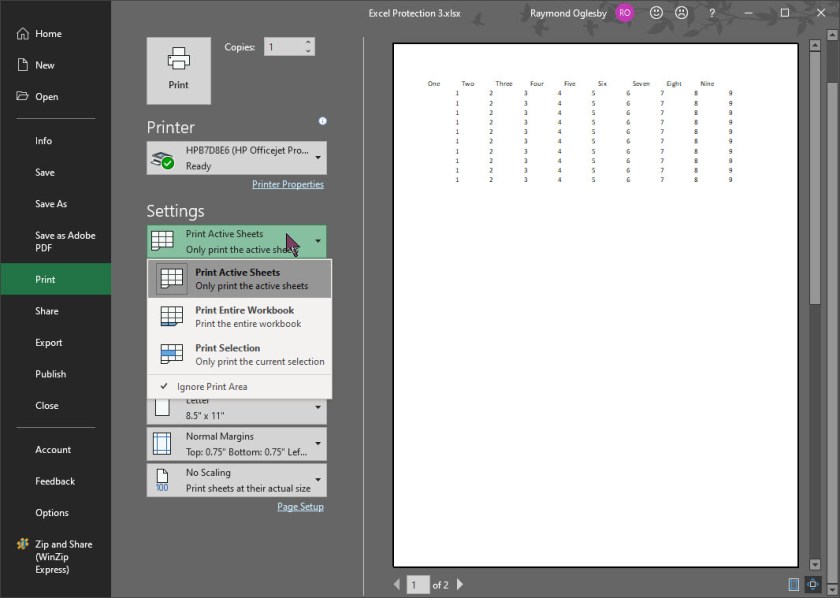
Before printing, select the option to Ignore Print Area. The Active Sheet is now ready for printing. Your Print Area is still saved, you are just ignoring it. Refer to following image:
Ignoring the Print Area for printing
I Would Like to Hear from You
Please feel free to leave a comment. I would love hearing from you. Do you have a computer or smart device tech question? I will do my best to answer your inquiry. Please mention the device, app and version that you are using. To help us out, you can send screenshots of your data related to your question.
The author’s Vietnam eBook on the Battle for Tra Bong: Events and Aftermath
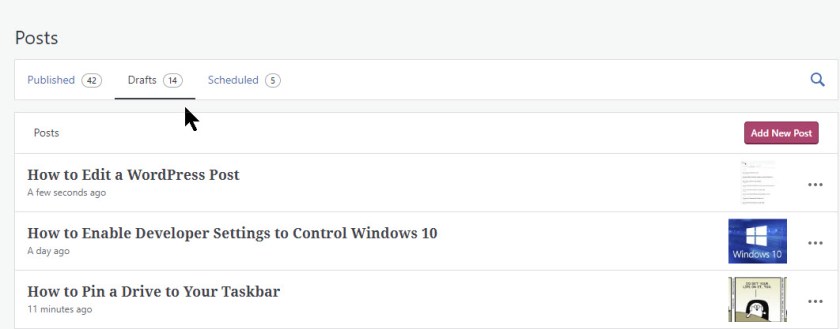
What has happen to WordPress? When you clicked on a Draft, Scheduled or Published post, WordPress would assume you wanted to View the blog post. In a recent update, WordPress now assumes you want to Edit the blog post. This is frustrating. I simply want to view a post and make changes “on the fly”. Now you have to click Save Draft, Update or Schedule the post regardless if you made a change or not. Refer to below image on how I used to view/edit by clicking on a post:
Viewing my Drafts posts in the Editor
Following is my exchanges with WordPress engineers.
My comment: “I go to Posts and click to open a draft. The Save Draft is displayed in upper right corner. All I do is view the post, I make no changes. I want to leave the post, I then have to save it. I go back into the post, sometimes it ask to Restore the backup.
But I made no changes. This is frustrating. Same thing happens to a Scheduled post. I always have to update. It didn’t use to work this way. If I made no changes, I just used the back arrow; now I always have to save and sometimes restore from a backup.”
See following image asking me to Restore the backup when I made no changes:
Asking me to restore the backup when I made no changes
WordPress response: “I just ran a test on your site, and did find that if I open a post, and keep it open for more than 30 seconds, close it and then go back into it, it’s providing the message of restoring a backup, even though no changes were made.
Clicking Update on the unchanged post, before closing it, gets rid of the message and avoids it from appearing at all.
It’s not really a bug or a problem, it’s the result of opening a post for a period of time, even if no changes are made.
You can prevent it by clicking Update before exiting any post or page that you open.”
My response: “Microsoft products are smart enough to know if you have made a change. When you edit a document, and you don’t’ save it , Microsoft will prompt you if you want to save. WordPress should do the same. If all I am doing is viewing a post, it should not prompt me to save or update.”
WordPress response: “Thank you for the critical feedback! We are always working to improve our editing experience and feedback like this is helpful. One of our genuine concerns is that users do not lose their content while they are working on their post or page. With that said, we hope to ensure that users are prompted to save even the smallest changes made to their posts so that they don’t lose their work.
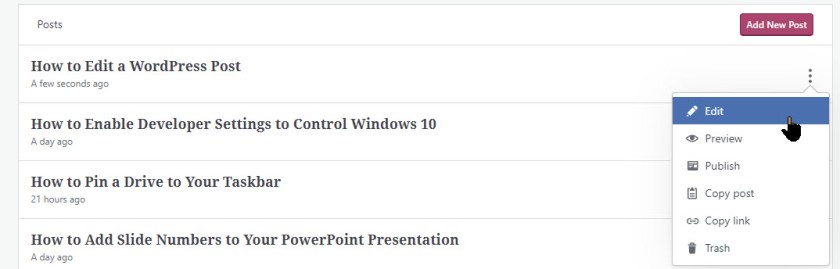
My best suggestion here is to view your published posts instead of the posts within the editor. This will give you a better sense of what your readers see as well and will ensure that no unwanted changes are made to the posts or pages. You can click on the three dots to the right of the post or page title and click “View” to see the published version of the post/page.”
Refer to below image on how to Edit or Preview a post:
How you must edit or preview a post
Are you experincing this behavior from your WordPress blog site?
I have done the usual like logging in and out of WordPress; clearing my Chrome cache and cookies at least twice. But I still have problems.
I Would Like to Hear from You
Please feel free to leave a comment. I would love hearing from you. Do you have a computer or smart device tech question? I will do my best to answer your inquiry. Please mention the device, app and version that you are using. To help me out, you can send screenshots of your data related to your question.
The author’s Vietnam eBook on the Battle for Tra Bong: Events and Aftermath
Yes, you can now hear Podcasts on your Amazon Echo device. Apple Podcasts and others, like Spotify and iHeartRadio, are now options to choose from for your favorite podcasts.
We are going to link your Echo device to one of these podcast services. Our example is linking Apple Podcasts to the Amazon Echo. The ways this is done is somewhat clumsy. The Echo seems to be hard to program; it’s not straightforward. But follow along, it’s not time consuming and is worth it.
This is for iOS devices (iPhone and iPad) and the Amazon Echo
Starting Alexa
Open the Alexa app on your smart device. If you have yet to download the app, head to the Apple Store to download and install.
Tap the hamburger icon, the one with 3 dots in upper right hand corner or tap on the menu icon in upper left hand corner
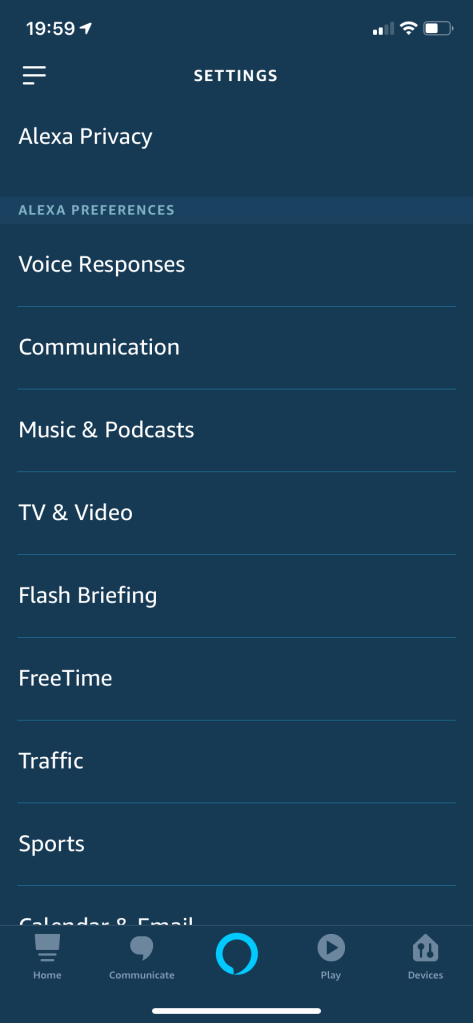
Select Settings. You will see the following screen:
The Settings image
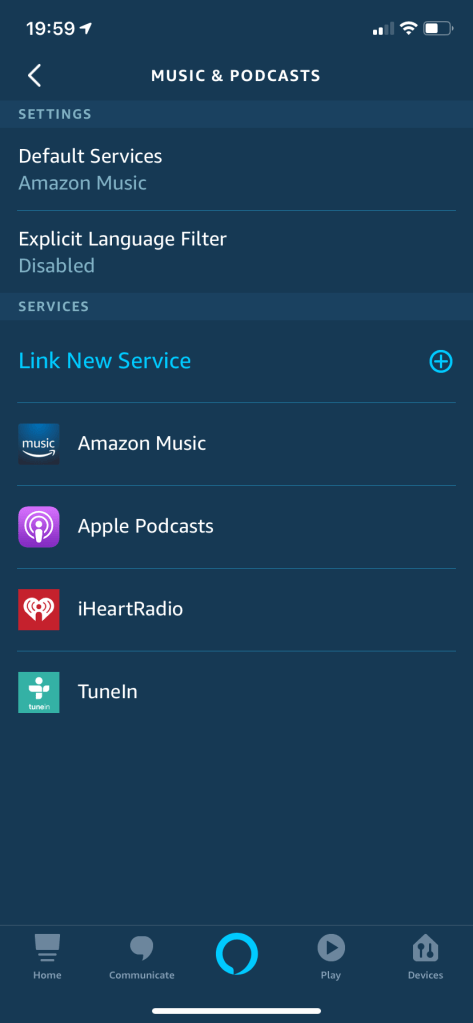
Select Music & Podcasts. Refer to following image:
The Music & Podcasts screen
Setting up the Link
Select Link New Service.
Select Apple Podcasts. Refer to following image:
Enabling the Apple Podcasts image
Tap ENABLE TO USE.
You will be asked to enter your Apple ID, Password and Passcode depending on your login procedure
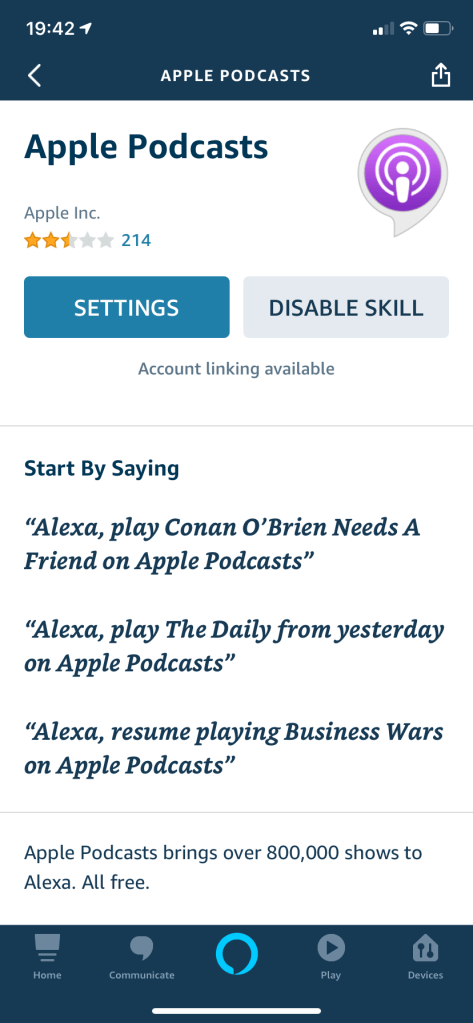
Tap SETTINGS. See following screen:
The Apple Podcasts settings screen.
Linking the Service to Echo
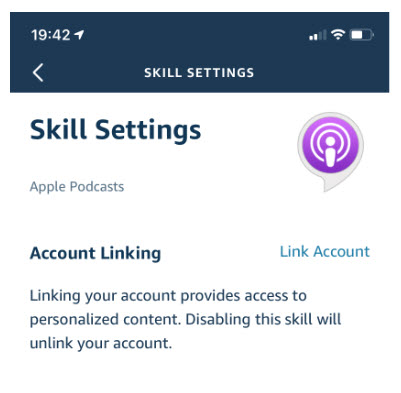
On the Skill Settings screen, tap on the Link Account link. See below image:
The link screen for Apple Podcasts
Allowing Access for the Link
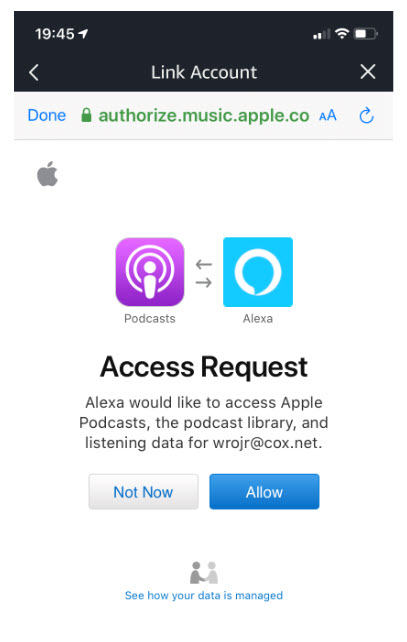
Tap Allow on the AccessRequest screen. You may see a different screen depending on what service you are linking. Refer to below image for Apple Podcasts:
Allowing the link to Apple Podcasts image
Linkage for the Podcast Service Completed
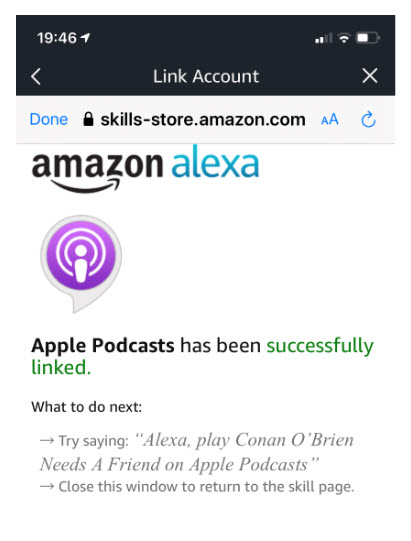
You will see that Apple Podcasts has been successfully linked. See following image:
Apple Podcasts now linked to Amazon Echo screen
Click Done
Now you can listen to your favorite Apple Podcasts. Just repeat the above steps to add other podcast service(s).
I Would Like to Hear from You
Please feel free to leave a comment. I would love hearing from you. Do you have a computer or smart device tech question? I will do my best to answer your inquiry. Please mention the device, app and version that you are using. To help me out, you can send screenshots of your data related to your question.
The author’s Vietnam eBook on the Battle for Tra Bong: Events and Aftermath
I get frustrated when Microsoft Word does not remember my last zoom setting for a document. At times it seems to just forget. It will bring up four pages when I only want to work on one page. To help us out, let’s explore a few options of the Zoom feature.
The Zoom bar is located on the right side of the status bar at the bottom for a Word document. To use the Zoom bar, click and drag the slider to the right or left to zoom out or in. As you do so, the page percentage decreases or increases. Also, you can click the “+” or “-” sign to zoom out or in by 10% increments.
This is for Word for Office 365 Windows and Mac versions. Other versions of Word will be similar.
The Zoom Dialog
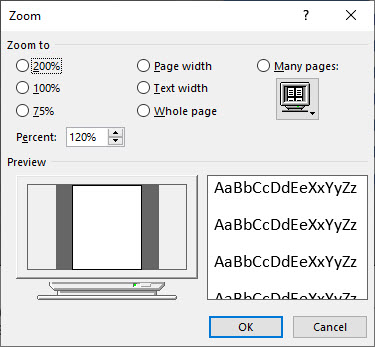
If you want more control, the Zoom Dialog Box offers a few more options. To access this, select View>Zoom. You will see the following screen:
Word Zoom options
You can choose a predefined option, like “75%”, as noted on the left hand side of the dialog box. Alternatively, you can choose the up and down arrows in the Percent button to increase or decrease the percentage in 1% increments. These percentages will differ depending on your device’s screen size of your Word windows (full screen, half screen, etc). When you are finished, click OK.
Some Shortcuts
If your are using a touchscreen or touchpad, you can take advantage of the pinch to zoom feature. This feature allows you to zoom out or in by placing two fingers on the screen. To Zoom out, you pinch your fingers together, to Zoom in, you separate your fingers.
If you are using a mouse, you can hold the Ctrl button and scroll the wheel up or down to Zoom in and out. Some mouses have separate flywheel buttons for zooming in or out.
I Would Like to Hear from You
Please feel free to leave a comment. I would love hearing from you. Do you have a computer or smart device tech question? I will do my best to answer your inquiry. Please mention the device, app and version that you are using. To help us out, you can send screenshots of your data related to your question.
The author’s Vietnam eBook on the Battle for Tra Bong: Events and Aftermath













 and type the person’s phone number or email address. Tap the number or address, then tap Audio
  or Video









 Tech Savvy Life