How to Download PDFs Instead of Viewing Them Using Chrome

When you click a PDF link in Chrome, the browser opens the PDF in a preview window. If you do not want this, you can change its default behavior.

RAYMOND OGLESBY @RaymondOglesby2
August 19, 2021

When you click a PDF link in Chrome, the browser opens the PDF in a preview window. If you do not want this, you can change its default behavior.

The Chrome browser has a built-in option to change this default setting. You can instruct Chrome to automatically download the PDF file without opening it in a preview window.

Instead, Chrome will prompt you to save your PDFs. Let’s explore how to set this feature in Google Chrome.

This is for devices running Google Chrome

Dilbert and Jesus
Copyright Scott Adams, Inc./Distributed by Universal Uclick for UFS

First, open Google Chrome on your computer. Next, click the Chrome menu (three dots hamburger icon) in the top right-hand corner of your window. Now, select Settings. Refer to below image:

PDF 1
Accessing Settings

Next, in Chrome settings, click Privacy and security in the left sidebar. Click Site Settings on the right. See below image:

PDF 2
Accessing Site Settings

Now, scroll down in Site Settings and click Additional content settings at the very bottom of your screen. See following image:

PDF 3

Accessing additional content

Next, in the expanded menu, select PDF documents on the left. Refer to below image:

PDF 4
Accessing PDF documents

Now, toggle ON the Download PDF files instead of automatically opening them in Chrome option. Refer to below image:

PDF 5
Enable download of PDF documents instead of preview

Chrome will now display the standard save prompt for PDFs.

Quote For the Day

But the fact that some geniuses were laughed at does not imply that all who are laughed at are geniuses. They laughed at Columbus, they laughed at Fulton, they laughed at the Wright Brothers. But they also laughed at Bozo the Clown.

Carl Sagan

You are finished. Please feel free to share this post! One way to share is via Twitter.

Just click the Tweet icon below. This will launch Twitter where you click its icon to post the Tweet.

Check out TechSavvy.Life for blog posts on smartphones, PCs, and Macs! You may email us at contact@techsavvy.life for comments or questions.

I Would Like to Hear From You

Please feel free to leave a comment. I would love hearing from you. Do you have a computer or smart device tech question? I will do my best to answer your inquiry. Just send an email to contact@techsavvy.life. Please mention the device, app and version that you are using. To help us out, you can send screenshots of your data related to your question.

The author’s Vietnam eBook on the Battle for Tra Bong: Events and Aftermath

How to Use the Microsoft Measurement Converter

Microsoft Word, PowerPoint, and Outlook offer a hidden measurement converter to save you from doing measurement conversions manually. If you are working with a document, presentation, or email that contains measurements, you will find this time-saving feature useful.

RAYMOND OGLESBY @RaymondOglesby2
August 17, 2021

Microsoft Word, PowerPoint, and Outlook offer a hidden measurement converter to save you from doing measurement conversions manually. If you are working with a document, presentation, or email that contains measurements, you will find this time-saving feature useful. Lets explore this feature.

This is for Office 365. Screenshots are from Windows 10 PC.

Dilbert and Employee
Copyright Scott Adams, Inc./Distributed by Universal Uclick for UFS

Enable Converter in Word and PowerPoint

First, open a document in Microsoft Word or a presentation in PowerPoint. Next, click

File > Options

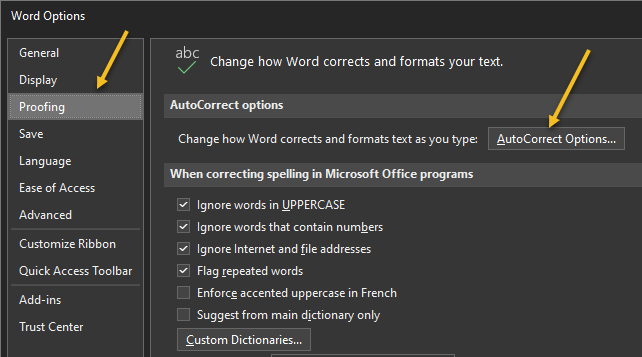
from the menu. Now, select Proofing on the left and click AutoCorrect Options on the right. Refer to below image:

Accessing AutoCorrect.Options

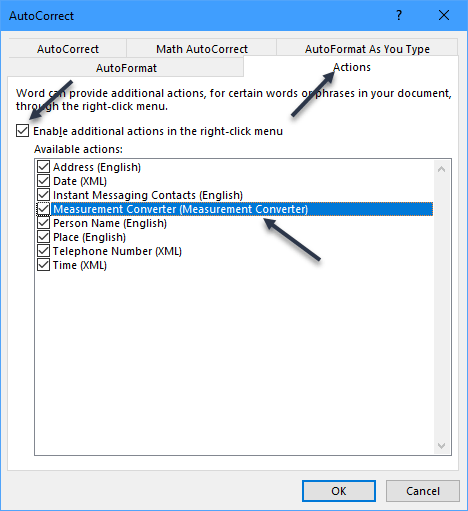
Next, select the Actions tab. Now, check the boxes for Enable Additional Actions in the right-click menu then Measurement Converter from the list. You will notice other actions you can enable. Just checkmark any additional ones you would like to use. See below image:

Enabling Measurement Converter option

Click OK, then OK once more to save and exit the options menu.

Enable Converter in Outlook

First, open Microsoft Outlook and click

File > Options

from your inbox or an email window.

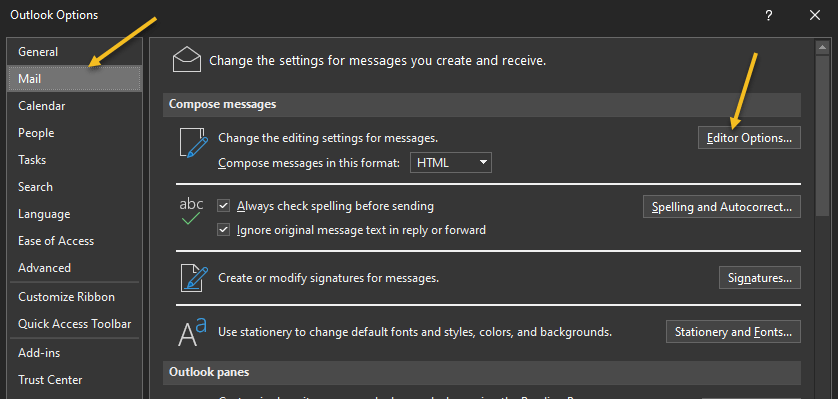
Now, select Mail on the left and click Editor Options on the right. See following image:

Accessing Editor Options

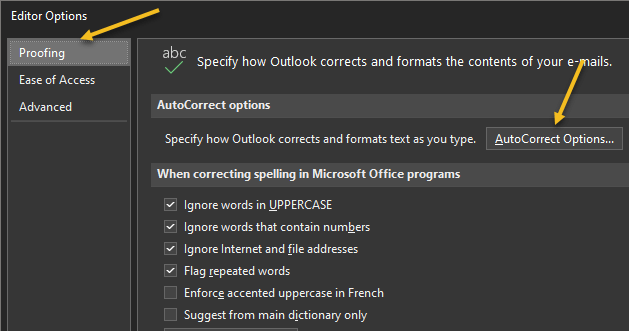
On the next screen, choose Proofing on the left and AutoCorrect Options on the right. Refer to below image:

Accessing AutoCorrect Options

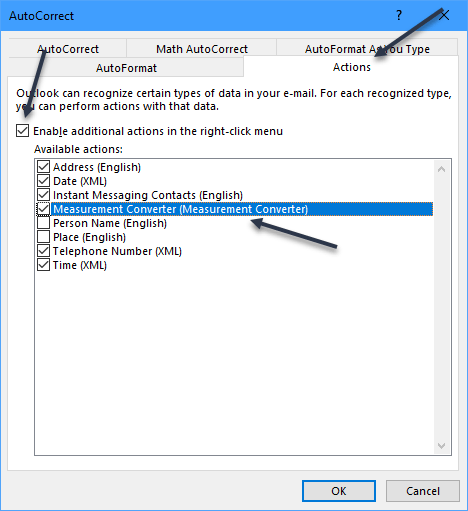
Next, select the Actions tab. Now, check the boxes for Enable Additional Actions in the right-click menu, and Measurement Converter in the list. Like with Word and PowerPoint you can checkmark the boxes for any other actions you would like to use. See below image:

Enabling Measurement Converter option

Next click OK on all screens to save and exit,

Use the Converter in Office

When you receive a document that includes unfamiliar measurements, such as those from a foreign country, this tool takes the work out of manual conversions. And if you are creating the document yourself, you can convert the measurement for your audience.

Just, select the text containing the measurement. You can do this by dragging your cursor through it.

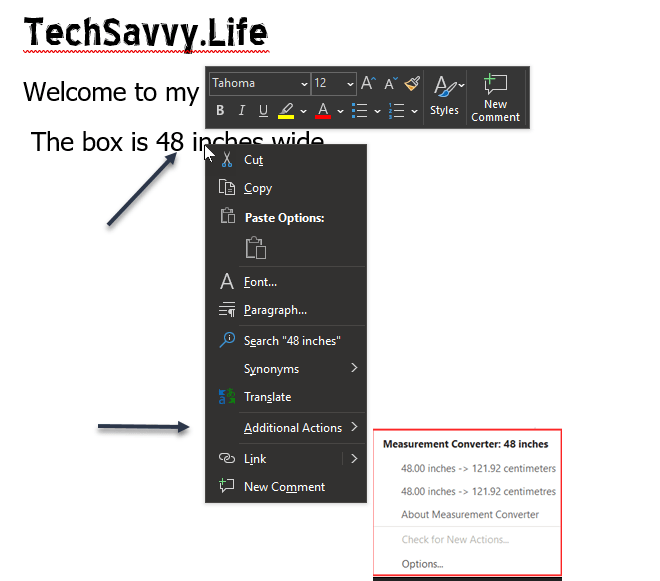
Now, right-click and move your cursor down to Additional Actions in the menu. You will see the Measurement Converter in the pop-out window. Refer to below image:

Accessing Measurement Converter

This lets you view the conversion. Additionally, you can click to select a conversion from the list and it will replace the measurement in your document, presentation, or email. This is convenient when you are preparing an item for someone expecting a different unit of measurement.

Quote For the Day

The greatest mistake you can make in life is continually fearing that you’ll make one.

Elbert Hubbard

That’s it. Please feel free to share this post! One way to share is via Twitter.

Just click the Tweet icon below. This will launch Twitter where you click its icon to post the Tweet.

Check out TechSavvy.Life for blog posts on smartphones, PCs, and Macs! You may email us at contact@techsavvy.life for comments or questions.

I Would Like to Hear From You

Please feel free to leave a comment. I would love hearing from you. Do you have a computer or smart device tech question? I will do my best to answer your inquiry. Just send an email to contact@techsavvy.life. Please mention the device, app and version that you are using. To help us out, you can send screenshots of your data related to your question.
The author’s Vietnam eBook on the Battle for Tra Bong: Events and Aftermath

How to Change Chrome New Tab Background

It’s easy to get bored at Chrome’s single white image background. Can we change this background image when opening a new tab? Yes we can. Chrome allows you to automatically switch the new tab page’s wallpaper every day.

RAYMOND OGLESBY @RaymondOglesby2
August 12, 2021

It’s easy to get bored at Chrome’s single white image background. Can we change this background image when opening a new tab? Yes we can. Chrome allows you to automatically switch the new tab page’s wallpaper every day. Let’s explore how this is done.

This is for devices running Google Chrome

Dilbert and Zoom
Copyright Scott Adams, Inc./Distributed by Universal Uclick for UFS

First, launch the Google Chrome browser on your Windows 10, Mac, Chrome OS, or Linux computer. Next, open a new tab and click the Customize pencil icon in the bottom-right corner of your screen. Refer to below image:

Background 1
Accessing new tab Customize icon

Now, in the pop-up window that appears, make sure that you are in the Background section. See below image:

Background 2
The Background section

Next, on the Background page, you will find a number of preset collections of backdrops, such as “Textures,” “Seascapes,” “Art,” and “Earth.” Google Chrome can automatically apply a new wallpaper from any one of these collections every day on your new tab page.

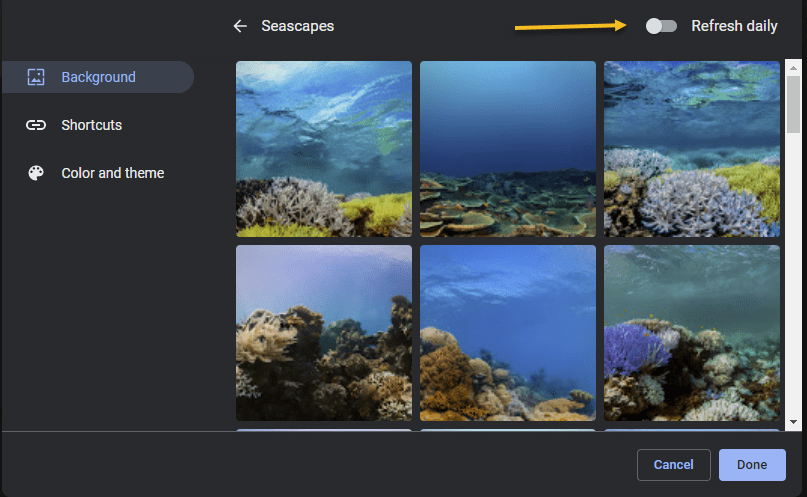
Let’s say that you want Google Chrome to display a new wallpaper from the “Seascapes” collection on your new tab page.

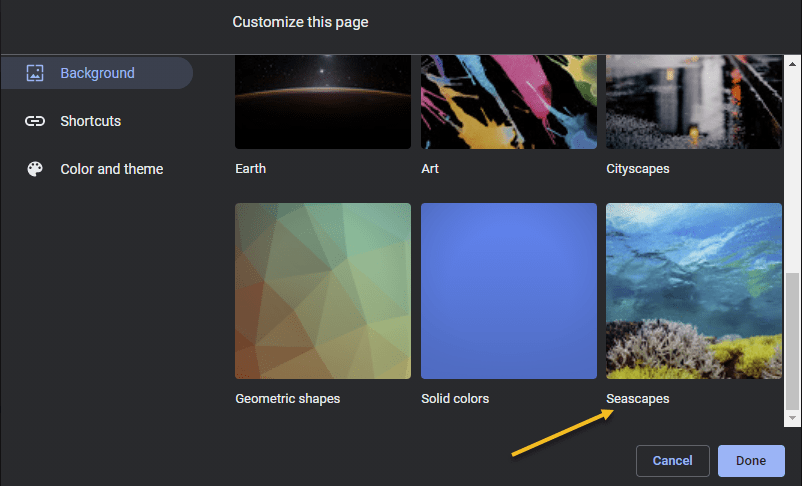
To do this, first, click the collection’s thumbnail in the grid. See following image:

Background 3
Accessing the Seascapes collection

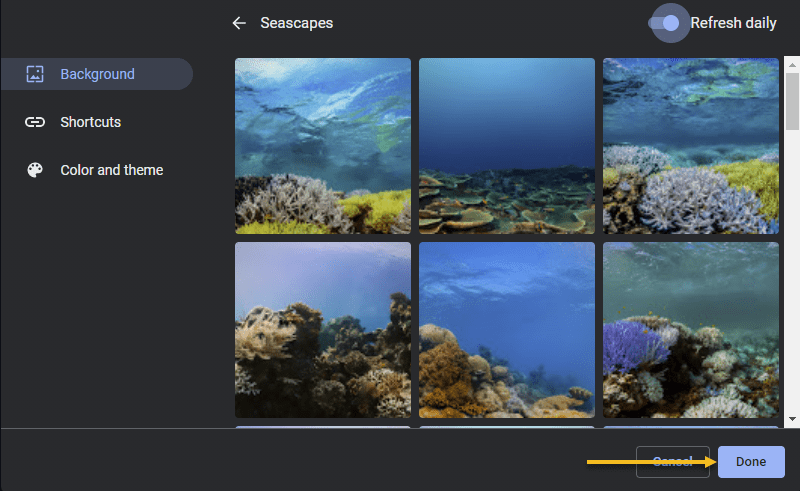
Now, on the next page, Google Chrome will list all of the collection’s wallpapers. Turn on the Refresh Daily switch in the top-right corner of the pop-up window. Refer to below image:

Background 4
Enabling daily switch

Now, click Done to save your preferences. See below image:

Background 5
Your Done

Next, the new tab page on your Google Chrome browser will show a fresh backdrop from the “Seascapes” collection (or whichever collection you have chosen) every day.

If you like one of the background images, you can see the name of the current background’s creator and its source in the bottom-left corner of the new tab page. See following image:

Background 6
Info about the backdrop

There are plenty of other ways that you can customize Google Chrome, such as edit more elements of the new tab page, or create your own browser theme.

Quote For the Day

Only two things are infinite, the universe and human stupidity, and I’m not sure about the former.

Albert Einstein

I like this little known feature of Chrome. Please feel free to share this post! One way to share is via Twitter.

Just click the Tweet icon below. This will launch Twitter where you click its icon to post the Tweet.

Check out TechSavvy.Life for blog posts on smartphones, PCs, and Macs! You may email us at contact@techsavvy.life for comments or questions.

I Would Like to Hear From You

Please feel free to leave a comment. I would love hearing from you. Do you have a computer or smart device tech question? I will do my best to answer your inquiry. Just send an email to contact@techsavvy.life. Please mention the device, app and version that you are using. To help us out, you can send screenshots of your data related to your question.
The author’s Vietnam eBook on the Battle for Tra Bong: Events and Aftermath

How to Free Up Space in Google Drive

It’s easy to run out of space on Google Drive, since it stores data across much of your Google account. Fortunately, it’s also easy to delete data and free up some storage. As you will see, I am running out of space. Let’s explore how to do this.

RAYMOND OGLESBY @RaymondOglesby2
August 10, 2021

It’s easy to run out of space on Google Drive, since it stores data across much of your Google account. Fortunately, it’s also easy to delete data and free up some storage. As you will see, I am running out of space. Let’s explore how to do this.

This is for devices using Google Drive. Screenshots are from Drive on Windows 10 PC

Dilbert and Sane
Copyright Scott Adams, Inc./Distributed by Universal Uclick for UFS

If you use Google Drive to share large files, it’s quite easy to hit the 15GB free data limit on your Google account. While you can upgrade, for a price, it’s best to manually delete some data for more space first. After doing this, I upgraded to the 100GB plan, yet I am still out of space.

You will not need to spend hours combing through every nook and cranny in Google Drive. The website has a storage management feature that lists all your files, sorting them based on their file size.

First, open the Drive website in your browser.

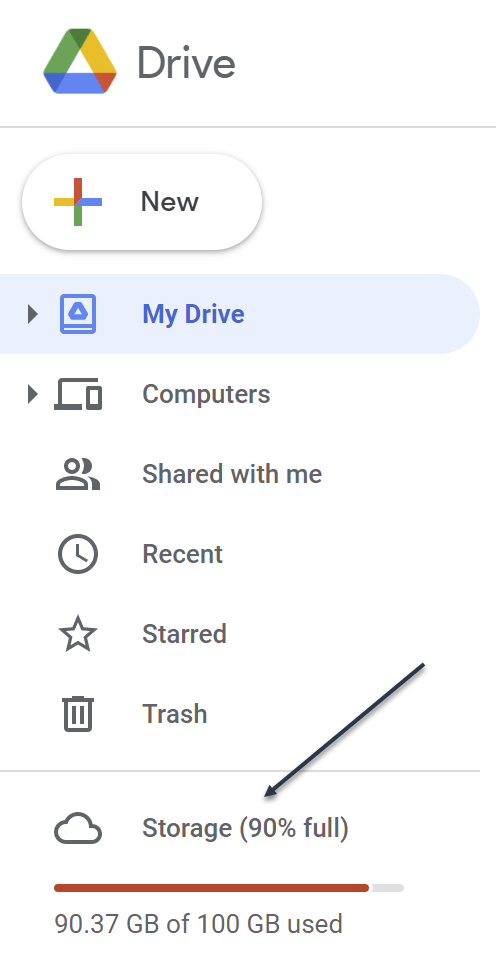
You will see the Storage section at the bottom of the left sidebar. This will show you how much storage space you have left in your account. Now, click the Storage button. Refer to below image:

Drive 1
Your used Storage space

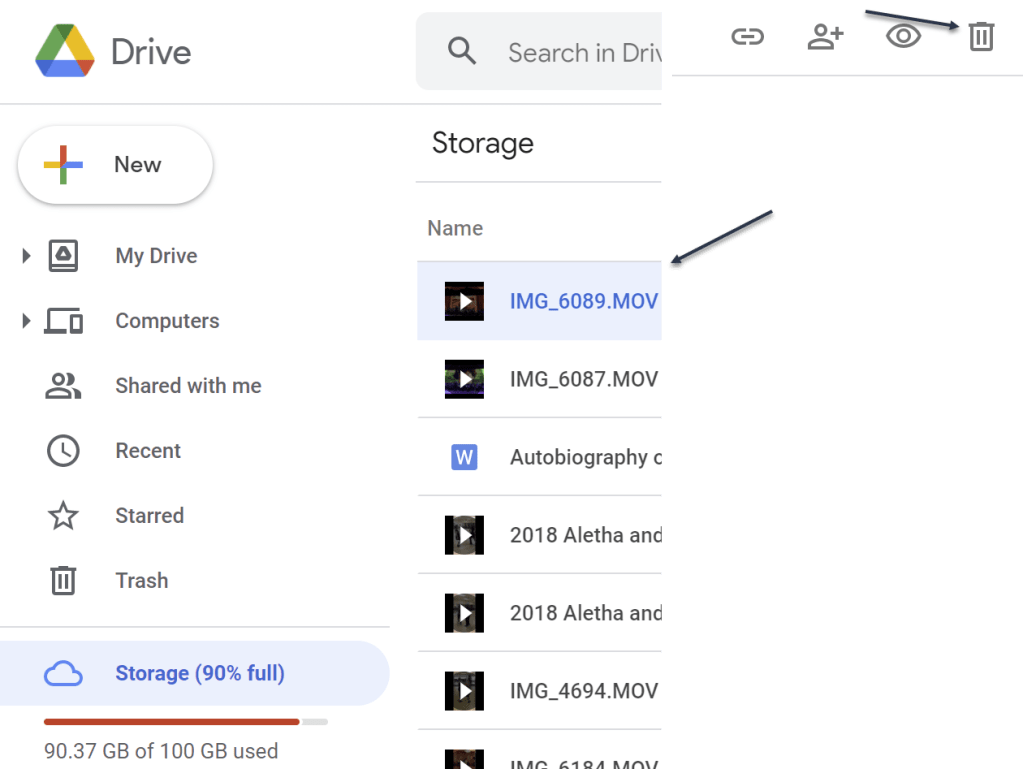
Next, you will see a list of all the large files in your account. Just click a file to select it. To select multiple files, hold the Command/Control key while selecting the file.

Now, to delete the file (or files), click the Remove button (the Trashcan icon) in the top toolbar. See below image:

Drive 2
Delete a file

Google Drive will remove the file and send it to the Trash.

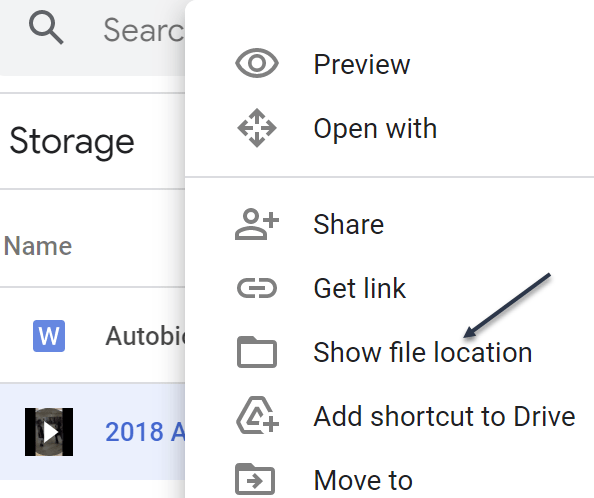
If you want to find and open a folder where a particular file is saved (or find more files to delete), right-click and choose the Show File Location option. See following image:

Drive 3
Find more files

Next, you can select multiple files and use the Remove (Trashcan icon) in the toolbar to delete all the files at once. (You can use this method to delete entire folders as well.)

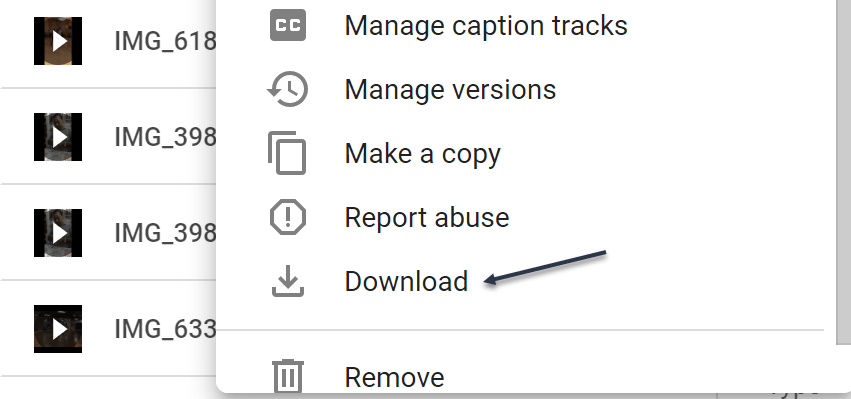
If you do not have a backup of the file that you are planning to delete, click the Download button in the right-click menu to download a copy of the file to your local storage. Refer to below image:

Drive 4
Download a file before deletion

Once you delete files like this, the files are no longer available in Google Drive, but you have not recovered any storage space yet. That’s because Google Drive does not actually delete the files for 30 days. So, if you change your mind, you have up to 30 days to recover the data.

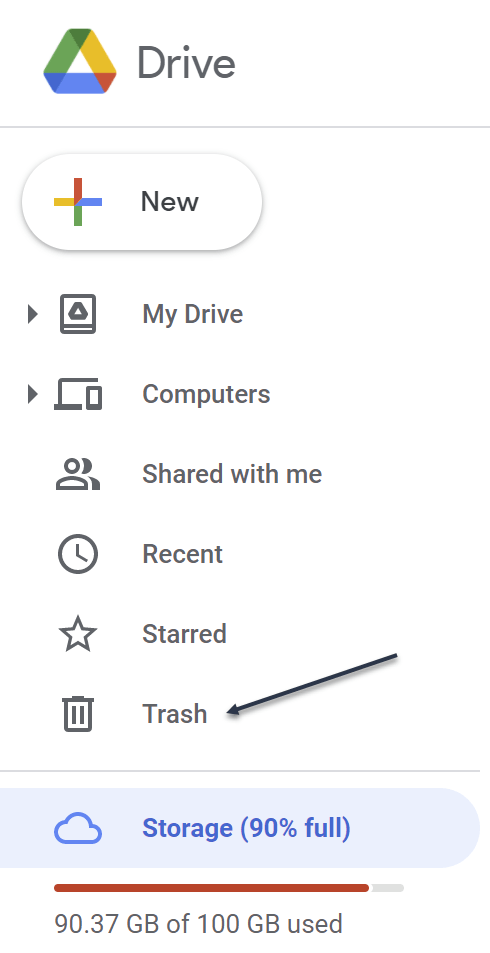
If you want to reclaim the storage space, you will have to force Google Drive to permanently delete the data. To do this, go to the Trash or Bin section in the sidebar. See below image:

Drive 5
Accessing the Trash

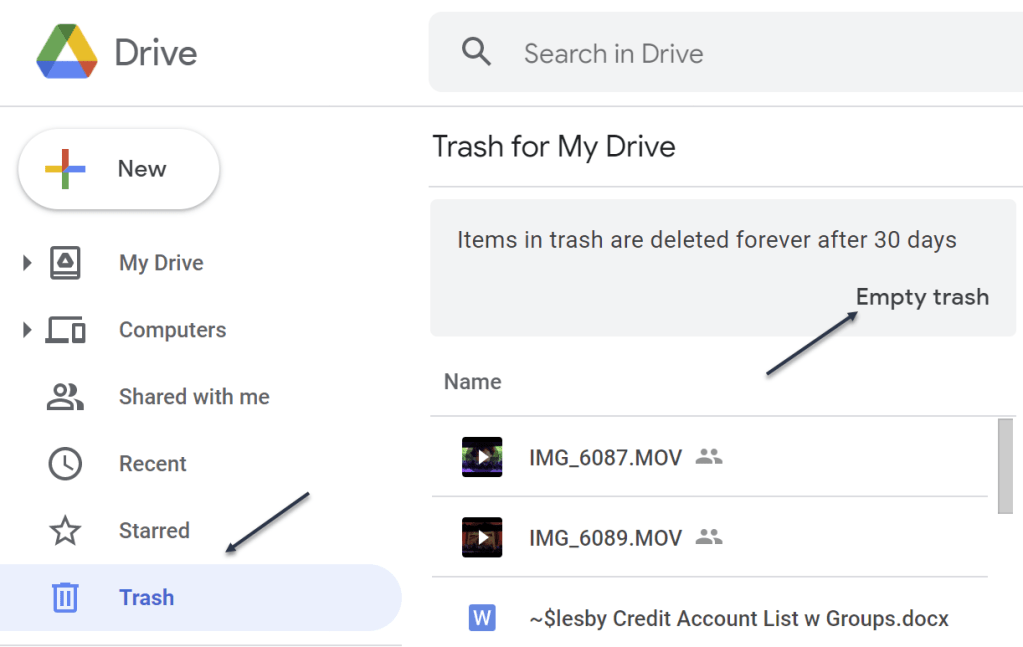
Now, in the Trash, you will see a list of files that have yet to be deleted. To individually delete a file, right-click and choose the Delete Forever option. Or, click Empty Trash to delete all the files. See following image:

Drive 6
Delete your file(s)

Next, in the pop-up that appears, confirm using the Delete Forever button. Refer to below image:

Drive 7
Confirm to delete the file(s) forever

Now, all the files will be deleted. Once you reload the page, you will see that the storage space has been recovered.

Quote For the Day

I have noticed even people who claim everything is predestined, and that we can do nothing to change it, look before they cross the road.

Stephen Hawking

You now know how to clean up storage space on Google Drive. Please feel free to share this post! One way to share is via Twitter.

Just click the Tweet icon below. This will launch Twitter where you click its icon to post the Tweet.

Check out TechSavvy.Life for blog posts on smartphones, PCs, and Macs! You may email us at contact@techsavvy.life for comments or questions.

I Would Like to Hear From You

Please feel free to leave a comment. I would love hearing from you. Do you have a computer or smart device tech question? I will do my best to answer your inquiry. Just send an email to contact@techsavvy.life. Please mention the device, app and version that you are using. To help us out, you can send screenshots of your data related to your question.
The author’s Vietnam eBook on the Battle for Tra Bong: Events and Aftermath

How to Use Advanced Search to Find Tweets

Twitter has tons of information that flows by faster than we can comprehend. Fortunately, it’s possible to search for tweets using various parameters.

5RAYMOND OGLESBY @RaymondOglesby2
August 5, 2021

Twitter has tons of information that flows by faster than we can comprehend. Fortunately, it’s possible to search for tweets using various parameters. Let’s explore this feature.

This is for devices running Twitter

Copyright Scott Adams, Inc./Distributed by Universal Uclick for UFS

Search Tweets by Dates Range

Twitter provides both a mobile and a desktop browser Advanced Search page that lets you search for tweets posted within a certain date range. If you are on a mobile device, open your browser and click here for mobile. For the desktop browser, open your browser and click here for desktop.

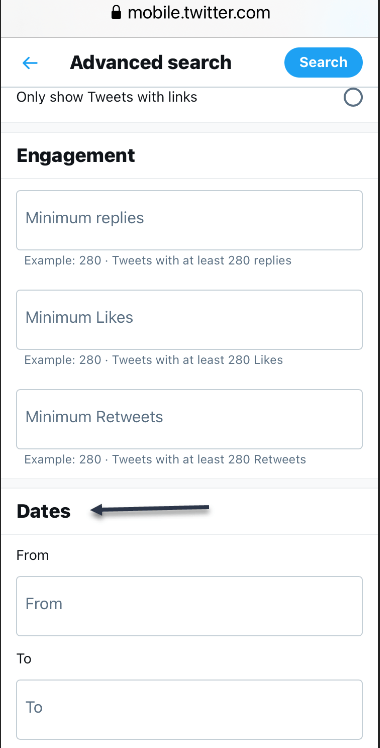
Now, on the Advanced Search page, scroll all the way down to the bottom to the Dates section. There, you will find two parameters: From and To. Refer to below image:

Accessing Dates section

Next, choose your desired month, day, and year for each parameter. Here’s what they do:

  • From: Set this to find tweets posted after midnight (12:00 a.m.) on this date.
  • To: Set this to find tweets posted up until midnight (12:00 a.m.) on this date.

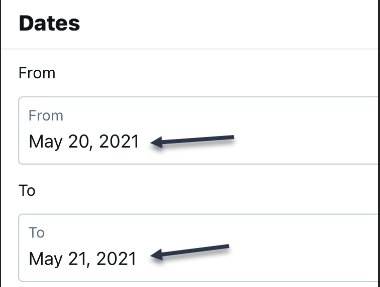
While this sounds simple, using the parameters can be confusing. For example, if you want to find tweets only from May 20, 2021, you would set From to “May 20, 2021” and To to “May 21, 2021.” You will get tweets posted between midnight on May 20 until midnight on May 21. You would not set both fields to the same date. See below image:

Setting From and To date

Similarly, if you wanted to find only tweets from the month of May 2021, you would set From to “May 1, 2021” and To to “June 1, 2021.” That way, your search will cover all 31 days of May.

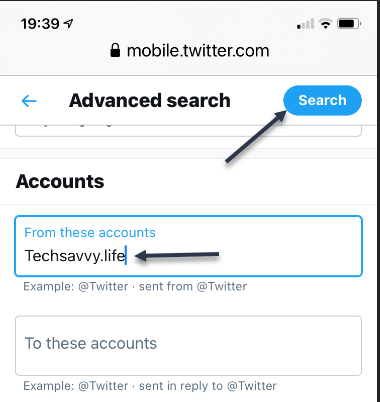
Now, scroll up and enter another parameter, such as a search term in the Words section, or an account name in the Accounts section. Next, click Search when you are done. See following image for an Account search:

Search an Account

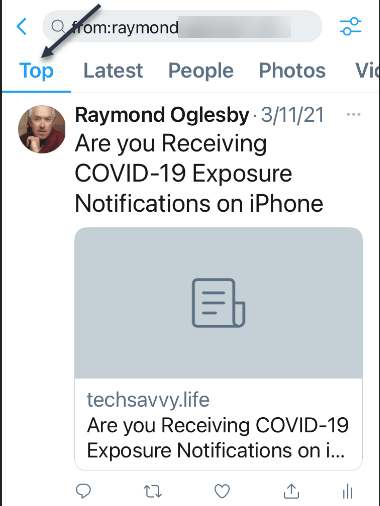
When you see the results, you can further sort them by different criteria using tabs located just below the search bar. Top shows the matching tweets with the most engagements. Latest shows all matching tweets in reverse chronological order. Refer to below image for the Latest using my domain name:

Display Latest posts for an Account

See below image for my Top posts using my Twitter name:

Display Top posts for a Twitter name

If you need to do another search, just revisit Twitter’s advanced search page and search again. It includes many parameters that allow you to narrow down tweets on certain dates, people, photos, videos, and much more.

Search Tweets by Date Range Using Inline Parameters

Another way of searching for tweets from a specific date or dates is using inline search parameters that you type directly into the search box in the Twitter app or on the Twitter website.

Here are three parameters that you can use:

Note! the following are just examples, not for literal input.

  • From: Find tweets posted only by this Twitter account. For example: from:raymondxxx  or from:techsavvy.
  • Since: Find tweets posted since 12:00 a.m. on this date. The date format is YYYY-MM-DD. For example: since:2021-05-01.
  • Until: Find tweets posted until 12:00 a.m. on this date. The date format is YYYY-MM-DD. For example: until:2021-06-01.

For example, if you would like to see all tweets posted by the “techsavvy” Twitter account between May 1, 2021 and June 1, 2021, you would type the following into the Twitter search box:

from:techsavvy until:2021-06-01 since:2021-05-01

If you wanted to find all posts about “Safari” by “raymondxxx” posted on May 15, 2021, you would enter:

safari from:raymondxxx since:2021-05-15 until:2021-05-16

And so on. This kind of quick inline search can be quite powerful once you get the syntax of the date format. You can also find embarrassing old tweets and delete them.

Quote For the Day

There ain’t no answer. There ain’t gonna be any answer. There never has been an answer. That’s the answer.

Gertrude Stein

You are finished with learning how to find tweets using Advance Search. Please feel free to share this post! One way to share is via Twitter.

Just click the Tweet icon below. This will launch Twitter where you click its icon to post the Tweet.

Check out TechSavvy.Life for blog posts on smartphones, PCs, and Macs! You may email us at contact@techsavvy.life for comments or questions.

I Would Like to Hear From You

Please feel free to leave a comment. I would love hearing from you. Do you have a computer or smart device tech question? I will do my best to answer your inquiry. Just send an email to contact@techsavvy.life. Please mention the device, app and version that you are using. To help us out, you can send screenshots of your data related to your question.
The author’s Vietnam eBook on the Battle for Tra Bong: Events and Aftermath

How to Open File Explorer to “This PC”

Windows 10 users may have noticed that by default, File Explorer opens to Quick Access. Quick Access gives you a view of recent and frequently used files and folders. You also have the option to Pin items to Quick Access.

RAYMOND OGLESBY @RaymondOglesby2
August 3,2021

Windows 10 users may have noticed that by default, File Explorer opens to Quick Access. Quick Access gives you a view of recent and frequently used files and folders. You also have the option to Pin items to Quick Access.

If you prefer, you can change the default to open to This PC instead. This PC option shows your drives, network locations, and user folders like Documents, Desktop, and Downloads.

This is for devices running Windows 10

Dilbert and Stock
Copyright Scott Adams, Inc./Distributed by Universal Uclick for UFS

First, open any File Explorer window. Next, in the menu, click:

File > Options > Change folder and search options

Refer to below image:

This PC 1
Accessing the Change folder option

Now, in Folder Options, click the General tab. Next, click the menu beside Open File Explorer to. See below image:

This PC 2
Accessing where to open File Explorer

Now, in the menu that appears, select This PC. Next, click OK to close the window. See following image:

This PC 3
Choosing This PC option to open File Explorer

The next time you open File Explorer, you will see This PC as the first location that opens.

Quote For the Day

Technology is a useful servant but a dangerous master.

Christian Lous Lange

That was easy. That’s it. Please feel free to share this post! One way to share is via Twitter.

Just click the Tweet icon below. This will launch Twitter where you click its icon to post the Tweet.

Check out TechSavvy.Life for blog posts on smartphones, PCs, and Macs! You may email us at contact@techsavvy.life for comments or questions.

I Would Like to Hear From You

Please feel free to leave a comment. I would love hearing from you. Do you have a computer or smart device tech question? I will do my best to answer your inquiry. Just send an email to contact@techsavvy.life. Please mention the device, app and version that you are using. To help us out, you can send screenshots of your data related to your question.
The author’s Vietnam eBook on the Battle for Tra Bong: Events and Aftermath

How to View Excel Sheet/Workbook Statistics

If you need to see how many formulas, pivot tables, or form controls you have in a spreadsheet or workbook, check out the Workbook Statistics feature in Microsoft Excel.

If you need to see how many formulas, pivot tables, or form controls you have in a spreadsheet or workbook, check out the Workbook Statistics feature in Microsoft Excel. Let’s explore this feature.

This is for devices running Excel. Screenshots are from Excel in Office 365 on Windows 10

Dilbert and Issue
Copyright Scott Adams, Inc./Distributed by Universal Uclick for UFS

You may have found statistics in Word helpful for seeing the number of pages, words, or characters. Getting statistics in Excel can be just as useful. You may have a workbook for a class with specific requirements, or you may have a spreadsheet for business that you want to review for unnecessary elements.

View Your Sheet/Workbook Statistics

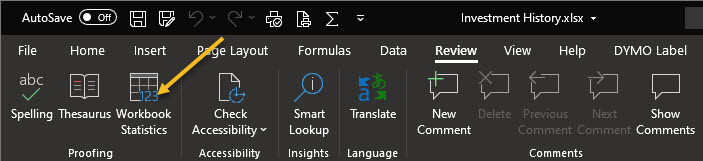
First, open your Excel workbook. Next, navigate to the Review tab. Now, click Workbook Statistics in the Proofing section. You can also press Ctrl+Shift+G. (Note that the shortcut will not work in Excel for the Web.) Refer to below image:

Stats 1
Accessing Workbook Statistics button

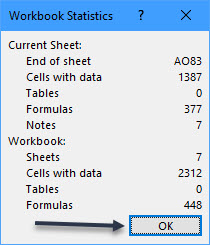
Now, a small window will open to display the data for your current sheet at the top and the entire workbook at the bottom. See below image:

Stats 2
Displaying one Sheet Statistics

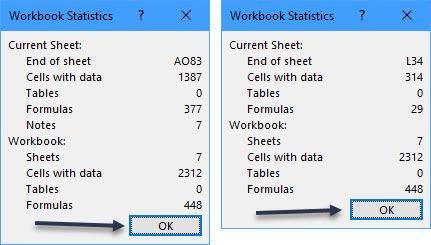
If you want details for a different sheet in your workbook, close the Workbook Statistics window by clicking OK. Next click the tab for the sheet that you want to see and follow the same steps listed above. As a downside, the sheet and workbook name are not shown. See following image:

Stats 3
Displaying two Sheets and Workbook Statistics

Data Included

You can see a the following data with the Workbook Statistics feature. This is helpful for situations where you expect to see something in your current sheet or workbook and you do not, or vice versa. Statistics may differ slightly between the spreadsheet and the entire workbook.

Spreadsheet Statistics:

  • The end of the sheet (the last cell with data)
  • Cells with data
  • Tables and PivotTables
  • Formulas
  • Charts
  • Images and objects
  • Form controls
  • Comments and notes

Workbook Statistics:

  • Number of sheets
  • Cells with data
  • Tables and PivotTables
  • Formulas
  • Charts
  • External connections
  • Macros

You can view Workbook Statistics in Excel for Microsoft 365 on Windows and Mac as well as in Excel on the Web. The only difference is that Excel online does not display the complete data lists written above for sheets and workbooks.

The scientific theory I like best is that the rings of Saturn are composed entirely of lost airline luggage.

Mark Russell

That’s it. Please feel free to share this post! One way to share is via Twitter.

Just click the Tweet icon below. This will launch Twitter where you click its icon to post the Tweet.

Check out TechSavvy.Life for blog posts on smartphones, PCs, and Macs! You may email us at contact@techsavvy.life for comments or questions.

I Would Like to Hear From You

Please feel free to leave a comment. I would love hearing from you. Do you have a computer or smart device tech question? I will do my best to answer your inquiry. Just send an email to contact@techsavvy.life. Please mention the device, app and version that you are using. To help us out, you can send screenshots of your data related to your question.

The author’s Vietnam eBook on the Battle for Tra Bong: Events and Aftermath

How to Drag Tabs Between Browser Windows

Did you know you can drag tabs between browser windows within Chrome, Edge, Firefox, and Safari on Windows, Linux, and Mac? (But not between different browser types.) It seems obvious in retrospect, but many people never notice.

Did you know you can drag tabs between browser windows within Chrome, Edge, Firefox, and Safari on Windows, Linux, and Mac? (But not between different browser types.) It seems obvious in retrospect, but many people never notice. Let’s explore how this is done.

This is for modern browsers. Screenshots are from Chrome in Windows 10

Dilbert and Press
Copyright Scott Adams, Inc./Distributed by Universal Uclick for UFS

First, open Google Chrome, Microsoft Edge, Apple Safari, or Mozilla Firefox on a Mac or PC. Open a few tabs in one browser window and then press Ctrl+n (or Command+n on a Mac) to open another browser window.

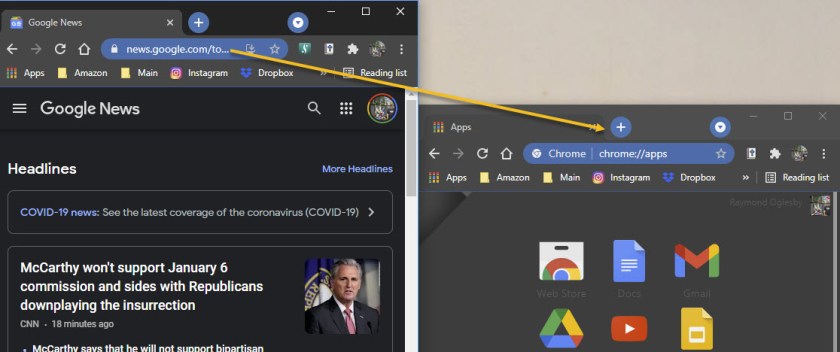
To move a tab between browser windows, click and drag the tab from the tab bar in one window onto the tab bar in another window.

(In Safari, you can alternatively just drag a tab and drop it anywhere on top of another Safari browser window.) Refer to below image for using Chrome:

Tabs 1

Once you drag the tab into the other window’s tab bar, you will see that tab appear in the tab list of the destination window. See below image:

Tabs 2

In Chrome, Edge, and Firefox, you can select multiple tabs. Just hold down Ctrl (or Command on a Mac) and click on multiple tabs. Once they are selected, you can drag them off into a new window, or you can close all of them by pressing any tab’s X button.

Quote For the Day

Part of the inhumanity of the computer is that, once it is competently programmed and working smoothly, it is completely honest.

Isaac Asimov

That’s it. Please feel free to share this post! One way to share is via Twitter.

Just click the Tweet icon below. This will launch Twitter where you click its icon to post the Tweet.

Check out TechSavvy.Life for blog posts on smartphones, PCs, and Macs. You may email us at contact@techsavvy.life for comments or questions.

I Would Like to Hear From You

Please feel free to leave a comment. I would love hearing from you. Do you have a computer or smart device tech question? I will do my best to answer your inquiry. Just send an email to contact@techsavvy.life. Please mention the device, app and version that you are using. To help us out, you can send screenshots of your data related to your question.
The author’s Vietnam eBook on the Battle for Tra Bong: Events and Aftermath

How to Remove All Images in a Word Document

If you need to quickly remove all the images and graphics from a Microsoft Word document, it’s easy to use a built-in option to delete them all at once.

If you need to quickly remove all the images and graphics from a Microsoft Word document, it’s easy to use a built-in option to delete them all at once. Let’s explore how this is done.

This is for devices running Microsoft Word

Dilbert and Politics
Copyright Scott Adams, Inc./Distributed by Universal Uclick for UFS

The Technique

Microsoft Word includes a feature called Find and Replace to find items in your documents and replace them with something of your choice. Using this feature, you can find all the images in your document and replace them with nothing. This removes the images and leaves a blank space where they were located.

As a slight drawback, this technique will also remove all charts and graphs from your document.

The Removal Process

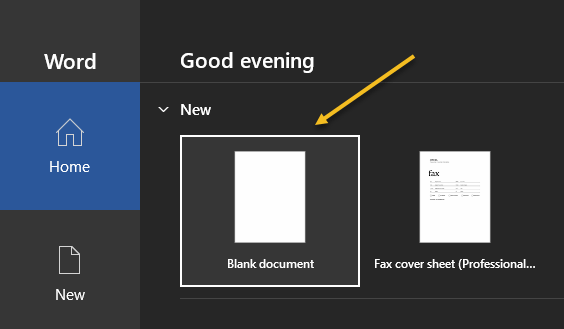
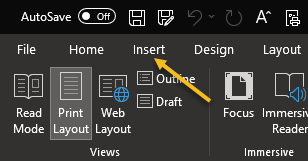
First, open your document with Microsoft Word. Next, in the menu at the top of the window, click Home. Now, click Replace in the Editing section of the toolbar. Refer to below image:

Image 1
Accessing the Replace button

Next, in the Find and Replace window, click the Find what box. In this box, type:

^g

(Alternately, you can click the More button, and then select Special and Graphic from the drop-down menu. Word will insert a ^g for you.)

In this case, ^g is a special code that means “graphic.” This “graphic” tag includes all images, charts, or graphs in your document. But no need to worry, you can undo this step later if you remove the images by mistake.

Now, click Replace All at the bottom of the window. See below image:

Image 2
Selecting Replace All to remove all images

All images in your document will be removed. A pop-up window will appear denoting the number of images removed. Click OK to close the window. See following image:

Image 3
Pop-up window denoting number of images replaced with a blank line

If you want to bring them back, press Ctrl+Z on Windows or Command+Z on Mac to undo the removal process. Or, you can insert images again if necessary. (You may need to edit your document to remove blank lines). Now, save your changes (if any) and exit Word.

Quote For the Day

The art of teaching is the art of assisting discovery.

Mark Van Doren

That was easy. Please feel free to share this post! One way to share is via Twitter.

Just click the Tweet icon below. This will launch Twitter where you click its icon to post the Tweet.

Check out TechSavvy.Life for blog posts on smartphones, PCs, and Macs! You may email us at contact@techsavvy.life for comments or questions.

I Would Like to Hear From You

Please feel free to leave a comment. I would love hearing from you. Do you have a computer or smart device tech question? I will do my best to answer your inquiry. Just send an email to contact@techsavvy.life. Please mention the device, app and version that you are using. To help us out, you can send screenshots of your data related to your question.
The author’s Vietnam eBook on the Battle for Tra Bong: Events and Aftermath

What Are Windows 11 Minimum Requirements

Following are the basic requirements for installing Windows 11 on a PC. If your device does not meet these requirements, you may not be able to install Windows 11 and might want to consider purchasing a new device.


Following are the basic requirements for installing Windows 11 on a PC. If your device does not meet these requirements, you may not be able to install Windows 11 and might want to consider purchasing a new device. If you are unsure whether your PC meets these requirements, you can check with your PC Original Equipment Manufacturer (OEM) or, if your device is already running Windows 10, you can use the PC Health Check app to assess compatibility.

Note! As of this writing, the PC Health Check app has been removed from the App Store. The reason is because the app is denying millions of PCs for the upgrade. Microsoft has some hurdles to overcome. Let’s find out.

This is for Windows 10 devices

Dilbert and Skin
Copyright Scott Adams, Inc./Distributed by Universal Uclick for UFS

The Requirements

Processor:

  • 1 gigahertz (GHz) or faster with 2 or more cores on a compatible 64 bit processor System on a Chip (SoC)

RAM:

  • 4 gigabyte (GB)

Storage:

  • 64 GB or larger storage device

System firmware:

  • UEFI, Secure Boot capable

TPM:

  • Trusted Platform Module (TPM) version 2.0

Graphics card:

  • Compatible with DirectX 12 or later with WDDM 2.0 driver

Display:

  • High definition (720p) display that is greater than 9” diagonally, 8 bits per color channel

Internet connection and Microsoft accounts: 

  • Windows 11 Home edition requires internet connectivity and a Microsoft account to complete device setup on first use. Switching a device out of Windows 11 Home in S mode also requires internet connectivity.

For all Windows 11 editions, internet access is required to perform updates and to download and take advantage of some features. A Microsoft account is required for some features.

Check Your Version of Trusted Platform Module (TPM)

To check this, we are going to use the Device Manager.

First, type “device manager” in the Cortana search box in lower left-hand corner. Next, in the search results, click on Device Manager in upper left-hand corner. Refer to below image:

Win 11 Requirements 1
Selecting Device Manager

Now, after the Device Manager opens, scroll down and click on Security Device to expand the menu and see if any TPM entries exist. See below image:

Win 11 Requirements 2
Opening Security devices for TPM entry

This computer meets the requirement for version 2.0 of TPM.

If you have TPM 1.2, you may be able to upgrade to Windows 11; there are no guarantees.

Quote For the Day

No sensible decision can be made any longer without taking into account not only the world as it is, but the world as it will be.

Isaac Asimov

That’s it. Please feel free to share this post! One way to share is via Twitter.

Just click the Tweet icon below. This will launch Twitter where you click its icon to post the Tweet.

Check out TechSavvy.Life for blog posts on smartphones, PCs, and Macs! You may email us at contact@techsavvy.life for comments or questions.

I Would Like to Hear From You

Please feel free to leave a comment. I would love hearing from you. Do you have a computer or smart device tech question? I will do my best to answer your inquiry. Just send an email to contact@techsavvy.life. Please mention the device, app and version that you are using. To help us out, you can send screenshots of your data related to your question.
The author’s Vietnam eBook on the Battle for Tra Bong: Events and Aftermath