How to Free Up Space in Google Drive

It’s easy to run out of space on Google Drive, since it stores data across much of your Google account. Fortunately, it’s also easy to delete data and free up some storage. As you will see, I am running out of space. Let’s explore how to do this.

RAYMOND OGLESBY @RaymondOglesby2
August 10, 2021

It’s easy to run out of space on Google Drive, since it stores data across much of your Google account. Fortunately, it’s also easy to delete data and free up some storage. As you will see, I am running out of space. Let’s explore how to do this.

This is for devices using Google Drive. Screenshots are from Drive on Windows 10 PC

Dilbert and Sane
Copyright Scott Adams, Inc./Distributed by Universal Uclick for UFS

If you use Google Drive to share large files, it’s quite easy to hit the 15GB free data limit on your Google account. While you can upgrade, for a price, it’s best to manually delete some data for more space first. After doing this, I upgraded to the 100GB plan, yet I am still out of space.

You will not need to spend hours combing through every nook and cranny in Google Drive. The website has a storage management feature that lists all your files, sorting them based on their file size.

First, open the Drive website in your browser.

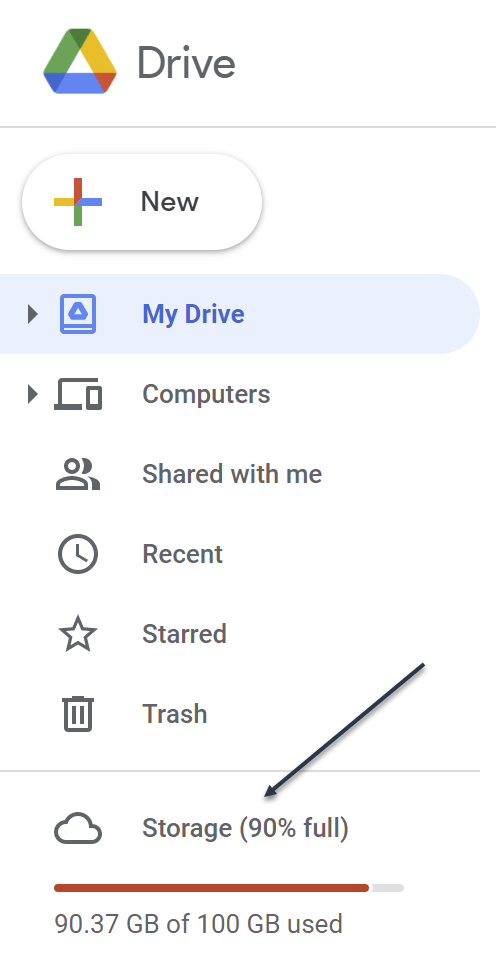
You will see the Storage section at the bottom of the left sidebar. This will show you how much storage space you have left in your account. Now, click the Storage button. Refer to below image:
Drive 1
Your used Storage space

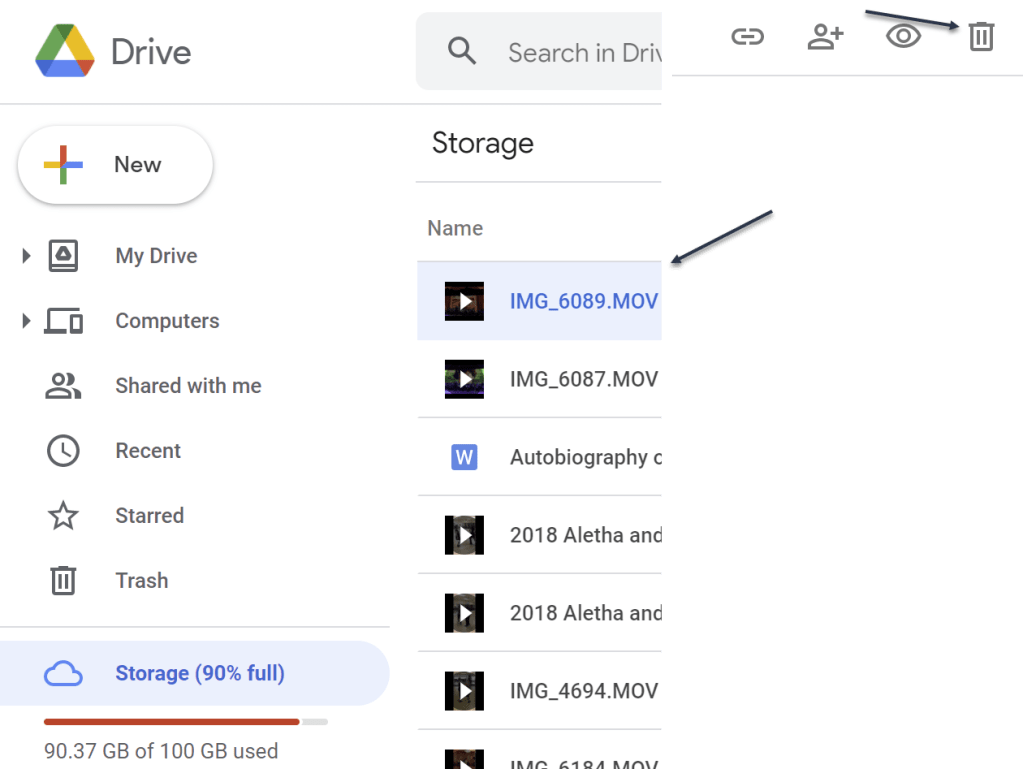
Next, you will see a list of all the large files in your account. Just click a file to select it. To select multiple files, hold the Command/Control key while selecting the file.

Now, to delete the file (or files), click the Remove button (the Trashcan icon) in the top toolbar. See below image:
Drive 2
Delete a file

Google Drive will remove the file and send it to the Trash.

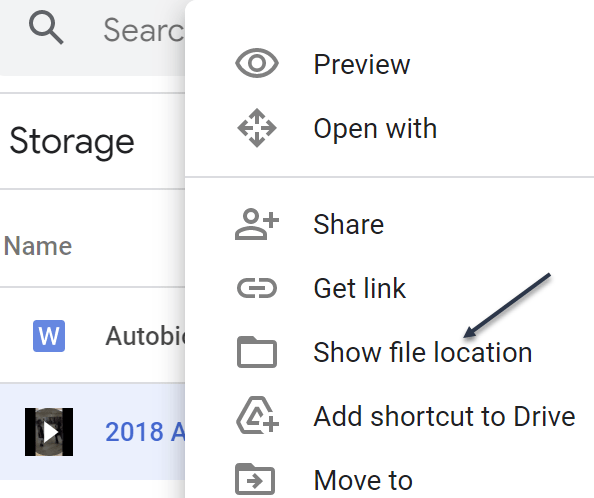
If you want to find and open a folder where a particular file is saved (or find more files to delete), right-click and choose the Show File Location option. See following image:
Drive 3
Find more files

Next, you can select multiple files and use the Remove (Trashcan icon) in the toolbar to delete all the files at once. (You can use this method to delete entire folders as well.)

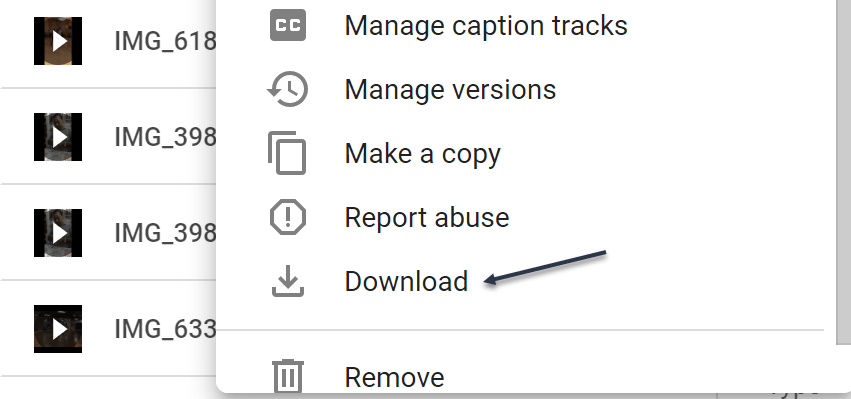
If you do not have a backup of the file that you are planning to delete, click the Download button in the right-click menu to download a copy of the file to your local storage. Refer to below image:
Drive 4
Download a file before deletion

Once you delete files like this, the files are no longer available in Google Drive, but you have not recovered any storage space yet. That’s because Google Drive does not actually delete the files for 30 days. So, if you change your mind, you have up to 30 days to recover the data.

If you want to reclaim the storage space, you will have to force Google Drive to permanently delete the data. To do this, go to the Trash or Bin section in the sidebar. See below image:
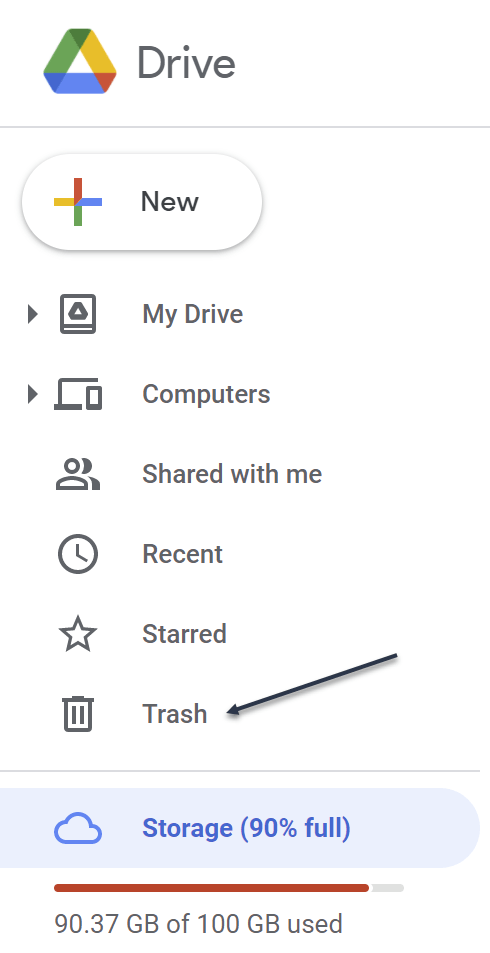
Drive 5
Accessing the Trash

Now, in the Trash, you will see a list of files that have yet to be deleted. To individually delete a file, right-click and choose the Delete Forever option. Or, click Empty Trash to delete all the files. See following image:
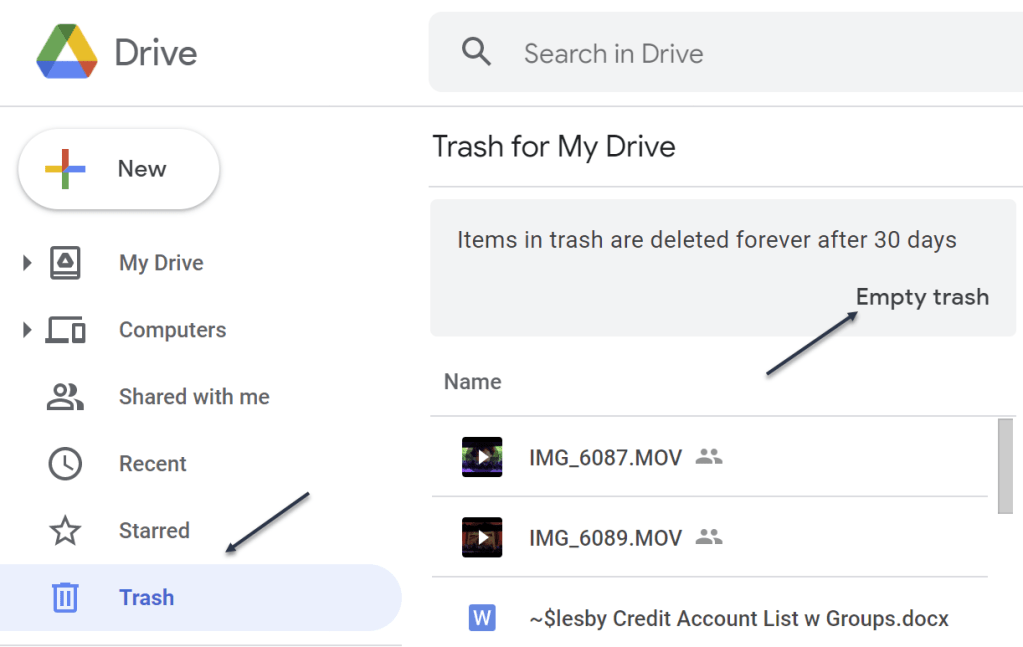
Drive 6
Delete your file(s)

Next, in the pop-up that appears, confirm using the Delete Forever button. Refer to below image:
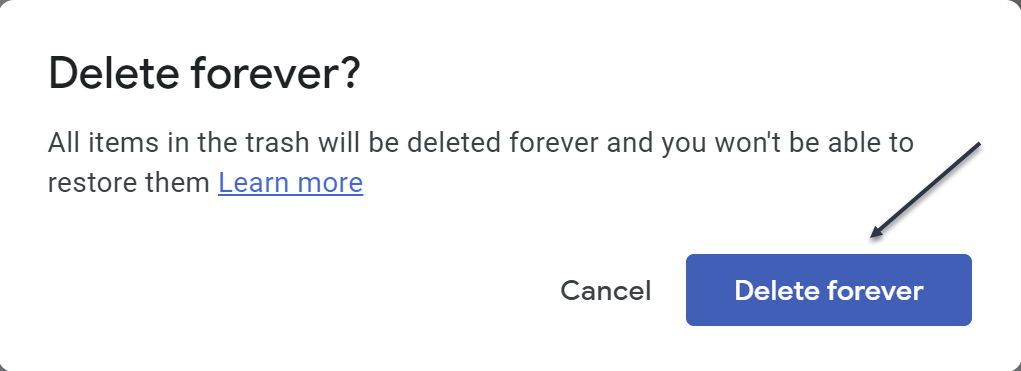
Drive 7
Confirm to delete the file(s) forever

Now, all the files will be deleted. Once you reload the page, you will see that the storage space has been recovered.

Quote For the Day

I have noticed even people who claim everything is predestined, and that we can do nothing to change it, look before they cross the road.

Stephen Hawking

You now know how to clean up storage space on Google Drive. Please feel free to share this post! One way to share is via Twitter.

Just click the Tweet icon below. This will launch Twitter where you click its icon to post the Tweet.

Check out TechSavvy.Life for blog posts on smartphones, PCs, and Macs! You may email us at contact@techsavvy.life for comments or questions.

I Would Like to Hear From You

Please feel free to leave a comment. I would love hearing from you. Do you have a computer or smart device tech question? I will do my best to answer your inquiry. Just send an email to contact@techsavvy.life. Please mention the device, app and version that you are using. To help us out, you can send screenshots of your data related to your question.


The author’s Vietnam eBook on the Battle for Tra Bong: Events and Aftermath

How to Use Advanced Search to Find Tweets

Twitter has tons of information that flows by faster than we can comprehend. Fortunately, it’s possible to search for tweets using various parameters.

5RAYMOND OGLESBY @RaymondOglesby2
August 5, 2021

Twitter has tons of information that flows by faster than we can comprehend. Fortunately, it’s possible to search for tweets using various parameters. Let’s explore this feature.

This is for devices running Twitter

Copyright Scott Adams, Inc./Distributed by Universal Uclick for UFS

Search Tweets by Dates Range

Twitter provides both a mobile and a desktop browser Advanced Search page that lets you search for tweets posted within a certain date range. If you are on a mobile device, open your browser and click here for mobile. For the desktop browser, open your browser and click here for desktop.

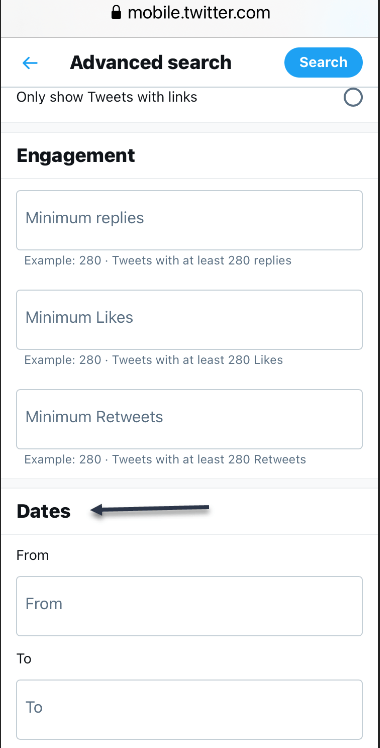
Now, on the Advanced Search page, scroll all the way down to the bottom to the Dates section. There, you will find two parameters: From and To. Refer to below image:

Accessing Dates section

Next, choose your desired month, day, and year for each parameter. Here’s what they do:

  • From: Set this to find tweets posted after midnight (12:00 a.m.) on this date.
  • To: Set this to find tweets posted up until midnight (12:00 a.m.) on this date.

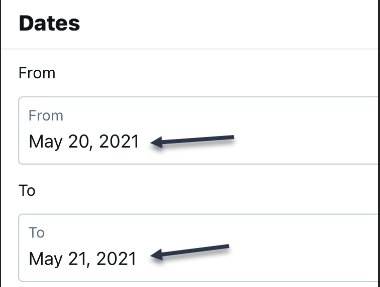
While this sounds simple, using the parameters can be confusing. For example, if you want to find tweets only from May 20, 2021, you would set From to “May 20, 2021” and To to “May 21, 2021.” You will get tweets posted between midnight on May 20 until midnight on May 21. You would not set both fields to the same date. See below image:

Setting From and To date

Similarly, if you wanted to find only tweets from the month of May 2021, you would set From to “May 1, 2021” and To to “June 1, 2021.” That way, your search will cover all 31 days of May.

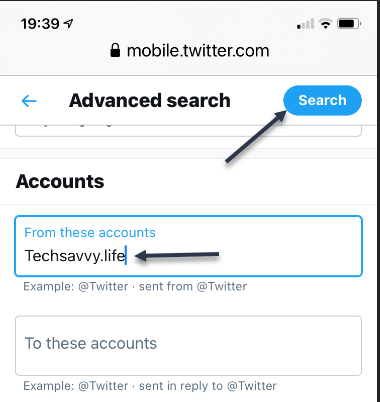
Now, scroll up and enter another parameter, such as a search term in the Words section, or an account name in the Accounts section. Next, click Search when you are done. See following image for an Account search:

Search an Account

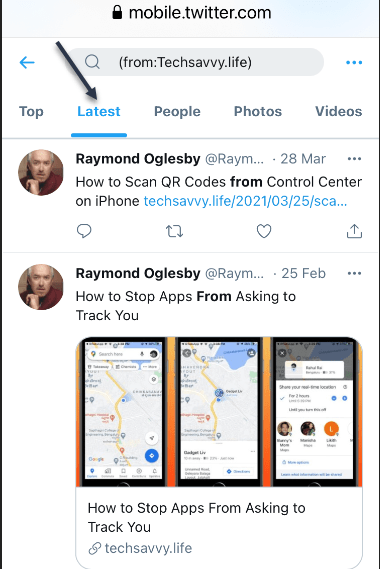
When you see the results, you can further sort them by different criteria using tabs located just below the search bar. Top shows the matching tweets with the most engagements. Latest shows all matching tweets in reverse chronological order. Refer to below image for the Latest using my domain name:

Display Latest posts for an Account

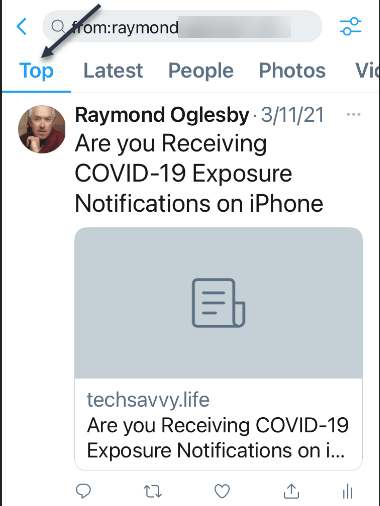
See below image for my Top posts using my Twitter name:

Display Top posts for a Twitter name

If you need to do another search, just revisit Twitter’s advanced search page and search again. It includes many parameters that allow you to narrow down tweets on certain dates, people, photos, videos, and much more.

Search Tweets by Date Range Using Inline Parameters

Another way of searching for tweets from a specific date or dates is using inline search parameters that you type directly into the search box in the Twitter app or on the Twitter website.

Here are three parameters that you can use:

Note! the following are just examples, not for literal input.

  • From: Find tweets posted only by this Twitter account. For example: from:raymondxxx  or from:techsavvy.
  • Since: Find tweets posted since 12:00 a.m. on this date. The date format is YYYY-MM-DD. For example: since:2021-05-01.
  • Until: Find tweets posted until 12:00 a.m. on this date. The date format is YYYY-MM-DD. For example: until:2021-06-01.

For example, if you would like to see all tweets posted by the “techsavvy” Twitter account between May 1, 2021 and June 1, 2021, you would type the following into the Twitter search box:

from:techsavvy until:2021-06-01 since:2021-05-01

If you wanted to find all posts about “Safari” by “raymondxxx” posted on May 15, 2021, you would enter:

safari from:raymondxxx since:2021-05-15 until:2021-05-16

And so on. This kind of quick inline search can be quite powerful once you get the syntax of the date format. You can also find embarrassing old tweets and delete them.

Quote For the Day

There ain’t no answer. There ain’t gonna be any answer. There never has been an answer. That’s the answer.

Gertrude Stein

You are finished with learning how to find tweets using Advance Search. Please feel free to share this post! One way to share is via Twitter.

Just click the Tweet icon below. This will launch Twitter where you click its icon to post the Tweet.

Check out TechSavvy.Life for blog posts on smartphones, PCs, and Macs! You may email us at contact@techsavvy.life for comments or questions.

I Would Like to Hear From You

Please feel free to leave a comment. I would love hearing from you. Do you have a computer or smart device tech question? I will do my best to answer your inquiry. Just send an email to contact@techsavvy.life. Please mention the device, app and version that you are using. To help us out, you can send screenshots of your data related to your question.
The author’s Vietnam eBook on the Battle for Tra Bong: Events and Aftermath

How to View Excel Sheet/Workbook Statistics

If you need to see how many formulas, pivot tables, or form controls you have in a spreadsheet or workbook, check out the Workbook Statistics feature in Microsoft Excel.

If you need to see how many formulas, pivot tables, or form controls you have in a spreadsheet or workbook, check out the Workbook Statistics feature in Microsoft Excel. Let’s explore this feature.

This is for devices running Excel. Screenshots are from Excel in Office 365 on Windows 10

Dilbert and Issue
Copyright Scott Adams, Inc./Distributed by Universal Uclick for UFS

You may have found statistics in Word helpful for seeing the number of pages, words, or characters. Getting statistics in Excel can be just as useful. You may have a workbook for a class with specific requirements, or you may have a spreadsheet for business that you want to review for unnecessary elements.

View Your Sheet/Workbook Statistics

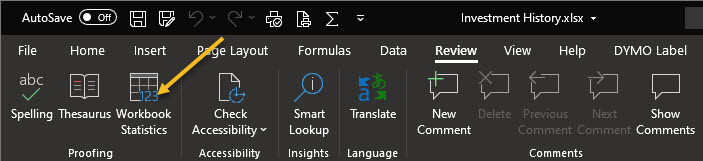
First, open your Excel workbook. Next, navigate to the Review tab. Now, click Workbook Statistics in the Proofing section. You can also press Ctrl+Shift+G. (Note that the shortcut will not work in Excel for the Web.) Refer to below image:

Stats 1
Accessing Workbook Statistics button

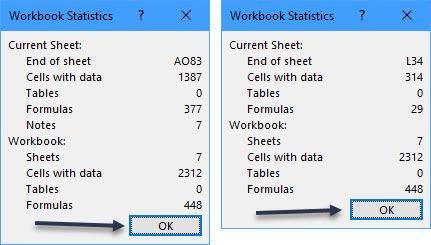
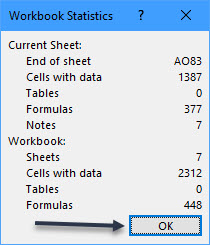
Now, a small window will open to display the data for your current sheet at the top and the entire workbook at the bottom. See below image:

Stats 2
Displaying one Sheet Statistics

If you want details for a different sheet in your workbook, close the Workbook Statistics window by clicking OK. Next click the tab for the sheet that you want to see and follow the same steps listed above. As a downside, the sheet and workbook name are not shown. See following image:

Stats 3
Displaying two Sheets and Workbook Statistics

Data Included

You can see a the following data with the Workbook Statistics feature. This is helpful for situations where you expect to see something in your current sheet or workbook and you do not, or vice versa. Statistics may differ slightly between the spreadsheet and the entire workbook.

Spreadsheet Statistics:

  • The end of the sheet (the last cell with data)
  • Cells with data
  • Tables and PivotTables
  • Formulas
  • Charts
  • Images and objects
  • Form controls
  • Comments and notes

Workbook Statistics:

  • Number of sheets
  • Cells with data
  • Tables and PivotTables
  • Formulas
  • Charts
  • External connections
  • Macros

You can view Workbook Statistics in Excel for Microsoft 365 on Windows and Mac as well as in Excel on the Web. The only difference is that Excel online does not display the complete data lists written above for sheets and workbooks.

The scientific theory I like best is that the rings of Saturn are composed entirely of lost airline luggage.

Mark Russell

That’s it. Please feel free to share this post! One way to share is via Twitter.

Just click the Tweet icon below. This will launch Twitter where you click its icon to post the Tweet.

Check out TechSavvy.Life for blog posts on smartphones, PCs, and Macs! You may email us at contact@techsavvy.life for comments or questions.

I Would Like to Hear From You

Please feel free to leave a comment. I would love hearing from you. Do you have a computer or smart device tech question? I will do my best to answer your inquiry. Just send an email to contact@techsavvy.life. Please mention the device, app and version that you are using. To help us out, you can send screenshots of your data related to your question.
The author’s Vietnam eBook on the Battle for Tra Bong: Events and Aftermath

How to Drag Tabs Between Browser Windows

Did you know you can drag tabs between browser windows within Chrome, Edge, Firefox, and Safari on Windows, Linux, and Mac? (But not between different browser types.) It seems obvious in retrospect, but many people never notice.

Did you know you can drag tabs between browser windows within Chrome, Edge, Firefox, and Safari on Windows, Linux, and Mac? (But not between different browser types.) It seems obvious in retrospect, but many people never notice. Let’s explore how this is done.

This is for modern browsers. Screenshots are from Chrome in Windows 10

Dilbert and Press
Copyright Scott Adams, Inc./Distributed by Universal Uclick for UFS

First, open Google Chrome, Microsoft Edge, Apple Safari, or Mozilla Firefox on a Mac or PC. Open a few tabs in one browser window and then press Ctrl+n (or Command+n on a Mac) to open another browser window.

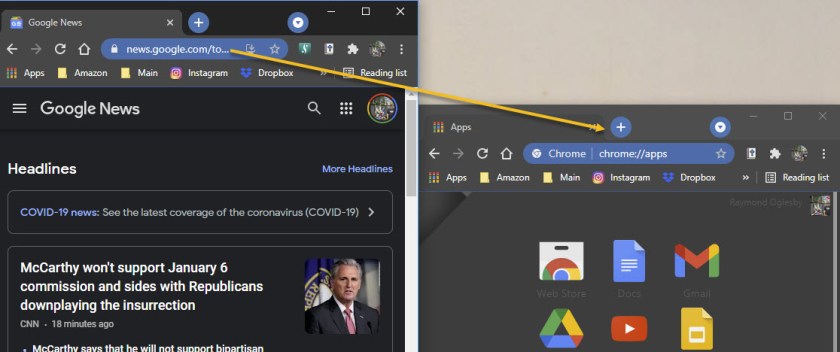
To move a tab between browser windows, click and drag the tab from the tab bar in one window onto the tab bar in another window.

(In Safari, you can alternatively just drag a tab and drop it anywhere on top of another Safari browser window.) Refer to below image for using Chrome:

Tabs 1

Once you drag the tab into the other window’s tab bar, you will see that tab appear in the tab list of the destination window. See below image:

Tabs 2

In Chrome, Edge, and Firefox, you can select multiple tabs. Just hold down Ctrl (or Command on a Mac) and click on multiple tabs. Once they are selected, you can drag them off into a new window, or you can close all of them by pressing any tab’s X button.

Quote For the Day

Part of the inhumanity of the computer is that, once it is competently programmed and working smoothly, it is completely honest.

Isaac Asimov

That’s it. Please feel free to share this post! One way to share is via Twitter.

Just click the Tweet icon below. This will launch Twitter where you click its icon to post the Tweet.

Check out TechSavvy.Life for blog posts on smartphones, PCs, and Macs. You may email us at contact@techsavvy.life for comments or questions.

I Would Like to Hear From You

Please feel free to leave a comment. I would love hearing from you. Do you have a computer or smart device tech question? I will do my best to answer your inquiry. Just send an email to contact@techsavvy.life. Please mention the device, app and version that you are using. To help us out, you can send screenshots of your data related to your question.
The author’s Vietnam eBook on the Battle for Tra Bong: Events and Aftermath

How to Remove All Images in a Word Document

If you need to quickly remove all the images and graphics from a Microsoft Word document, it’s easy to use a built-in option to delete them all at once.

If you need to quickly remove all the images and graphics from a Microsoft Word document, it’s easy to use a built-in option to delete them all at once. Let’s explore how this is done.

This is for devices running Microsoft Word

Dilbert and Politics
Copyright Scott Adams, Inc./Distributed by Universal Uclick for UFS

The Technique

Microsoft Word includes a feature called Find and Replace to find items in your documents and replace them with something of your choice. Using this feature, you can find all the images in your document and replace them with nothing. This removes the images and leaves a blank space where they were located.

As a slight drawback, this technique will also remove all charts and graphs from your document.

The Removal Process

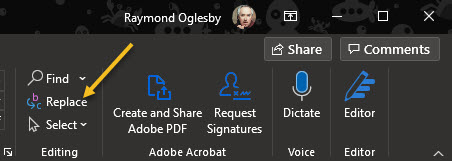
First, open your document with Microsoft Word. Next, in the menu at the top of the window, click Home. Now, click Replace in the Editing section of the toolbar. Refer to below image:

Image 1
Accessing the Replace button

Next, in the Find and Replace window, click the Find what box. In this box, type:

^g

(Alternately, you can click the More button, and then select Special and Graphic from the drop-down menu. Word will insert a ^g for you.)

In this case, ^g is a special code that means “graphic.” This “graphic” tag includes all images, charts, or graphs in your document. But no need to worry, you can undo this step later if you remove the images by mistake.

Now, click Replace All at the bottom of the window. See below image:

Image 2
Selecting Replace All to remove all images

All images in your document will be removed. A pop-up window will appear denoting the number of images removed. Click OK to close the window. See following image:

Image 3
Pop-up window denoting number of images replaced with a blank line

If you want to bring them back, press Ctrl+Z on Windows or Command+Z on Mac to undo the removal process. Or, you can insert images again if necessary. (You may need to edit your document to remove blank lines). Now, save your changes (if any) and exit Word.

Quote For the Day

The art of teaching is the art of assisting discovery.

Mark Van Doren

That was easy. Please feel free to share this post! One way to share is via Twitter.

Just click the Tweet icon below. This will launch Twitter where you click its icon to post the Tweet.

Check out TechSavvy.Life for blog posts on smartphones, PCs, and Macs! You may email us at contact@techsavvy.life for comments or questions.

I Would Like to Hear From You

Please feel free to leave a comment. I would love hearing from you. Do you have a computer or smart device tech question? I will do my best to answer your inquiry. Just send an email to contact@techsavvy.life. Please mention the device, app and version that you are using. To help us out, you can send screenshots of your data related to your question.
The author’s Vietnam eBook on the Battle for Tra Bong: Events and Aftermath

How to Create a Link for Selected Text in Chrome

As of Google Chrome version 90 and higher, you can create a link to selected text on a web page. When clicked, this link takes you to the page and highlights the selected text.

As of Google Chrome version 90 and higher, you can create a link to selected text on a web page. When clicked, this link takes you to the page and highlights the selected text. Let’s explore how to create such links.

This is for devices running Chrome 90 and higher. Screenshots are from Windows 10 PC

Dilbert and Problems
Copyright Scott Adams, Inc./Distributed by Universal Uclick for UFS

Enable the Feature

For some of us, Chrome’s Copy Link to Text feature is enabled by default, for others, it’s not. If this is your case, you will have to manually enable it on Chrome’s experimental flags page.

First, open Google Chrome on your computer. In the address bar of any window, type:

chrome://flags

and press Enter. Refer to below image:

Enabling Chrome flags

Now, on the Experiments tab that opens, click the search box at the top and type this:

Copy Link To Text

See below image:

Setting up the feature

Next, in the search results, click the drop-down menu beside Copy Link To Text and select Enabled. See following image:

Enabling the feature

Now, Chrome will ask you to restart the browser so that the change can take effect. Click Relaunch in bottom left-hand corner. Refer to below image:

Restart Chrome

After Chrome restarts, the feature will now be enabled.

Create the Link

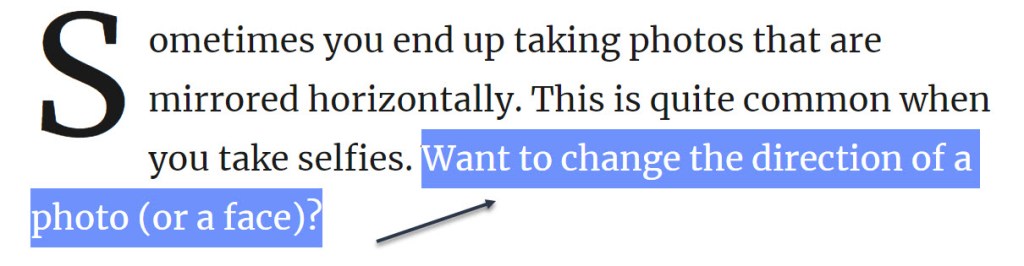
To use the Copy Link to Text feature, first, open a site and select the text that you want to copy a link for using your mouse or keyboard. See below image:

Highlight the link

Next, right-click the highlighted text and select Copy Link to Highlight from the menu. See following image:

Copy highlighted link

Now, Chrome will copy the link for your selected text to your clipboard. You can now share this link via social media, send it in an email, paste it in a text editor, or use any other method. Refer to below image for sending the link via email:

Paste the link in an email

When the recipient clicks the link, they will be taken directly to the page with the previously selected passage highlighted. See below image:

Once the above email link is clicked, you will see the highlighted text in the original document

It’s a very handy feature.. Repeat as often as you like.

Quote For the Day

Hard work spotlights the character of people: some turn up their sleeves, some turn up their noses, and some don’t turn up at all.

Sam Ewing

You are finished. Please feel free to share this post! One way to share is via Twitter.

Just click the Tweet icon below. This will launch Twitter where you click its icon to post the Tweet.

Check out TechSavvy.Life for blog posts on smartphones, PCs, and Macs! You may email us at contact@techsavvy.life for comments or questions.

I Would Like to Hear From You

Please feel free to leave a comment. I would love hearing from you. Do you have a computer or smart device tech question? I will do my best to answer your inquiry. Just send an email to contact@techsavvy.life. Please mention the device, app and version that you are using. To help us out, you can send screenshots of your data related to your question.
The author’s Vietnam eBook on the Battle for Tra Bong: Events and Aftermath

How to Use Safety Check in Google Chrome

Google Chrome offers a tool that lets you perform a checkup to secure your web browsing.

Google Chrome offers a tool that lets you perform a checkup to secure your web browsing. Let’s explore this feature.

This is for devices running Google Chrome. Screenshots are from Windows 10 PC

Dilbert and Keyboard
Copyright Scott Adams, Inc./Distributed by Universal Uclick for UFS

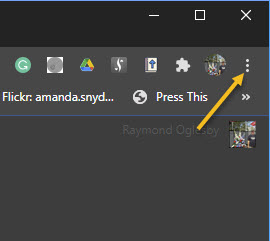
First, launch the Chrome web browser on your Windows 10, Mac, Chrome OS, or Linux computer and click the three-dot (hamburger icon) located in the top-right corner. Refer to below image:

Selecting the hamburger icon

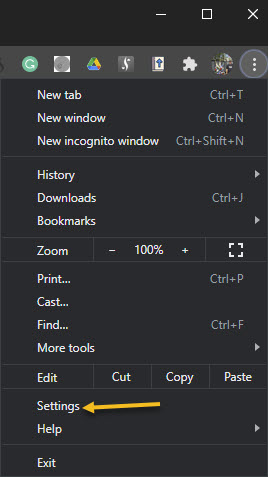
Next, click on Settings from the drop-down menu. See below image:

Selecting the Settings option

Now, scroll down to find the Safety Check section and click the Check Now option. See following image:

Selecting the Check Now option

Next, Chrome will kick off the Safety Check test. Depending on how much browsing data you have, this can take anywhere from a few seconds to a couple of minutes. When finished, just click the Review option by any listing. Refer to below image:

Selecting the Review button

In this process, Chrome scans a total of four core modules to look for any malicious code. It will make sure that the browser app is on the most recent version for protection against the latest internet viruses and that all of your installed third-party extensions are harmless. It will also check whether any of your saved passwords have been compromised in a data breach and that Safe Browsing, a setting that warns you against suspicious sites, is enabled.

Once the Safety Check is complete, Chrome will pull up shortcuts for anything that may need your immediate attention, such as reviewing compromised credentials.

After running Safety Check on my PC, it found comprised passwords. See below image where we are displaying three of them:

Viewing Comprised Passwords

After taking the recommended steps, you can also run the Safety Check again to ensure that your new security settings are active.

There’s another feature you can use by switching on Enhanced Safe Browsing, an advanced mode that allows Google to assess your browsing for potential threats and suggest privacy-focused improvements. However, we do not recommend using this option because you are choosing to share a copy of your browsing data with Google.

You are finished. Please feel free to share this post! One way to share is via Twitter.

Just click the Tweet icon below. This will launch Twitter where you click its icon to post the Tweet.

Check out TechSavvy.Life for blog posts on smartphones, PCs, and Macs! You may email us at contact@techsavvy.life for comments or questions.

I Would Like to Hear From You

Please feel free to leave a comment. I would love hearing from you. Do you have a computer or smart device tech question? I will do my best to answer your inquiry. Just send an email to contact@techsavvy.life. Please mention the device, app and version that you are using. To help us out, you can send screenshots of your data related to your question.

The author’s Vietnam eBook on the Battle for Tra Bong: Events and Aftermath

How to Name Chrome Windows for Alt+Tab and Taskbar

If you keep many Google Chrome windows open to organize your tabs like me, you can go one step further and name each window. Chrome’s built-in naming feature makes it easy to remember the windows name in the Taskbar or the overview screen (Alt+Tab).

If you keep many Google Chrome windows open to organize your tabs like me, you can go one step further and name each window. Chrome’s built-in naming feature makes it easy to remember the windows name in the Taskbar or the overview screen (Alt+Tab).

The Windows naming feature was introduced in Chrome 90 and is available for Chrome on Windows 10, Mac, and Linux. It is easy to use and can save you from opening the wrong window.

This is for devices running Chrome 90. Screenshots are from Windows 10

Dilbert and Workplace
Copyright Scott Adams, Inc./Distributed by Universal Uclick for UFS

First, launch Chrome and open a Chrome window. Next, click the three-dot menu (the hamburger) icon in the top-right of the Chrome window. Refer to below image:

Name 1
Accessing the main menu

Now, from the drop-down menu, select More Tools. See below image:

Name 2
Selecting More Tools option

Next, from the expanded options, click Name Window. If you don’t see this, you are not running Chrome 90. To check your Chrome version, go to:

Click the three-dot menu (the hamburger) icon > Help > About Google Chrome

Now, your Google version will be displayed. Google should auto update to the latest version.

See following image for your expanded options:

Name 3
Accessing Name window option

A pop-up text box will appear. Now, enter the name for the window and click OK. Refer to below image:

Name 4
Naming your window

Alternatively, you can right-click the title bar of the Chrome window and select Name Window from the drop-down menu and go through the process of assigning it a name. See below image:

Name 5
Accessing Name window option from title bar

You will now see this name in the Alt+Tab on Windows 10. See following image:

Name 6
Your Alt+Tab named window

Additionally, this name will appear in the Taskbar on Windows 10. Refer to below image:

Name 7
Your Taskbar named window

Quote For the Day

The more you eliminate the inefficient use of information, the better it is for productivity.

Mitch Kapor

You are finished. This is probably a pretty niche feature, but for those of us who like to organize Chrome tabs by separating them out into windows, it’s a handy little trick.

Please feel free to share this post! One way to share is via Twitter.

Just click the Tweet icon below. This will launch Twitter where you click its icon to post the Tweet.

Check out TechSavvy.Life for blog posts on smartphones, PCs, and Macs! You may email us at contact@techsavvy.life for comments or questions.

I Would Like to Hear From You

Please feel free to leave a comment. I would love hearing from you. Do you have a computer or smart device tech question? I will do my best to answer your inquiry. Just send an email to contact@techsavvy.life. Please mention the device, app and version that you are using. To help us out, you can send screenshots of your data related to your question.

The author’s Vietnam eBook on the Battle for Tra Bong: Events and Aftermath

Five Real Life Samples of Malware

Chances are good you will never seen malware up close and personal. Even if you threw caution to the winds and visited a dangerous site or clicked a treacherous link, your antivirus software probably wiped out any offending program before the latter could say boo. So, you might wonder, just what does malware look like? Would I even recognize a malware program if I saw it?

Courtesy of PC Mag

Chances are good you will never seen malware up close and personal. Even if you threw caution to the winds and visited a dangerous site or clicked a treacherous link, your antivirus software probably wiped out any offending program before the latter could say boo. So, you might wonder, just what does malware look like? Would I even recognize a malware program if I saw it?

To be fair, a lot of malicious programs do not look like anything at all. A virus, for example, tries its best to hide from view while infecting other files and computers. A bot sits quietly on your computer until it gets orders from the command and control center to spew some spam or participate in a DDoS attack on a major website. Trojans, by contrast, appear to be useful, legitimate programs, putting up a pretty façade to hide background activities like stealing your personal data. And when ransomware hollers for your attention, it’s bad news.

This is for all devices

Dilbert and Video
Copyright Scott Adams, Inc./Distributed by Universal Uclick for UFS

The Horror of Ransomware

If a ransomware attack hits your computer, you will not know it at first. The ransomware stays out of sight, quietly encrypting your important files. Once the dirty work is done, the malware totally demands your attention with its ransom note. The perpetrators promise that if you pay the specified ransom (usually in Bitcoin or some other cryptocurrency) you will get your files back, but if they take your money and run, you do not have any recourse. You really do not want a direct encounter with ransomware.

Malware Bundled

Sometimes the problem with an installation is notthe program itself, but the software that’s bundled with it. You may find completely legitimate software—even antivirus programs; bundled with adware, spyware, or other unwanted trash. In a case like that, the security vendor is not to blame. A third party created the deceptive bundle. AppEsteem is a young company with a mission to expose these deceptors and to warn legitimate companies when they stray too far toward the dark side of bundling.

The installer shown here offers a free player for FLV video files. Along with the player you are privileged to receive a shady Adware program masquerading as a coupon browser. There’s a checkbox that says you agree to its terms; uncheck the box and you can not proceed. No video player for you! The best thing that can happen with this kind of bundling is that you’re forced to install a program you did not want. Mostly it’s worse than that, because the bundled bonus is malware. Refer to below image:

Malware 2
Bundled Malware

Now here’s something handy; a multi-utility install program. If you read Russian, you know it’s “the fastest and most convenient way to install programs.” Just check the boxes for the ones you want and turn the installer loose. The list includes browsers, messenger programs, video players, even antivirus utilities. But when you install them, you also get a dose of malware. See below image:

Malware 3
Utility Pack Malware

Trojan Horses

Here, we have a sharp-looking utility designed, apparently, to ensure that your PC does not limp along with old, outdated drivers. However, if you try to update any drivers, or back up your existing drivers, you must pay. This is a model used both by some legitimate programs and by rogue antivirus scareware utilities. Lucky you, though: there’s a promotional price that ends today. Its overt activities are just a wee bit suspicious. See following image:

Malware 4
Driver Malware

Want to get into smartphone repair? This set of tools and manuals looks like it might be a big help. Alas, you ca not see just what you’re getting until you pay for your registration. While you are perusing schematics, it collects personal information behind the scenes and takes orders for further unwanted activity from a remote command and control server. Refer to below image:

Malware 5
Smartphone Malware

You probably do not know this, but the EXE files that represent programs on your Windows computer are also called PE files, short for Portable Executable. Every PE file starts with an extensive header that contains a ton of information telling Windows about the program. Malware researchers learn a lot by digging into that header. See below image:

Malware 6
Portable Executable Malware

Lets Hope You Don’t See These

As you can see, malicious programs, like legitimate programs, run the gamut from sad-looking attempts to totally professional ones. With any luck, and with powerful, up-to-date antivirus protection, these images are the only malware you will ever see. Malware is just one of many threats to your devices and private information.

The best utility for finding Malware on your device is Malwarebytes, download here.

Email/Phone Scams

A few reminders to keep the bad guys away in your emails and phone calls:

  • Do not click that link. Instead hover your mouse over each element of the email and look for anything suspicious. If suspicious, do not click that link – per my son, VP at True Digital Security.
  • Do not open emails from FedX, USPS, Wells Fargo, Walmart, Cox Communications, Thank You, SSA, or VA if you have no dealings with them. They will contact you by mail not by phone.
  • Do not give out personal informati0n over the phone. If you need to contact someone, you initiate the call.
  • Never buy gift cards or give out their serial number.
  • If your Userid or Password has been leaked in a data breech, change them as soon as possible.

Quote For the Day

I don’t pretend we have all the answers. But the questions are certainly worth thinking about.

Arthur C Clarke

That’s it. Please feel free to share this post! One way to share is via Twitter.

Just click the Tweet icon below. This will launch Twitter where you click its icon to post the Tweet.

Check out TechSavvy.Life for blog posts on smartphones, PCs, and Macs! You may email us at contact@techsavvy.life for comments or questions.

I Would Like to Hear From You

Please feel free to leave a comment. I would love hearing from you. Do you have a computer or smart device tech question? I will do my best to answer your inquiry. Just send an email to contact@techsavvy.life. Please mention the device, app and version that you are using. To help us out, you can send screenshots of your data related to your question.
The author’s Vietnam eBook on the Battle for Tra Bong: Events and Aftermath

How to Access Two-Factor Authentication for Major Apps

Two-Factor authentication (2FA) adds an extra security layer to your accounts across the internet. 2FA means your accounts require information beyond user name and password to confirm you are who you say you are before you can get into the accounts. Let’s explore how to access 2FA.

Two-Factor authentication (2FA) adds an extra security layer to your accounts across the internet. 2FA means your accounts require information beyond user name and password to confirm you are who you say you are before you can get into the accounts. Let’s explore how to access 2FA.

This is for iPhone, iPad, PCs and Macs. Screenshots are from Windows 10 and iPhone XR

Dilbert and Zoom
Copyright Scott Adams, Inc./Distributed by Universal Uclick for UFS

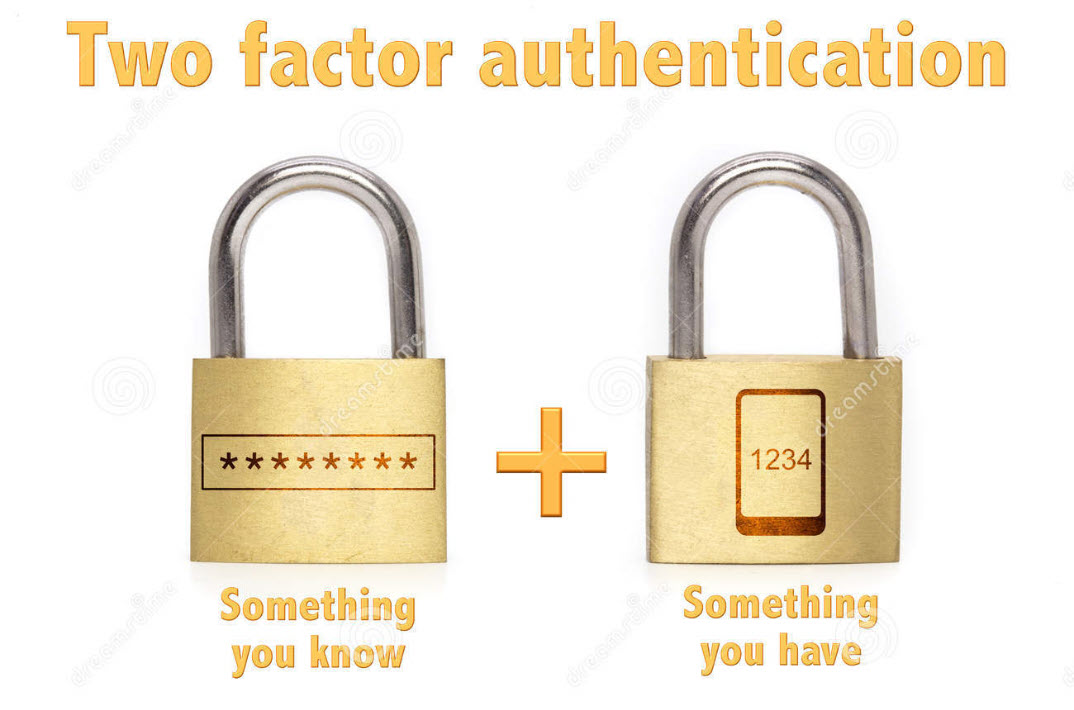
The “second factor” comes in after you enter your username and password, which are considered to be the “first factor.” 2FA can be used to confirm your identity by asking for an extra piece of information. The additional information can be:

  • Something you know, like an additional passcode.
  • Something you have, like your phone to receive a one time authorization code.
  • Something you are, like a fingerprint or voice print. This is also called biometric security.

The idea is to provide another piece of information a hacker would not have, making it harder for the bad guy to break into your account.

The following is not an exhaustive list of services with 2FA ability, but we cover the major services everyone tends to use, and walk you through how to access. We will cover Amazon, Apple, Facebook, Google, Instagram, LinkedIn, Microsoft, and Twitter. Activate 2FA on all of these and you will be more secure. Once you have found their 2FA screens you can can set it up for each app.

Amazon

First, launch Amazon.com on the desktop and login in to your account. Next, click the Menu icon in upper left-hand corner. Now, scroll down the drop-down menu to Your Account option.

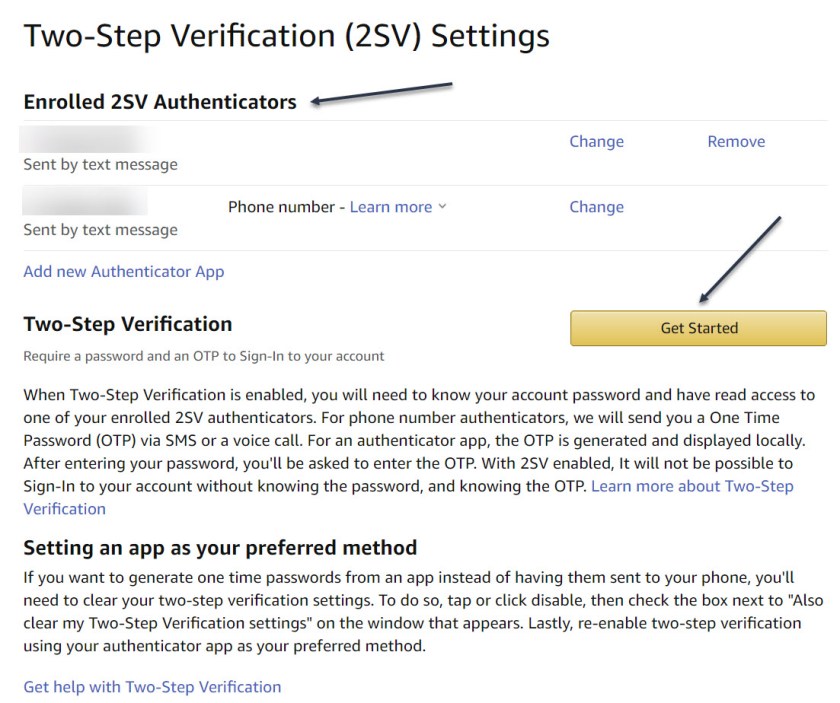
Next, click on the Login & Security big button. Now, on the next page, click Edit next to Two-Step Verification (2SV) Settings. The preferred method is an authentication app (scan the QR code); phone number(s) are the backup method. Refer to below image where I already have 2SV based on my phone number (which is dimmed out):

2FA 1
Amazon 2SV

If you think your account has been comprised, go back to Login & Security and click the Edit button next to Secure Your Account.

Apple

Following are the steps on how to access 2FA for Apple using either iOS or macOS.

On iOS go to:

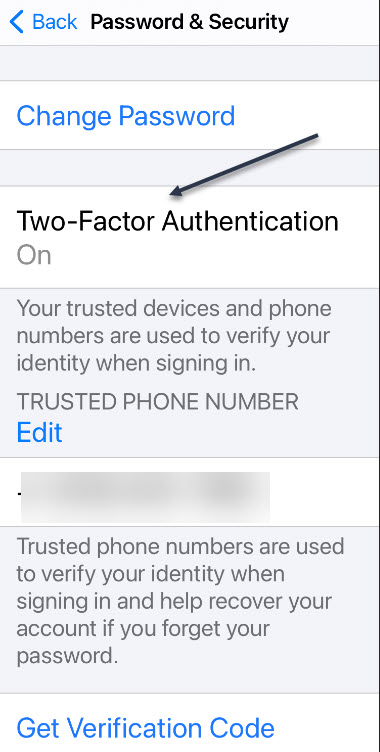
Settings > [your name at the top] > Password & Security > Turn on Two-Factor Authentication.

On macOS go to:

System Preferences > iCloud, then sign in, click Account Details > Security > Turn on Two-Factor Authentication.

Note! once Apple 2FA is activated for two weeks, you can not turn it off. “Certain features in the latest versions of iOS and macOS require this extra level of security, which is designed to protect your information,” according to Apple. See below image for iOS:

2FA 2
Apple 2FA

Facebook

First, login to Facebook on your desktop. Next, click the Down arrow in upper right-hand corner. Now, from the drop-down menu that appears, click on the Settings & Privacy option. On the next screen, click the Privacy & Checkup option. From there, click on the topic How to keep your account secure. Under this topic, you can access 2FA for Facebook. See following image where 2FA is On with a backup method of sending a text message to a phone number.

2FA 3
Facebook 2FA

Related

How to Perform a Privacy Checkup on Facebook

Google

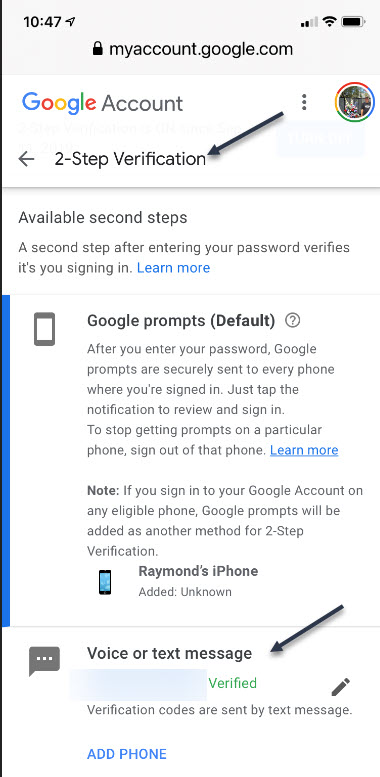
First, sign in to your Google account on your smart device. Next, at the top of the screen, locate the Security tab and tap it. Now, scroll down and tap the 2- Step Verification option. You can continuing scrolling to see more ways to verify you. Refer to below image where my 2SV is already turned On and I am using the backup method of Voice or text message:

2FA 4
Google 2SV

Google calls its system 2SV . It’s all about identifying you via phone. When you enter a password to access your Google account for almost any service, if 2SV is on, there are multiple options to get that second step. First among them now: the Google Prompt. You simply add your smartphone to your account, make sure the Google search app is on the phone, and at login, you can go to the phone and simply acknowledge with a tap that you are the one signing in.

Instagram

First, launch Instagram on your smart device. Next, go to your Profile in lower right-hand corner, then tap the menu (the hamburger icon) on the top-right. Tap Settings > Security > Two-Factor Authentication. There you can choose how you would like to get your authentication code by tapping the Get Started button. See below image:

2FA 5
Instagram 2FA

Linkedin

Business social network Linkedin makes it easy to set up verification, either by SMS texts or authentication app.

First, launch Linkedin on you smart device, then go to your Profile at upper left-hand screen. Next, go to Settings > Sign in & Security > Account > Two-step verification to activate it or deactivate. See following image:

2FA 6
Linkedin 2SV

Microsoft

First sign into your Microsoft account on your smart device. Now, tap your Profile. Next, scroll down and tap Security. 2FA is the second option, tap on it. Once again, tap Two -step verification > Manage. Microsoft will suggest you get app passwords as needed for older service or devices (like Xbox 360); go in later to generate one as needed. Refer to below image:

2FA 7
Microsoft 2SV

Twitter

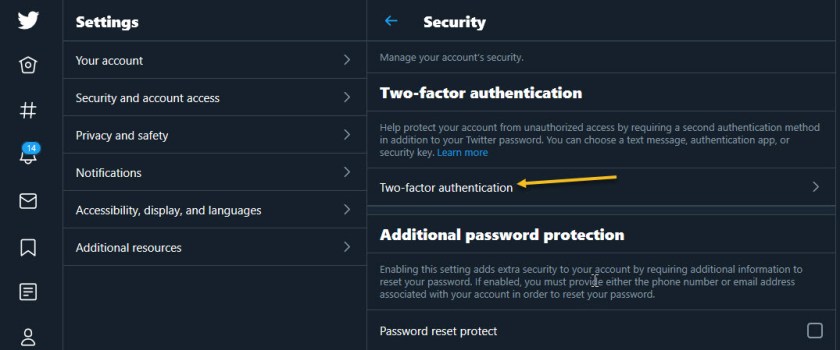
First, to activate Login Verification on Twitter.com on the desktop, login to Twitter, Click the More menu on the left (the three dots) and select Security & Account Access > Security > Two-Factor Authentication. See following image:

2FA 8
Twitter 2FA

Quote For the Day

Technology is a useful servant but a dangerous master.

Christian Louis Lange

That’s it. With 2FA activated on these apps you are more secure. Please feel free to share this post! One way to share is via Twitter.

Just click the Tweet icon below. This will launch Twitter where you click its icon to post the Tweet.

Check out TechSavvy.Life for blog posts on smartphones, PCs, and Macs! You may email us at contact@techsavvy.life for comments or questions.

I Would Like to Hear From You

Please feel free to leave a comment. I would love hearing from you. Do you have a computer or smart device tech question? I will do my best to answer your inquiry. Just send an email to contact@techsavvy.life. Please mention the device, app and version that you are using. To help us out, you can send screenshots of your data related to your question.
The author’s Vietnam eBook on the Battle for Tra Bong: Events and Aftermath