How to Protect an Excel Workbook, a Sheet and its Structure

Do you want to protect your Microsoft Excel workbook or a sheet in your workbook? If so, this blog post is for you. We are going to password protect a workbook, protect a sheet in a workbook and the Excel file itself.

This is for Excel for Office 365 Windows and Mac versions. Other versions of Excel will be similar.

Protect a Workbook

I recommend you start with a blank Excel workbook, just in case you forget a password. To assign a password to an Excel workbook, do the following:

  • Open a blank Excel workbook. For demonstration purposes, I am using an Excel workbook that contains one sheet with cell data. You can choose an existing Excel workbook if you chose. See my workbook below :
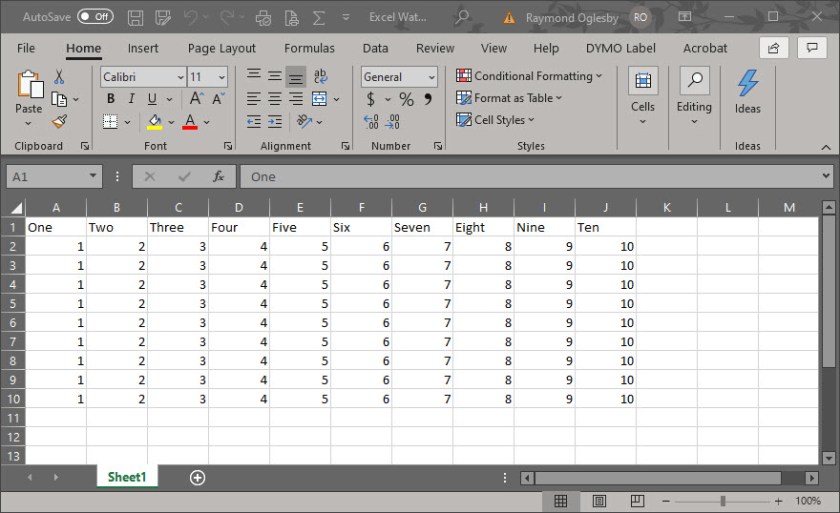
Excel Security 1
  • Select File>Save As
Excel Security 2
  • Select More options (underneath Excel Workbook drop down box)
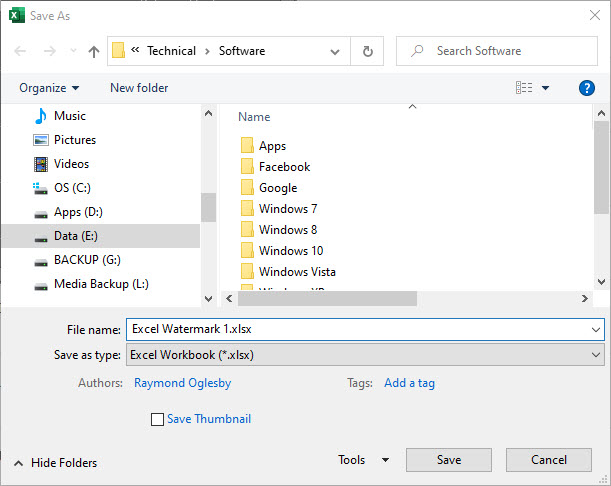
Excel Security 3
  • Select the Tools drop down box
  • Chose General Options
Excel Security 4

Set the Password(s)

You will see notice two password boxes, one to open the workbook and one to modify the workbook

  • Enter one or both passwords. Make sure you write down these passwords and store them in a safe place.

You have two other options to set if you chose, Always create backup and Enable Read-only recommended. The first is self explanatory. The second option is an extra layer of protection by enabling the workbook to read-only status upon opening.

  • Confirm your password(s) by reentering the password(s)
  • Click OK
  • Click Save
  • Close or Exit Excel

Note! A user who doesn’t know the second password can open and view the data by clicking the Read Only option. This user can still modify the data, but they are unable to save their changes to the protected workbook. However, the user can save the workbook under a new name, which circumvents the protection process. Of course, password-cracking software will get you into the workbook.

Protect a Sheet

  • Open a blank Excel workbook. For demonstration purposes, I am using an Excel workbook that contains one sheet with cell data. You can choose an existing Excel workbook if you chose.
  • Select the Review tab
  • Click the Protect icon
  • Click Protect Sheet icon. Refer to following image:
Excel Security 5
  • Enter your password in the Password to unprotect sheet box
  • Click OK
  • In the Confirm Password dialog box, type the password again
  • Click OK
  • Save your changes
  • Close or Exit Excel

Tip! To remove a password, click Protect>Unprotect Sheet and enter your password. You can also select Protect Workbook icon to protect a workbook which follows.

Protect Excel Structure

  • Open a blank Excel workbook. For demonstration purposes, I am using an Excel workbook that contains one sheet with cell data. You can choose an existing Excel workbook if you chose.
  • Select the Review tab
  • Click the Protect icon
  • Click Protect Workbook icon. Refer to the following image:
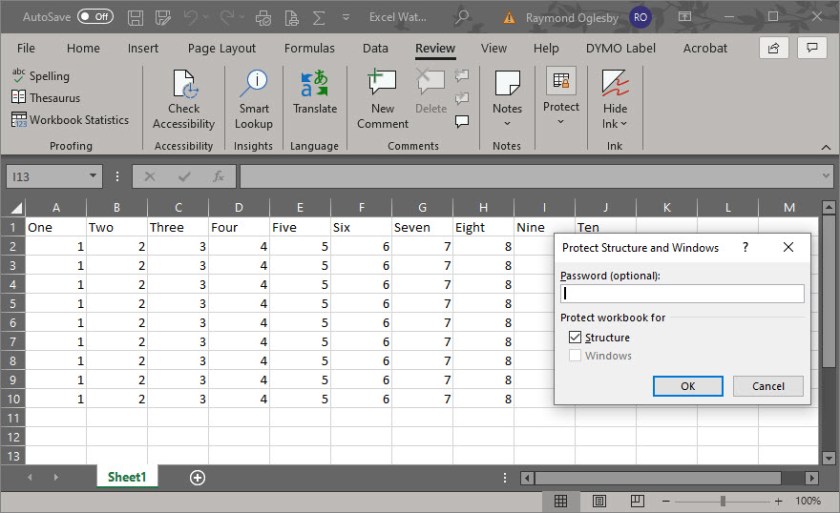
Excel Security 6

Select the Windows option if you want to prevent users from moving, resizing, or closing the workbook window or hide/unhide windows

  • Enter your password
  • Click OK
  • In the Confirm Password dialog box, type the password again
  • Click OK
  • Save your changes
  • Close or Exit Excel

Protect the Excel File

To prevent users from accessing the data in your Excel file, we are going to protect the file with a password

  • Open a blank Excel workbook. For demonstration purposes, I am using an Excel workbook that contains one sheet with cell data. You can choose an existing Excel workbook if you chose.
  • Select File>Info. Refer to my image below:
Excel Security 7
  • Click Protect Workbook icon
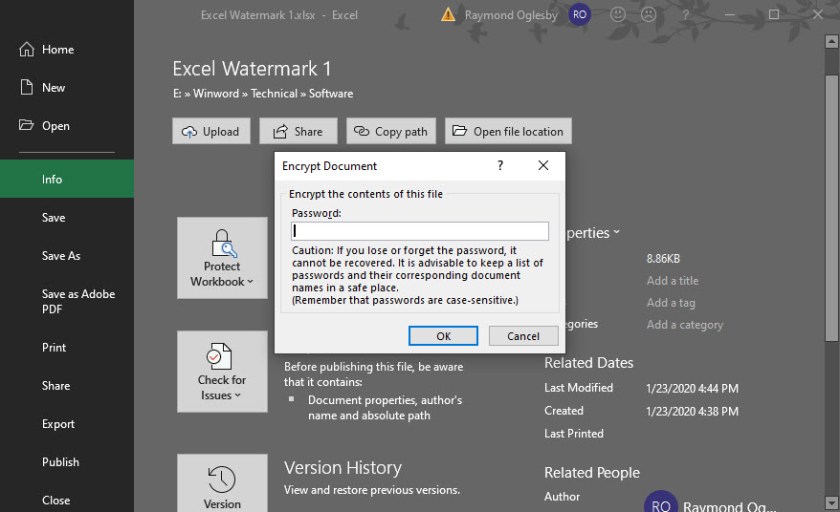
  • Chose Encrypt with Password option
Excel Security 8
  • Enter a password in the Encrypt Document dialog box
  • Click OK
  • In the Confirm Password dialog box, type the password again
  • Save your changes
  • Close or Exit Excel

Be cautious when sharing files or passwords with other users. You still run the risk of passwords falling into the hands of unintended users. Remember to write down your passwords and store them in a safe place.

I Would Like to Hear from You

Please feel free to leave a comment. I would love hearing from you. Do you have a computer tech question? I will do my best to answer your inquiry. Please mention the app and version that you are using. To help me out, you can send screenshots of your data related to your question.


PC Fine Tuning Summary

You can “pull on that drawer” like the above image to get your PC in shape or follow this blog post.

I have discussed various programs on fine tuning your PC in previous posts. This is a summary post of those programs, all in one place. I have done this fine tuning on many kinds of machines and operating systems in 15 countries as well as the USA. All these programs are free or available on a trial basis.

Some friends of mine had rather take their PC to a geek shop for a reformat of their hard drive and a fresh copy of Microsoft Windows every six months. They spend hundreds of dollars in doing this, which is unnecessary.

You have a choice of following the steps below or paying a consultant (like myself) or paying a geek shop to fine tune your PC. But its not hard to do it on your own. It takes one to three hours about every three to six months. If you haven’t already done so, you will need to download and install the following programs. You only have to do this once, then just run the programs. The links provided below walk you through downloading, installing and running these applications.

This is for a Windows based operating systems

Download and Install Applications

  • DriverMax (paid or trial version) or a similar free program like Driver Booster
  • Belarc Advisor
  • Autoruns
  • CCleaner
  • Wise Disk Cleaner
  • Wise Registry Cleaner
  • Defraggler

Lets get started.

I recommend doing the following steps in order:

Running the Applications

  1. Create a Restore Point and a backup of the Registry using Wise Registry Cleaner
  2. Uninstall applications not being used through the Apps and Features. In the Cortana search box. type “Uninstall Programs” (without the quotes) to load the feature to uninstall your unneeded programs
  3. Check your device driver updates using DriverMax (paid or trial program) or a similar free program like Driver Booster
  4. Run Belarc Advisor for a status of your PC, especially for anti virus software definitions and missing Windows Updates and apply updates as necessary
  5. Check your startup applications and missing entries using Autoruns
  6. Delete junk files using CCleaner and/or Wise Disk Cleaner. Its best to run both
  7. Clean your registry using Wise Registry Cleaner
  8. Defragment your hard drive(s) using Defraggler
  9. Reboot or restart your PC

That’s it. Your PC will now run faster and be more stable!

I Would Like to Hear from You

Please feel free to leave a comment. I would love hearing from you. Do you have a computer tech question? I will do my best to answer your inquiry. Please mention the app and version that you are using. To help me out, you can send screenshots of your data related to your question.
Related

Update your drivers using a program like DriverMax

Determine the status of your machine using Belarc Advisor

Turn off missing files using Autoruns

Delete junk file using CCleaner

A more robust file cleanup using Wise Disk Cleaner

Clean the Registry of invalid entries using Wise Registry Cleaner

Defragment your hard drive(s) and partitions using Defraggler

Using the Wise Registry Cleaner Program to Clean the Windows Registry

The Registry keeps growing when you use Windows, so does the obsolete items in the Registry, which would eventually lead to performance degradation and even system crashes. Wise Registry Cleaner scans the Windows Registry and finds errors and residual items in the Registry and then cleans or defrags them. By fixing these residual and corrupted items in Windows Registry, your system will run faster and be more stable.

I highly recommend this software utility. I have used this software on many PCs throughout the world. Best of all, there is a free version. This software is a companion product to Wise Disk Cleaner as discussed in a previous post. In troubleshooting a PC, I use them both to clean up a computer.

Its been my experience to find the best free program that does one thing very well. Although CCleaner has a Registry cleaner, I do not recommend it, instead use this software.

This is for a Windows based operating system from XP to Windows 10

Download and Install

Click here to download and install Wise Register Cleaner and follow these steps:

  • Click the Free Download button
  • You will see the download file in the lower left of your screen
  • Click or double click to install the software and follow the simple instructions
  • A desktop/laptop shortcut will be added
  • Close other running program(s)
  • Empty your Recycle Bin
  • Click or double click the shortcut to run

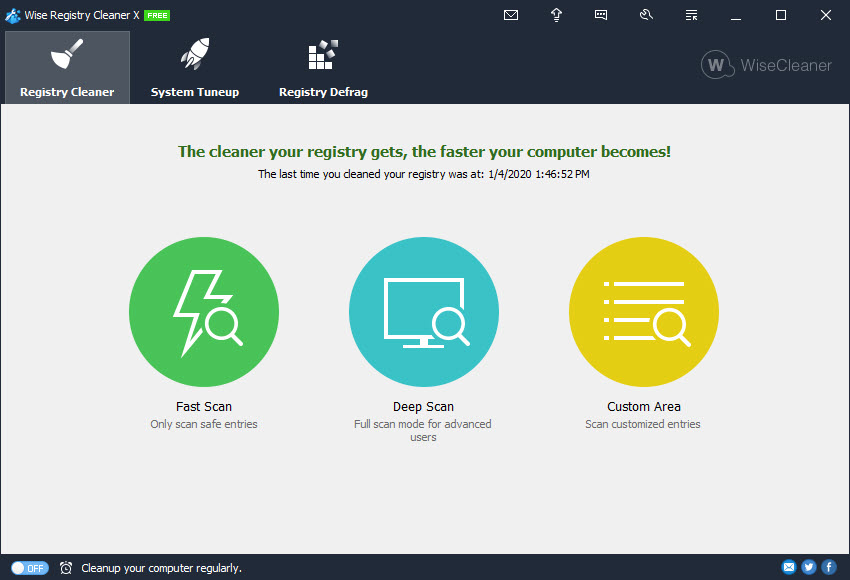
Following image is after an install. Your screen should look similar:

Wise Registry Cleaner
Wise Registry Cleaner main screen

Backup Before Running

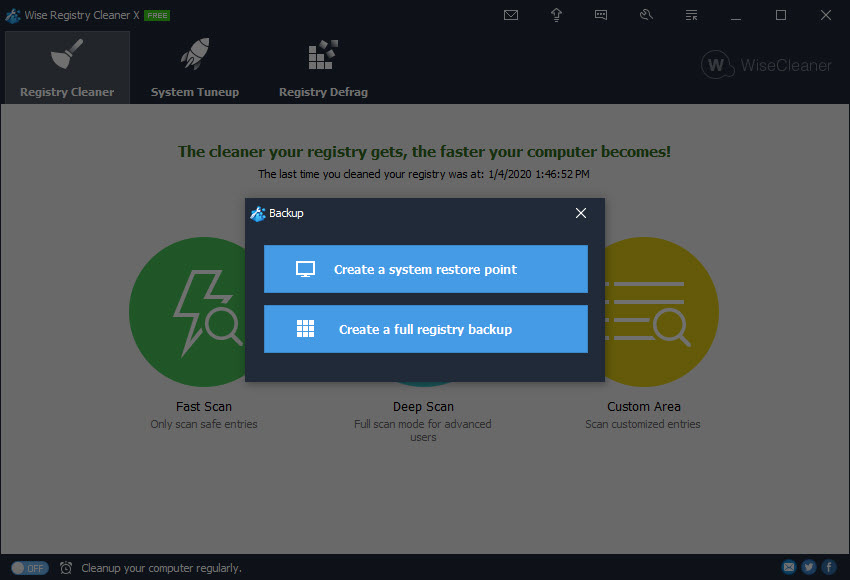
Although the program sets a Restore Point and a Backup of the Registry, I prefer doing this procedure manually. To view these options, refer to the last image in this post.

First, we want to create a System Restore point and a backup of the Registry as a safety precaution in case something goes wrong. See the following screenshot:

Wise Registry Cleaner Options
Wish Registry Cleaner Restore and Backup options
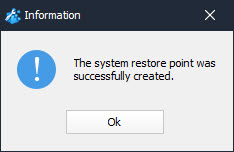
  • Select the Create a system restore point button. Once finished you will see the following popup image:
Wise Register Cleaner Restore Complete
Creation of System Restore completed
  • Click OK
  • Repeat above steps, but this time select Create a full registry backup button
  • When finished, your are taken back to the main program screen.

Run the Software

Click the Quick Scan icon to begin scanning your Registry. After completion, you will see a similar screenshot:

Wise Registry Cleaner Results
Results of Wise Registry Cleaner run
  • Click the Clean button to fix your Registry. Your results screen will be similar to the below image:
Wise Registry Cleaner Complete
Wise Registry Cleaner complete

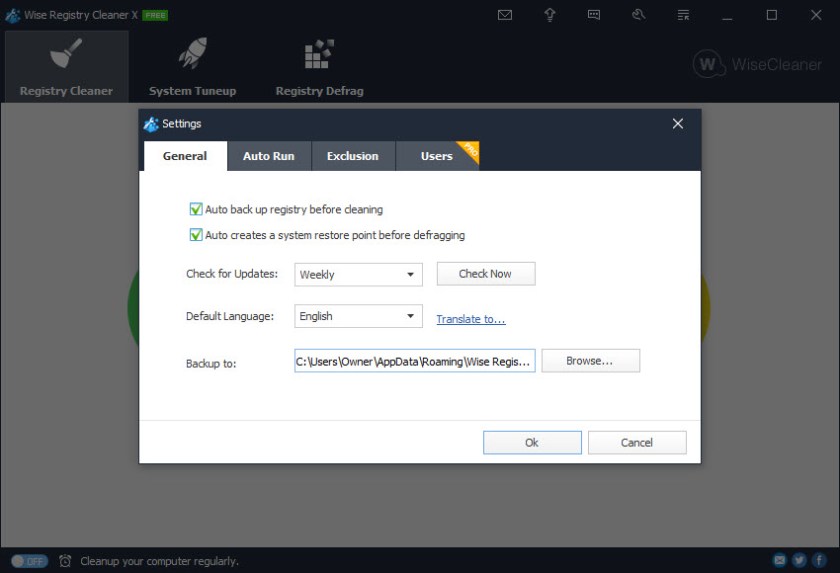
That’s it. You are done. If you want to setup a schedule for checking updates:

  • Click on Settings from the top of the main program screen
  • Select the General and change when to check for updates; I recommend keeping the default to Weekly.

Wise Registry Cleaner Pro has a Scheduler option and many others.

Your screen should look like the following:

Wise Registry Cleaner Scheduler
  • Close the program
  • Restart your machine

I Would Like to Hear from You

Please feel free to leave a comment. I would love hearing from you. Do you have a computer tech question? I will do my best to answer your inquiry. Please mention the app and version that you are using. To help me out, you can send screenshots of your data related to your question.
Related

CCleaner
Wise Disk Cleaner

Using the Wise Disk Cleaner Program to Delete Bad Files

Over time, junk files, temporary files, all kinds of system files and other items you do not need at all accumulate on your Windows computer. Those useless files take up valuable hard disk space and slow down your computer. Wise Disk Cleaner can delete these unnecessary files on your hard disk to free up disk space and make your computer run faster. It also provides many custom options to allow users to clean up more files they don’t need. Wise Disk Cleaner can scan and remove them quickly, making it one of the most efficient disk cleaners out there

I highly recommend this software utility. I have used this software on many PCs throughout the world. Best of all, there is a free version. This software is a companion product to CCleaner as discussed in a previous post. In troubleshooting a PC, I use them both to clean up a computer.

This is for a Windows based operating system from XP to Windows 10

Download and Install

Click here to download the free version of Wise Disk Cleaner and follow these steps:

  • Click the Free Download button
  • You will see the download file in the lower left of your screen
  • Click to install the software and follow the simple instructions
  • A desktop/laptop shortcut will be added
  • Close any running program(s)
  • Empty your Recycle Bin
  • Click or double click the shortcut to run

After installation you will see the following image:

Wise Disk Cleaner Install
Wise Disk Cleaner install

Run the Software

  • Click the Scan button to begin

Your screen will be similar to the following image:

Wise Disk Cleaner Results
Wise Disk Cleaner scan

Notice the results of my scan; the number of files to be deleted, the disk space to be saved and number of Traces to be deleted are shown. Traces are messages that can occupy a large amount of disk space, and they can be deleted without effecting your PC. When you run this software for the first time, do not be surprised at the scan results.

  • Click the Clean button to delete the files

You may receive popup menus regarding closing your browser like the image below:

Wise Disk Cleaner Chrome is Running
Google Chrome popup
  • Click Yes

In my case, I responded with a No because I needed my browser running to document this post. Normally, you would respond with a Yes.

The Results

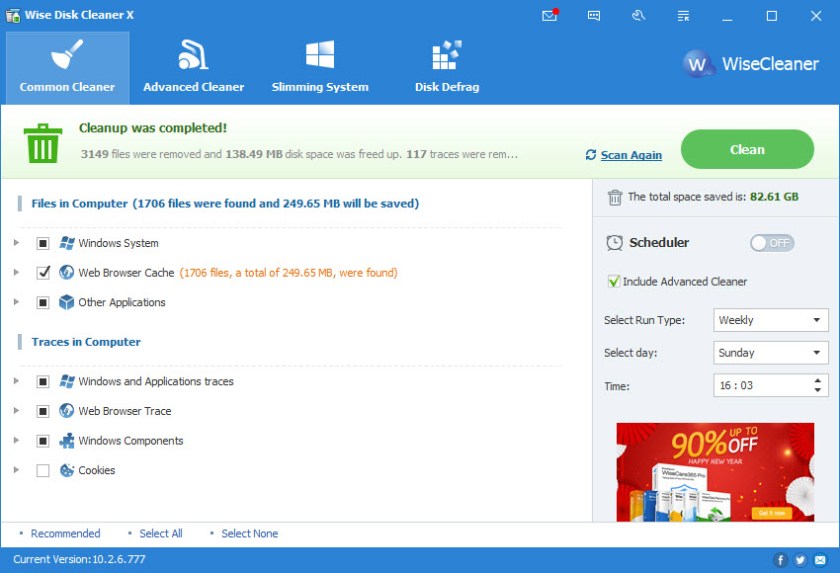
After cleaning, you will see the results like the image below:

Wise Disk Cleaner Complete
Wise Disk Cleaner results

That’s it, you are done. You may set up a schedule on when to run the software. I recommend you run this program weekly.

  • Close the program
  • Restart your PC

I Would Like to Hear from You

Please feel free to leave a comment. I would love hearing from you. Do you have a computer tech question? I will do my best to answer your inquiry. Please mention the app and version that you are using. To help me out, you can send screenshots of your data related to your question.
Related

Delete Junk Files using CCleaner


DriverMax Software for Updating the PC Drivers

Are your device drivers up-to-date on your PC? How would you know? You don’t unless you visit each manufacture for their latest driver for each device in your PC. My favorite program for device updates is DriverMax. When you run this program for the first time, don’t be surprised at the number of drivers that are out of date.

I have used this utility software for several years. The software does one task; update your PC drivers. There is a trial version for you to check out. I recommend purchasing the Pro version.

This is for Windows based operating systems

Downloading DriverMax

The Pro version is available on subscription basis for a little over $10 per year or under $15 for a 2 year subscription. You can download the trial version or purchase and download here.

You can find driver updates for 32-bit and 64-bit versions of Windows 10, Windows 8.1, Windows 8, Windows 7, Windows Vista, and Windows XP.

DriverMax analyzes your existing drivers and provides the latest versions for over 2.3 million devices.

DriverMax automatically tests each new driver before installing it on your PC. In addition, it backs up the current drivers and creates a system Restore Point, allowing a quick rollback of the installation.

Starting DriverMax

The following is a screenshot of DriverMax at startup:

DriverMax Install
DriverMax install

Running DriverMax

Just click on the Scan… button to begin. The following screenshot is my results from my PC. I have two drivers that are out of date. Just click on the Download and Install button and take a short break while the drivers are being updated.

DriverMax Results
DriverMax results

DriverMax has a Backup and Restore feature. As mentioned above, the program automatically creates a Restore Point when you are updating any drivers. You can click on the Backup tab to manually create a Restore Point. The Restore tab lets you roll back your latest driver updates if something goes wrong.

DriverMax Notifications

You will receive notifications in your Tray Bar (as shown below) when new drivers are detected.

DriverMax Notification

I Would Like to Hear from You

Please feel free to leave a comment. I would love hearing from you. Do you have a computer tech question? I will do my best to answer your inquiry. Please mention the app and version that you are using. To help me out, you can send screenshots of your data related to your question.

How to Transfer iPhone Contacts to Windows 10

Have you ever wanted to share your iPhone contacts with your Windows 10 PC? I have wanted to do this for a year. It used to work but my PC went “south” last year. I finally did some research and came up with this post for you to implement. You can share your smart device contacts through Apple’s iCloud service. To use this service, your contacts must be synced with iCloud. So, lets get started.

This is for iPhone or iPad and Windows 10 operating system

  • Open the Settings app on your iPhone. Its usually located on your home screen. Your screen should look similar to the following image:
Win 10 Contacts Settings
My iPhone home screen
  • Tap your name at the top of the screen. See following screenshot:
Win 10 Contacts Profile
My iPhone Settings screen

Syncing Contacts

  • Tap iCloud
  • Verify that your Contacts is being synced. Either the toggle switch will be green or you will see iCloud storage being used like the below image. If not, tap the toggle button to enable the process and sync your contacts.
Win 10 Contacts Storage
My iPhone iCloud Storage screen
  • On your Windows 10 PC, log in to iCloud website with your Apple ID and Password
  • Click on the Contacts applet. See following screenshot:
Win 10 iCloud Contacts
iCloud applets on Windows 10 PC screen

Selecting/Exporting Contacts

  • Select a Contact from your list. See the following image for my selection of Chris Dow:
Win 10 iCloud Selection
iCloud Contacts screen
  • Click the small gear icon at the bottom left corner
  • Select Export vCard. Refer to following screenshot:
Win 10 iCloud Export
Selecting and Exporting an iCloud Contact screen

You can select more than one contact by selecting a single name and using the “Shift” key to select the last contact. There is an option to Create Group at the bottom right for your multiple contact selection.

Note! It is best to export just one contact. Although you can select multiple contacts, only one contact data (the first one selected) is exported, especially for Outlook.

By default, the exported VCF file is placed in your PC Downloads folder.

  • Open your File Explore and find the VCF file. Refer to following image:
Win 10 iCloud Downloads
File Explorer Downloads folder screen with Chris Dow VCF file

Using Your VCF File

  • Right click on the VCF file and select Open
  • Select where you want to install your contact(s). You have several choices, like Outlook, the People app and Windows Contacts
  • Select your choice and click OK

Your choice will open for your review.

  • For Outlook, click the Save & Close option to complete the export. See following screen::
Win 10 iCloud Outlook
Exported VCF file from iCloud to Microsoft Outlook in Windows 10 screen

That’s it. You are done.

Enable iCloud Contacts Sharing

BUT WAIT, I want to share all my Contacts via iCloud to my Windows 10 PC, not just a few. You can use iCloud for Windows to synchronize your contacts and other data between your iOS device and Outlook. Lets get started.

This works with the following variations of Outlook:

Outlook for Office 365, Outlook 2019, Outlook 2016, Outlook 2013 and Outlook 2010

  • Download and install iCloud for Windows.
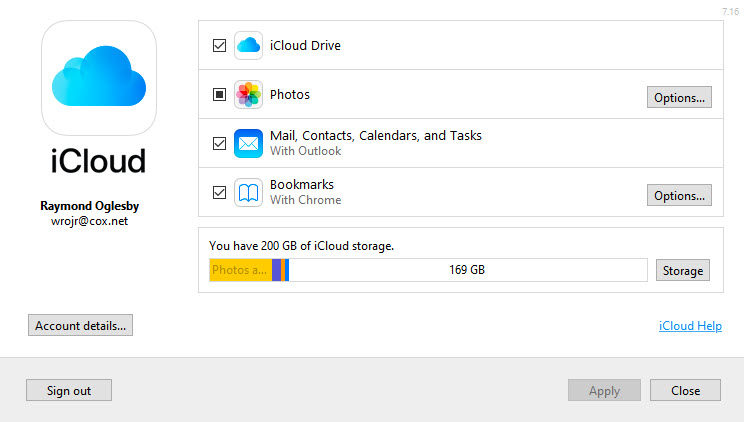
  • After installation, launch the iCloud app and sign in with your Apple ID and Password. Your screen should look like the below image:
Win 10 Outlook iCloud Screen
iCloud for Windows screenshot
  • Select the option to sync Mail, Contacts, Calendars, and Tasks. You can select other options to sync from this screen.
  • Click Apply
  • Click Close

Once the setup has finished, launch Outlook. Your iCloud email, contacts and calendars should now be synchronizing with Outlook.

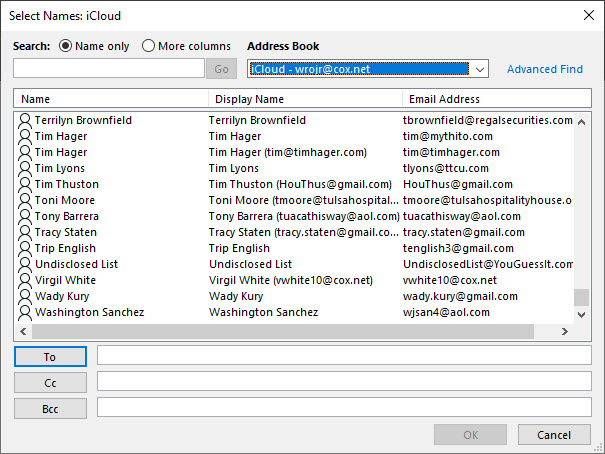
  • To verify, in Outlook, open a new email. In the Address Book drop down box, select iCloud like the image below:
Win 10 Outlook iCloud Names
Windows 10 iCloud contacts screen
  • You should see ALL your iCloud contacts
  • Close Outlook

If you are experiencing problems please click here for Apple help.

I Would Like to Hear from You

Please feel free to leave a comment. I would love hearing from you. Do you have a computer tech question? I will do my best to answer your inquiry. Please mention the app and version that you are using. To help me out, you can send screenshots of your data related to your question.

How to Create a Microsoft Excel Drop Down List

Drop down lists are used to select specific data, in our example, a list of Salutations. If the user tries to enter a Salutation that is not in the list, Excel rejects the entry.

I am using a simple drop down list in an Excel sheet. This feature is not well known nor initiative.

Salutations was a BIG DEAL for a religious organization that I worked for as a Consultant. The company had a donor base of 25,000+ names/addresses. (Of course, I was using a database, not Excel, to manage the data.) If the Salutation was incorrect on a donor letter, some donors refused to give monies for the company projects. For example, do you address them as Mr. and Mrs. or Dr. and Mrs. or Mr. and Dr.? Some donors wanted no Salutation. I spent a lot time getting the Salutations correct.

This is for Excel for Office 365 Windows and Mac versions. Other versions of Excel will be similar.

Setting Up the Excel Sheet

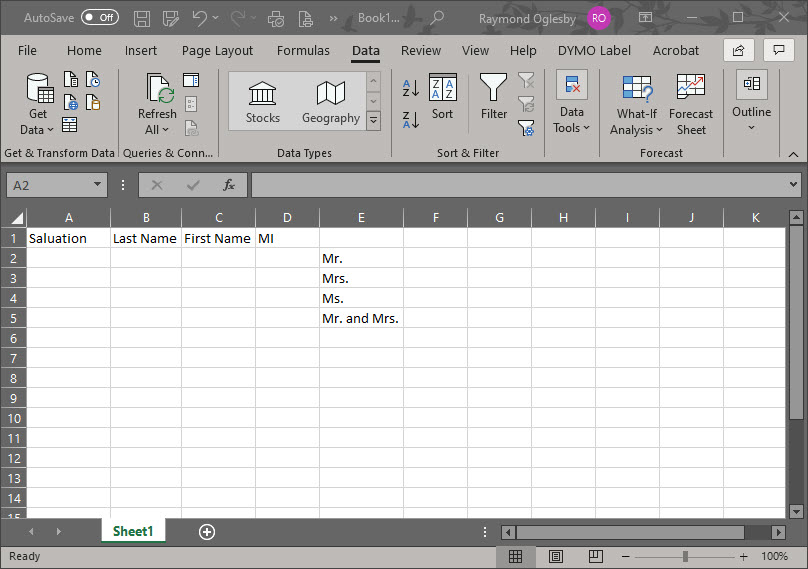
  • Enter the headings in Row 1 (Optional)
  • Create a list of cells E2:E5. Alternatively, you could put the list in another sheet.
  • Select the empty cell A2. (You can position the drop down list in most any cell or even multiple cells.)
Excel Drop Down List Setup
Setting up Excel for a drop down list

Using Data Validation

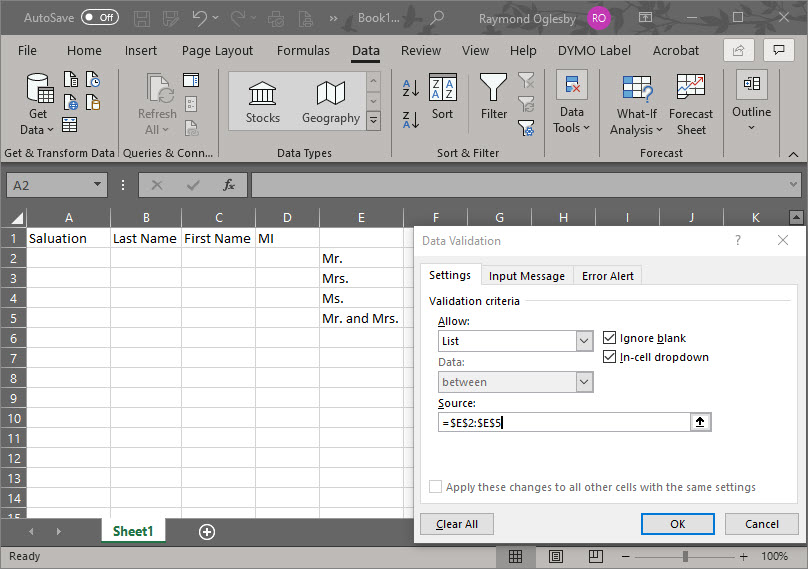
  • Select the Data tab
  • Select Data Validation
  • Choose List from the Allow options drop down list
  • Click the Source control and drag to highlight cells E2:E5. Alternatively, you could enter the cell reference $E$2:$E$5 or use a sheet and cell reference if your list is in another sheet.
  • Ensure that the In Cell dropdown option is checked. If you leave this unchecked, Excel forces users to enter only the list values, but it won’t present a drop down list. The users would have to guess the values; not a good idea!

See the following screenshot:

Excel Drop Down List Source
Entering the Allow and Source option
  • Click OK

You can add the drop down list to multiple cells. Select the range of data input cells instead of a single cell. Also, you can select noncontinuous cells by holding down the Shift key while you click the appropriate cells.

You can copy and paste this drop down cell to any other cells in your sheet.

Below is a screenshot where Mr. was selected as a Salutation for cell A2:

Excel Drop Down List Selected
Excel drop down list selection

I Would Like to Hear from You

Please feel free to leave a comment. I would love hearing from you. Do you have a computer tech question? I will do my best to answer your inquiry. Please mention the app and version that you are using. To help me out, you can send screenshots of your data related to your question.
How to Use Google Chrome Media Controls

Google Chrome is adding a new feature for controlling media within your Chrome browse on a desktop or laptop. Instead of trying to figure out where the video/sound is coming from, you can hear and/or see it in your Chrome browser. The update is rolling out gradually and is for Chrome version 79+. Instead of waiting for the update you can always go to the flags menu (see below) and manually trigger the new media playback controls.

This is for any device that uses Google Chrome.

Check Chrome Version

First, let’s check what version of Chrome you have; just follow these steps:

  • Click on the Menu icon in the upper right corner of the screen, the one with 3 dots
  • Click on Help
  • Click on About Google Chrome

Your Chrome browser version number is displayed like the example below:

Chrome Version
Chrome version screen
  • Close Chrome

Update Chrome

If you have a lower a version than 79, let’s try to update by doing the following:

  • Open Chrome
  • Click on Menu icon in the upper right corner of the screen, the one with the 3 dots
  • Click Update Google Chrome. Note! If you don’t see this button, you’re on the latest version.
  • Close Chrome

Setup Media Control

  • Open Chrome
  • Type in chrome://flags as the URL like the screenshot below:
Chrome URL for Flags
Chrome URL for flags
  • Type in Global Media Controls as your Search, like the example below:
Chrome Media Control Flag
  • Click on the Default drop down box and select Enabled
  • Click the Relaunch button in the lower right of the screen
  • Type in chrome://flags as the URL
  • Type in Global Media Controls as your Search

Your screen should show the Global Media Controls Enabled like the screen below:

Chrome Media Enabled
  • Close Chrome

After a browser restart, a Play button should show up whenever you have media playing.

If you don’t see the option, head to YouTube and play a video. A Play button should show up next to the address bar. Clicking on it will display the media content like title, source of the content, the play/pause and skip buttons.
This feature works for lots of websites to include Spotify, Netflix, Amazon Prime, Dailymotion and Microsoft.

I Would Like to Hear from You

Please feel free to leave a comment. I would love hearing from you. Do you have a computer tech question? I will do my best to answer your inquiry. Please mention the app and version that you are using. To help me out, you can send screenshots of your data related to your question.

How to Send a Messenger Video to Facebook

Are you unable to share a Messenger video on your iPhone to social media, like Facebook? This share feature is not available on the smartphone. But it is possible on your desktop or laptop.

This is for any device using Messenger and Facebook

Messenger on iPhone

On your iPhone, open Messenger and find the video you want to share like the example below:

Messenger video
Messenger video

You can click the Up Arrow rectangle box to send the video to certain friends and/or Create a Group. But we want to share the video to Facebook. Following are the steps:

Messenger on Desktop/Laptop

  • Open Messenger or Facebook on your desktop/laptop then select Messenger
  • Move your mouse next to the Up Arrow rectangle box
  • A Reply and More actions will magically appear
  • Click on More
  • Click on Save to Facebook

Your screen will look like the below image:

Saving Messenger video to Facebook

Facebook

  • Open Facebook on your Desktop/Laptop
  • Go to Home menu option on Facebook
  • On the left hand side menu, expand Explore (if necessary) and locate Saved
  • Click on Saved and you will see the video as shown below:
Saved video on Facebook
  • Click on the Share button to share on Facebook

Sometimes the author has blocked a video from being shared. If so, the Share button will not be displayed.

Courtesy Of

This tip is the courtesy of my wife, Dr. Aletha C. Oglesby. You may want to check out her blog on medical topics at Watercress Words-exploring and sharing the HEARTH of health.

I Would Like to Hear from You

Please feel free to leave a comment. I would love hearing from you. Do you have a computer tech question? I will do my best to answer your inquiry. Please mention the app and version that you are using. To help me out, you can send screenshots of your data related to your question.

Is Your Microsoft Word Document Getting Too Big?

Just how big can a Microsoft Word document be? The short answer, it depends. The amount of text, photos, images and videos content determines the document size. Also, your computer system resources plays a part.

The maximum file size of an “all text” document in Microsoft Word 2007 or later is 32 MB. If you add photos, images or videos, the maximum file size jumps to 512 MB or a half of a gigabyte. Although Word can handle a very large file, it becomes more unmanageable as you approach the 512 MB limit.

Older file formats use the “.doc” file extension while the newer versions, Word 2007 and above, use the “.docx” extension.

This is for Word for Office 365 Windows and Mac versions. Other versions of Word will be similar.

If you are working with the old format, “.doc” extension, you can covert the file to the newer format as follows:

  • Open Microsoft Word
  • Locate the file with a “.doc” extension
  • Click on File>Save As
  • From the drop down box, select Word Document (*.docx)
  • Click Save

Check Your Word Document File Size

There are several ways to check the size of your document. One way is as follows:

  • Open File Explorer
  • Locate the folder where the document resides
  • Click on View>Details
  • You will see the Size column denoting the file size

A second way is very similar.

  • Open File Explorer
  • Locate the file
  • Right click on the file name
  • Click on Properties

OR

  • Open File Explorer
  • Locate the file
  • Click Home on the main menu
  • Click Properties
  • Click Properties from the sub menu

A third way is from the Word document itself as follows:

  • Either using Word to locate and open the document or using File Explorer to locate the file; then double click to open
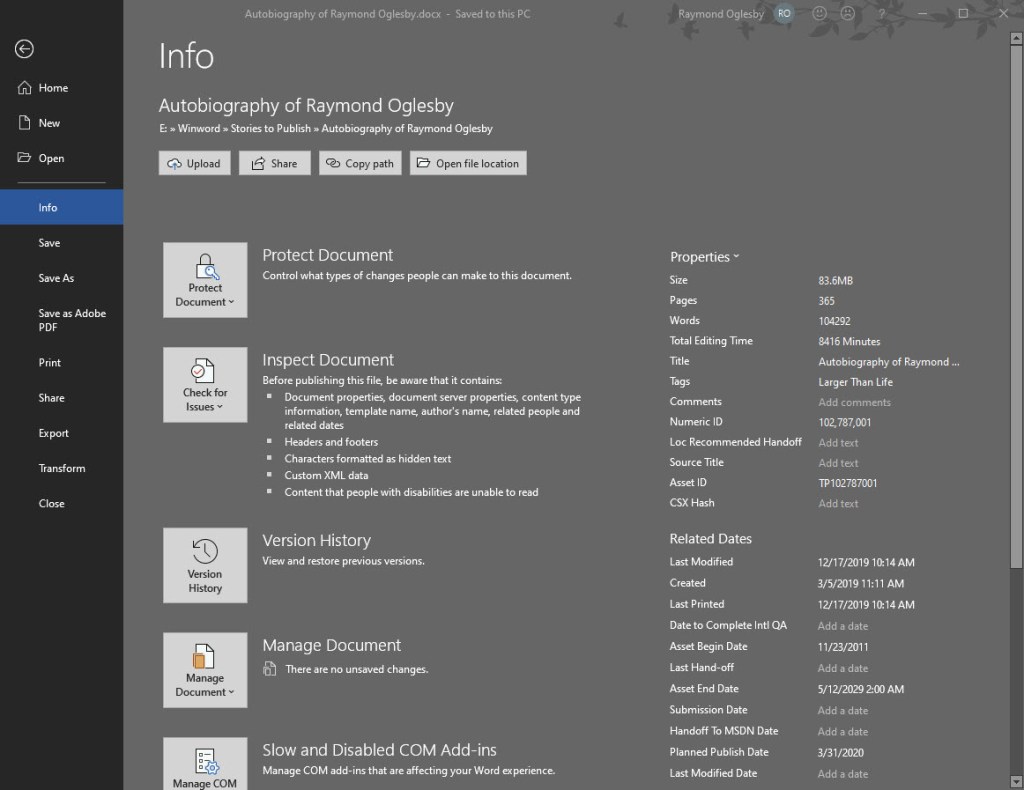
  • From the main menu, click on File>Info
  • Under Properties is the Size of the document
  • Your screen should look like the below image:
File Info Results
File Info screenshot

File Info Properties

Document properties, also known as metadata, are details about a file that describe or identify it. They include details such as title, author name, subject and keywords that identify the document’s topic or contents. You can use these keywords for searching Word documents. For example, in Word, you can use the Keywords property (also called Tags) to add the keyword “customers” to your sales documents. You can then search for all sales documents with that keyword.

Some entries can be changed. At the bottom of the File Info screen is the Show All Properties. Click on this to see more detail about your document. The grayed out options are the ones you can update.

Other properties are automatically updated. You can also search for these entries. For example, you can search for all files created after January 1, 2020, or for all files that were last changed yesterday.

A Personal Observation

I have an autobiography Word document that is 356 pages with 375 photos and images. The file size is only 83.6 MB (see above image). You should be able to manage a Word document with 1400 pages and 1400 images/photos and still not reach the 500 MB limit. Currently, I have no videos in the document. If I did, that would drastically increase the file size.

How to Reduce the Size of your Word Document

One way would be to split the document into two Word files. Of course, this would result in two Table of Contents, Bibliographies, etc. This may not be the right choice.

Another way is to compress the size of your images/photos. First, you should covert a “.doc” file extension document into the new “.docx” format as mentioned in this post.

To compress your images/photos, do the following:

  • Make a backup copy of your original Word document. Although you are using the Save As option to Save the file with a new file name, I prefer working with a backup copy.
  • Open your backup Word document
  • Click on File>Save As>More Options at the top of the screen

A screenshot is below:

File Save As
More Options screenshot
  • In the Save As dialog box, click Tools>Compress Pictures at the bottom of the screen

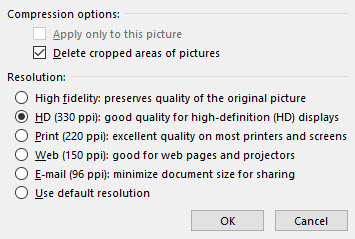
In the latest version of Word, you are presented with four Options as shown below:

File Compression
Photos compression options

For the smallest possible size:

  • Click “Email (96 ppi) …
  • Click OK
  • Click Save

This option will result in the poorest image quality. All your images/photos will be automatically compressed. Choosing any other option will result in a larger Word document.

Take a look at the results of your compressed document. Do you like the results? If not, then repeat the above steps with another backup copy of your document.

Once you are satisfied, then rename the compressed document back to the original file (overwrite the original file) or rename to a different file name.

I Would Like to Hear from You

Please feel free to leave a comment. I would love hearing from you. Do you have a computer tech question? I will do my best to answer your inquiry. Please mention the app and version that you are using. To help me out, you can send screenshots of your data related to your question.